For decades, the hardest part of legacy modernization was technical. Millions of lines of COBOL, decades-old batch jobs, and green-screen interfaces had to be understood and rewritten by scarce specialists. Programs ran for years, and many stalled.
AI is changing that part of the work. Tools can now read legacy code, explain it, extract business rules, and propose or generate modern equivalents. In June 2026, Pega announced that its Blueprint AI application design agent would be integrated with AWS’s agentic mainframe modernization service, so organizations can analyze COBOL with AWS and reimagine it as new cloud-ready applications with Pega.
When conversion becomes faster and cheaper, a different question becomes the bottleneck. Which processes should be carried forward as they are, and which should be redesigned? Legacy application modernization services that answer that question before converting code deliver modern systems. Those that skip it deliver old processes on new platforms.
What the Pega and AWS Integration Signals
According to Pega’s mainframe modernization announcement, made at PegaWorld on June 8, 2026, the Blueprint AI design agent will be integrated within AWS’s mainframe modernization service. Clients can extract and analyze legacy COBOL code with AWS and use Pega Blueprint AI to reimagine it as new cloud-ready applications through one experience.
The integration reflects a broader shift. Vendors are no longer focused only on translating code from one language to another. They are positioning AI to understand what legacy systems do and to design new applications around that understanding. That puts process decisions, not code conversion, at the center of modernization.
The Scale of the Legacy Problem
Legacy systems remain widespread in government and industry. In July 2025, the U.S. Government Accountability Office reported on the critical federal legacy systems most in need of modernization. Of the 11 systems it identified, 8 use outdated languages, 4 run on unsupported hardware or software, and 7 operate with known cybersecurity vulnerabilities. GAO also found that agencies had completed only three of the ten modernizations it flagged in 2019.
Private sector organizations in banking, insurance, retail, and manufacturing face similar challenges: core systems that work, but are expensive to change, hard to staff, and difficult to integrate with modern channels.
Replicate or Rebuild
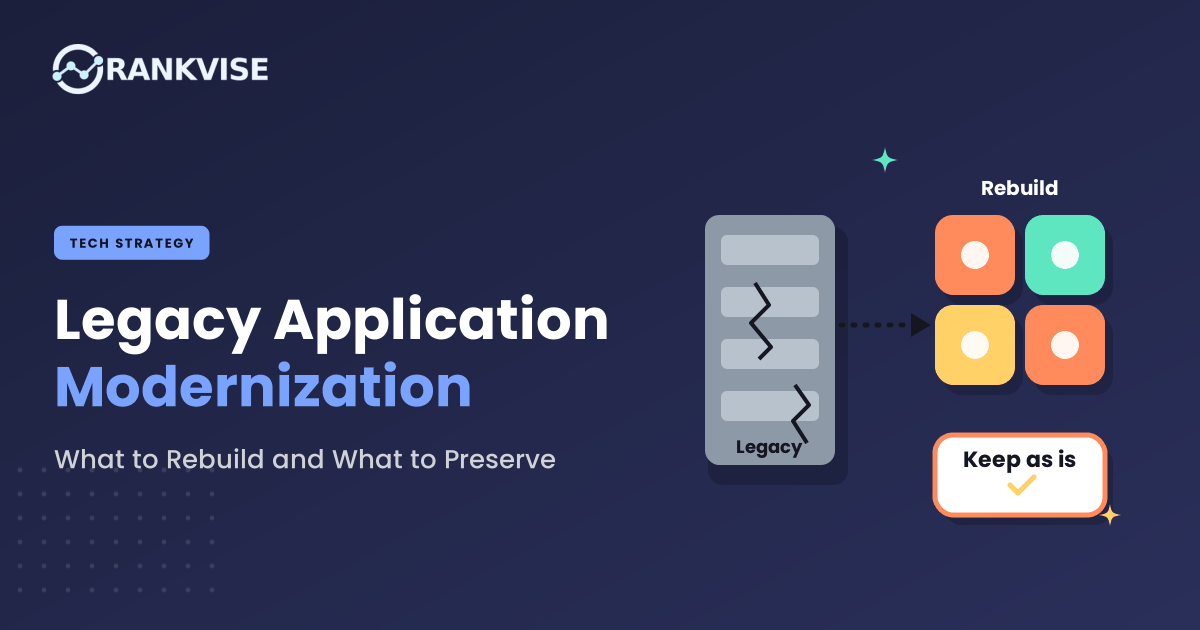
Every legacy process can follow one of several paths:
- Replicate: Convert the logic as faithfully as possible, preserving behavior exactly.
- Refactor: Convert and clean up the logic, removing dead code and simplifying structure, while keeping business behavior.
- Rebuild: Redesign the process around current business needs, often with new workflow, rules, and user experience.
- Replace: Retire the custom process in favor of a packaged application or service.
- Retire: Stop doing the process altogether, because it no longer serves a purpose.
Replicating everything is tempting because it seems low risk. But legacy processes often contain decades of workarounds, manual steps, duplicate checks, and rules for products that no longer exist. Converting them faithfully carries all of that into the new platform. Rebuilding everything, on the other hand, multiplies risk, cost, and the need for business involvement.
A Triage Framework for Legacy Modernization Services
Legacy modernization services should assess each process against several criteria:
- Business value: How important the process is to revenue, customers, compliance, or operations.
- Rule quality: Whether the business rules are still correct, consistent, and understood, or full of exceptions and obsolete logic.
- Change frequency: How often the business needs to change the process, such as pricing, eligibility, or product rules.
- Customer and employee experience: Whether the current process creates friction, delays, or errors.
- Regulatory sensitivity: Whether behavior must be preserved exactly for compliance or audit reasons.
- Integration needs: Whether the process must connect to new channels, partners, or data platforms.
Processes with high value, frequent change, poor rule quality, and weak user experience are strong candidates for rebuilding. Processes with stable, well-understood rules and strict regulatory requirements are often better replicated or refactored. Processes with low value may be candidates for replacement or retirement.
How Legacy Application Modernization Services Use AI in Triage
AI tools help with triage as well as conversion. Code analysis can identify which programs implement which processes, find dead code, map dependencies, and extract candidate business rules. Usage data from logs and transaction records shows which functions are actually used and how often. Together, these reveal processes that are rarely used, duplicated across programs, or full of special cases.
AI-extracted rules still need expert review. Subject matter experts should confirm which rules are current, which are obsolete, and which reflect workarounds for past system limitations. This review is where most of the value of triage lies. Schedule it in short, focused sessions by business area, and record each decision with its reasoning, so later teams understand why a rule was kept, changed, or dropped.
A Representative Program
Consider an insurer with a mainframe policy administration system supporting personal auto, home, and small commercial lines. A legacy application modernization company proposes AI-assisted conversion of the full system to a cloud platform.
Before conversion, the team runs a triage. AI analysis finds that about 20% of the code supports products the insurer no longer sells. Rating rules for personal auto change several times a year and are spread across dozens of programs, with many manual overrides. Billing logic is stable and well tested. Small commercial underwriting relies heavily on manual workarounds.
The plan changes. Code for discontinued products is retired, with data archived for regulatory retention. Billing is refactored and converted with strict equivalence testing. Personal auto rating is rebuilt on a rules engine so business users can update rates without code changes. Small commercial underwriting is rebuilt as a new workflow application with case management. The program costs less than full conversion, and the insurer gains flexibility where it matters most.
Sequencing the Program
Triage results also shape the order of work. Retiring unused code first reduces the volume to convert and test. Refactoring stable processes early builds confidence in tooling and equivalence testing. Rebuilt processes often need more business involvement and longer design cycles, so they should start early in parallel, even if they go live later. Integration points between converted and rebuilt components need careful planning, since both will often run side by side for a period.
Many programs use a strangler pattern, routing individual functions from the legacy system to new services one at a time. This approach suits a mix of replicated and rebuilt processes, because each function can follow its own path while the overall system keeps running.
Measuring Whether Rebuilding Paid Off
Rebuilding should be justified by measurable improvement. Before work starts, record baseline measures for each rebuilt process, such as cycle time, manual touches, error rates, time to implement a rule change, and customer satisfaction. After go-live, compare results. If a rebuilt rating process lets business users change rates in days rather than months, the value is clear. If results fall short, the lessons inform later waves. These measures also help sponsors defend the extra investment that rebuilding requires.
Data Decisions Matter Too
Process triage should include data. Legacy data stores often contain inconsistent formats, duplicated records, and fields whose meaning has drifted. Legacy data modernization services should decide which data to migrate, cleanse, restructure, or archive, in line with the process decisions. A rebuilt process built on poorly migrated data will inherit old problems. Data profiling early in the program shows the scale of cleansing work and often changes estimates for both data migration and the processes that depend on it.
Managing Risk in Rebuilt Processes
Rebuilding introduces risk because behavior changes by design. Manage it with:
- Clear requirements: Documented business rules confirmed by process owners
- Parallel runs: Comparison of old and new outcomes on real data, with differences explained
- Phased rollout: By product, region, or customer segment
- Rollback plans: The ability to revert if problems appear
Replicated processes need equivalence testing. Rebuilt processes need outcome testing against agreed business expectations.
Choosing a Legacy Application Modernization Company
When evaluating a legacy application modernization company, ask:
- How do you decide which processes to replicate, refactor, rebuild, replace, or retire?
- How do you use AI to analyze legacy code and usage?
- How do subject matter experts review extracted rules?
- How do you test equivalence for replicated processes and outcomes for rebuilt ones?
- How do you handle data decisions alongside process decisions?
- Can you share examples where triage changed the scope of a program?
Providers that answer with a structured approach will help focus investment where it creates value. Providers that offer only faster code conversion may deliver quickly, but leave the business with the same processes it wanted to escape.
Keeping the Business at the Center
Legacy system modernization succeeds when business leaders own process decisions. Technology teams and partners can provide analysis, options, and estimates, but decisions about which processes to redesign belong to the people who run them. Build governance that brings business owners into triage, design, and acceptance, and give them clear information about cost, risk, and benefit for each option. When owners see those trade-offs plainly, they make faster decisions and stand behind them when the program meets resistance.
AI is making legacy code analysis and conversion faster, as the Pega and AWS integration shows, which shifts the critical decision to which processes to rebuild and which to replicate. Legacy application modernization services should triage processes by business value, rule quality, change frequency, experience, regulatory sensitivity, and integration needs before converting anything. Opt for legacy application modernization services that combine AI-assisted analysis with structured process triage and business-led design. Modernization delivers its full value when the processes are worth carrying forward.