Opening a traditional office in downtown Chicago is expensive and slow. Savills’ Q2 2026 report puts average downtown asking rents at a record $47.90 per square foot, with Class A space reaching $56.00 per square foot. That’s before build-out, furniture, utilities, internet, and the multi-year lease that comes with it.
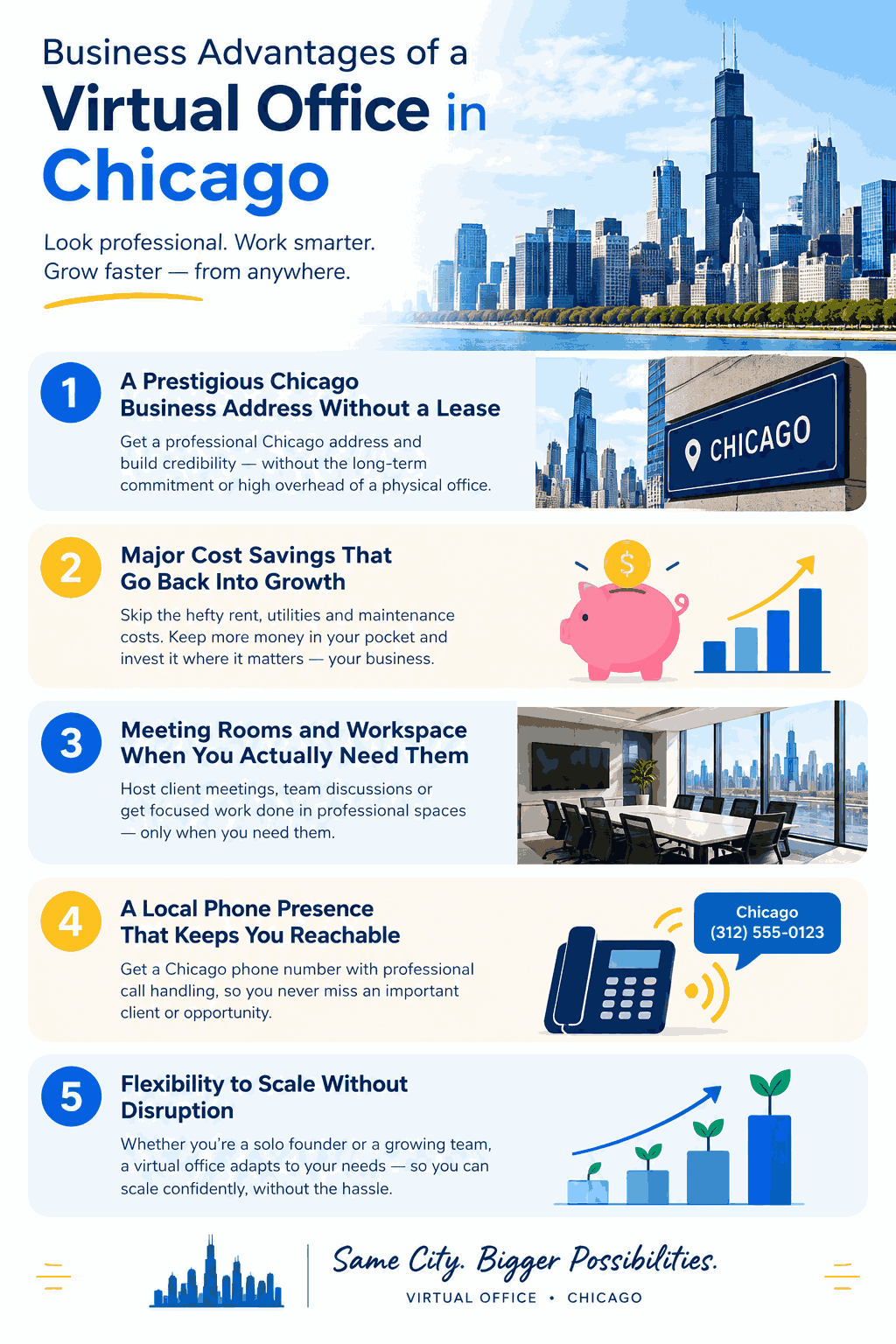
- Prestigious Chicago business address that signals credibility without a long-term lease.
- Significant overhead reduction so you can reallocate funds to hiring, product, or marketing.
- Book professional meeting rooms and day offices by the hour, presenting polished space only when needed.
- Chicago local number with live call answering that improves responsiveness and client trust.
- Month-to-month plans let you scale up or down without breaking leases or disrupting operations.
A virtual office in Chicago gives you the parts of an office that clients actually notice: a professional address, a local phone presence, and a boardroom when you need one. You skip the parts they don’t: the empty desks, the lease, and the fixed overhead.
In this guide, you’ll learn the five biggest business advantages of a Chicago virtual office, what it realistically costs in 2026, where its limits are, and how to choose a provider that fits your business.
What Is a Virtual Office?
A virtual office is a service that gives your business a real commercial address and office services without renting dedicated physical space. Most plans combine some or all of the following:
- A business address in a commercial building
- Mail receiving, scanning, and forwarding
- A local phone number with live call answering
- On-demand access to meeting rooms, day offices, or coworking space
You work from wherever suits you, whether that’s home, a client site, or another city, while your business presents a Chicago presence to the market.
Traditional Office vs. Virtual Office in Chicago
Here’s how the two options compare for a small team:
| Factor | Traditional Office (1,000 sq ft) | Virtual Office |
|---|---|---|
| Typical monthly cost | About $4,000 in rent alone at the $47.90/sq ft downtown average | Roughly $50–$200+, depending on services |
| Commitment | Multi-year lease, usually 3–10 years | Month-to-month or short-term plans |
| Upfront costs | Deposit, build-out, furniture, IT | Setup fee (often small or waived) |
| Meeting space | Always available, often unused | Booked by the hour when needed |
| Reception | Salaried hire | Shared receptionist included or added on |
| Scaling up or down | Relocation or sublease | Change your plan |
Rent figure calculated from Savills‘ Q2 2026 downtown Chicago average; excludes utilities, fit-out, and other occupancy costs.
1. A Prestigious Chicago Business Address Without a Lease
Your address shapes how people see your business before they ever speak to you. A home address can make a company look smaller than it is, and a P.O. box can make it look like it has something to hide. A virtual business space in Chicago, in a recognized Loop, River North, or Magnificent Mile building, signals stability and scale.
This is especially useful for:
- Out-of-state companies that want a Midwest foothold without opening a branch
- Consultants and agencies pitching Chicago-based clients
- Home-based founders who don’t want their residential address on invoices, websites, and public filings
You can use the address on your website, business cards, proposals, LinkedIn page, and most business directories. Many providers also allow it for company formation and business banking, though you should confirm this with the provider before you sign.
The practical advantage is simple: you get the credibility of a prime Chicago address for a small fraction of what the building’s tenants pay, and you can walk away without unwinding a lease.
2. Major Cost Savings That Go Back Into Growth
Cost is the advantage that makes the rest possible. Here’s what a Chicago virtual office typically costs in 2026:
- Address-only plans: basic address services generally start around $50 per month and rise as you add services like mail handling Quick Sprout.
- Bundled plans: packages that combine an address, live receptionist, phone number, and mail handling commonly run from about $99 to $200 per month.
- Add-ons: meeting rooms, day offices, mail forwarding postage, and lobby directory listings are often billed separately.
Compare that with the roughly $4,000 a month in rent alone for a modest 1,000-square-foot downtown suite, and the difference comes to more than $45,000 a year. That’s money that can go into hiring, product development, or marketing.
The savings extend well beyond rent:
- No utilities, cleaning, or building security
- No furniture, printers, or network hardware to buy and maintain
- No full-time receptionist on payroll
- No fixed obligation that becomes a liability when revenue dips
For early-stage companies and solo operators, lower fixed overhead is more than a convenience. It gives you room to survive a slow quarter.
Watch for: Entry prices can be misleading. Some providers exclude live answering from base plans, so adding core services can push the monthly bill well above the advertised price. Always compare total cost for the services you’ll actually use.
3. Meeting Rooms and Workspace When You Actually Need Them
The most common concern about virtual offices is what happens when a client wants to meet in person. Most providers solve this with on-demand meeting rooms, often at the same building as your business address.
You book a conference room by the hour, arrive to fast Wi-Fi and video conferencing equipment, and leave without handling any setup or cleanup. Your client sees a polished Chicago office and a professional boardroom. Whether you rent it by the hour makes no difference to their experience.
This model fits businesses with irregular meeting schedules. If you meet clients three or four times a month, paying for a dedicated conference room that sits empty the rest of the time makes little sense.
Many providers also offer:
- Day offices for focused work or interviews
- Coworking passes for teams that want occasional in-person days
- Network access to locations in other cities, which helps if you travel
Tip: Before signing, check the hourly rate for meeting rooms, how far ahead you need to book, and whether any hours are included in your plan.
4. A Local Phone Presence That Keeps You Reachable
A Chicago phone number with professional call answering is one of the most underrated features of a virtual office. Remote teams and solo founders often struggle with seeming hard to reach. A local number answered in your company’s name fixes that immediately.
Here’s how it typically works:
- You get a local number with a Chicago area code such as 312 (downtown) or 773 (the surrounding city).
- A trained receptionist answers during business hours using your company name.
- Calls are forwarded to you, or messages are relayed by email or text.
For businesses targeting Chicago customers, a local number reinforces the presence your address creates. In service industries where responsiveness is part of what you sell, having every call answered by a person rather than voicemail can make a real difference to how prospects see you.
Check the fine print: Plans differ widely. Some include unlimited live answering, while others cap it at a set number of minutes per month and charge for overages.
5. Flexibility to Scale Without Disruption
A virtual office scales with your business in both directions.
When you grow, you can add more meeting room hours, coworking days, or eventually a private office, often in the same building. Your address stays the same, so you don’t have to update clients, vendors, banks, or state records.
When business slows, you downgrade your plan rather than breaking a lease or searching for a subtenant.
That flexibility is rare in Chicago commercial real estate, where leases typically lock tenants in for years. For startups, seasonal businesses, and companies testing the Chicago market before committing, it removes one of the biggest risks of expansion.
What a Virtual Office in Chicago Won’t Do
A virtual office is a strong tool, but it isn’t a full substitute for a physical location in every case. Know these limits before you buy.
It usually won’t qualify for a Google Business Profile
This is the limit most businesses miss. Google’s guidelines state that a rented mailing address your business doesn’t operate from, known as a virtual office, isn’t eligible for a Business Profile, and coworking offices only qualify if they have clear signage, receive customers, and are staffed by your own team during business hours.
If local map rankings matter to you, a virtual office address alone won’t get you into the Google Maps results. Service-area businesses should instead set up a profile with a hidden address and a defined service area.
It isn’t automatically a registered agent
Illinois requires businesses registered in the state to maintain a registered agent with a physical Illinois address who can receive legal documents during business hours. Some virtual office providers offer registered agent service as an add-on, but a standard mailing address plan doesn’t cover it. Ask the provider directly.
It doesn’t replace daily team space
If your team needs to collaborate in person most days, a virtual office with occasional meeting rooms will feel limiting. A coworking membership or a small private office may be a better fit.
How to Choose the Right Chicago Virtual Office Provider
Use this checklist when comparing providers:
- Location: Is the building in a neighborhood that suits your brand and clients?
- Total monthly cost: Include phone answering, mail forwarding, and setup fees, not just the entry price.
- Contract terms: Month-to-month, or a six- or twelve-month minimum?
- Mail handling: Does the plan include scanning, forwarding, and package acceptance?
- Call answering: Unlimited or capped minutes? Custom greetings?
- Meeting rooms: Hourly rates, included hours, and booking lead time
- Legal use: Can the address be used for LLC formation, banking, and state filings?
- Registered agent: Is it available if you need it?
Conclusion
A virtual office in Chicago gives you five clear advantages: a prestigious business address, significant cost savings, meeting rooms on demand, a local phone presence, and the flexibility to scale without disruption. For remote teams, out-of-state companies, and founders who want Chicago credibility without Chicago overhead, it’s a practical, well-tested setup.
Just go in with realistic expectations. It won’t earn you a Google Maps listing on its own, and it isn’t a registered agent unless you add that service. Compare total costs, read the contract terms, and choose a provider whose location and services match how you actually work.
Ready to establish your Chicago presence? Start by listing the services you’ll really use, then compare two or three providers on total monthly cost, not the headline price.
Frequently Asked Questions
How much does a virtual office in Chicago cost?
Address-only plans generally start around $50 per month. Bundled plans with a live receptionist, local phone number, and mail handling usually run about $99 to $200 or more. Meeting rooms and mail forwarding postage are often extra.
Can I use a Chicago virtual office address to register my LLC?
Many providers allow it, but not all. Confirm with the provider before signing, and remember that Illinois also requires a registered agent, which is usually a separate service.
Can I list a virtual office on Google Maps?
Generally, no. Google’s guidelines exclude virtual offices from Business Profiles unless the location is staffed by your own team during business hours and receives customers.
Is a virtual office legal in Illinois?
Yes. Using a virtual office address for business correspondence and marketing is legal. What matters is using the address honestly and meeting state requirements like maintaining a registered agent.
What’s the difference between a virtual office and coworking?
A virtual office gives you an address and office services without a workspace. Coworking gives you a place to work, usually a shared desk. Many providers let you combine both.
Can I receive packages at a virtual office?
Most providers accept packages, but policies on size, storage time, and fees vary. Check before you rely on it for regular deliveries.