Buyers actively evaluating vendors in your category represent a small slice of your addressable market — one common estimate puts solution-aware buyers at around 5%.
- Discovery keywords are buyer phrasing of problems and symptoms, not your product terms; they surface before buyers know the solution category.
- Source verbatim language from sales calls, support logs, reviews, communities, and Search Console; record exact phrases before cleaning or translating them.
- Translate phrases to searchable cores, generate question variants, validate with keyword tools, and prioritize bottom up for revenue alignment.
Most marketing targets that slice exclusively. Everyone bids on the category term, everyone writes the comparison page, and everyone competes for the same small pool while the much larger group of people who have the problem but have not named it goes unaddressed.
Audience discovery keywords are the terms that larger group uses. They are what someone types before they know your solution category exists. Finding them is a different exercise from ordinary keyword research, and standard tools are structurally bad at it.
Discovery Keywords vs Product Keywords
The distinction is about whose vocabulary the search uses.
Product keywords use your language. “Marketing attribution software.” “CRM for real estate.” “Payroll automation tool.” The searcher already knows the category exists and is shopping within it.
Discovery keywords use the buyer’s language, before they have a category name. Someone experiencing the problem your product solves does not search for the solution. They search for the symptom: “why do my leads go cold after the demo,” “spending too much time on invoices,” “how to know which marketing actually works.”
Nobody in that second group is looking for you. They are looking for an explanation.
Why Keyword Tools Cannot Find These
Here is the structural problem, and it explains why most companies never build a discovery keyword list.
Every keyword tool works outward from seed terms. You type in what you sell, and the tool returns variations, related terms, and questions containing your vocabulary. That process is excellent at expanding a category you already named. It cannot surface language that shares no words with your category.
If your seed term is “attribution software,” no tool will hand you “I don’t know which channel is working.” The two phrases have no lexical overlap, so the expansion never reaches it.
Discovery keywords therefore have to be sourced from people, not tools. Tools come in later, for validation.
The Five Awareness Stages
Mapping awareness to language makes the target concrete.
| Stage | What the buyer knows | How they search |
|---|---|---|
| Unaware | Feels symptoms, has not named the cause | Symptom descriptions, frustrations |
| Problem aware | Has named the problem, not the solution | “How to fix,” “why does,” “what causes” |
| Solution aware | Knows a category of solution exists | “Best way to,” “tools for,” “alternatives to” |
| Product aware | Knows specific vendors | “X vs Y,” “X reviews,” “X pricing” |
| Most aware | Ready to buy | Branded terms, “X pricing,” “X demo” |
Discovery keywords live in the first two rows. Almost all conventional keyword research lives in the last two.
Where the Real Language Lives
Six sources, roughly in order of how much useful language they produce.
1. Your sales team. Ask what questions prospects actually ask on first calls, in their words. Sales hears the unfiltered version of the problem before marketing has translated it into category language. This is the single highest-yield source and it costs one conversation.
2. Support tickets and chat logs. Existing customers describing problems in plain language, at volume, already written down. Search for phrases rather than reading everything: “I can’t,” “how do I,” “why does.”
3. Reviews — yours and your competitors’. Review sites are full of people explaining what they were trying to escape. The “what problem were you solving” sections of B2B review platforms are especially direct.
4. Communities where your buyers complain. Reddit, industry forums, Slack groups, LinkedIn comment sections. Look for the recurring frustration posts, not the vendor discussions.
5. Search Console. You already rank for queries you never targeted. Filter to queries with impressions but no clicks, and sort by phrases containing question words. This surfaces language Google already associates with you.
6. Question tools. AnswerThePublic, AlsoAsked, and Google’s own People Also Ask boxes expand a symptom phrase into its question variants. Note that these still need a seed — they help once you have the buyer’s phrasing, not before.
Across all of these, the discipline is the same: record the phrasing exactly. The value is in the words your buyers use, not in your tidied-up version of them.
The Translation Step
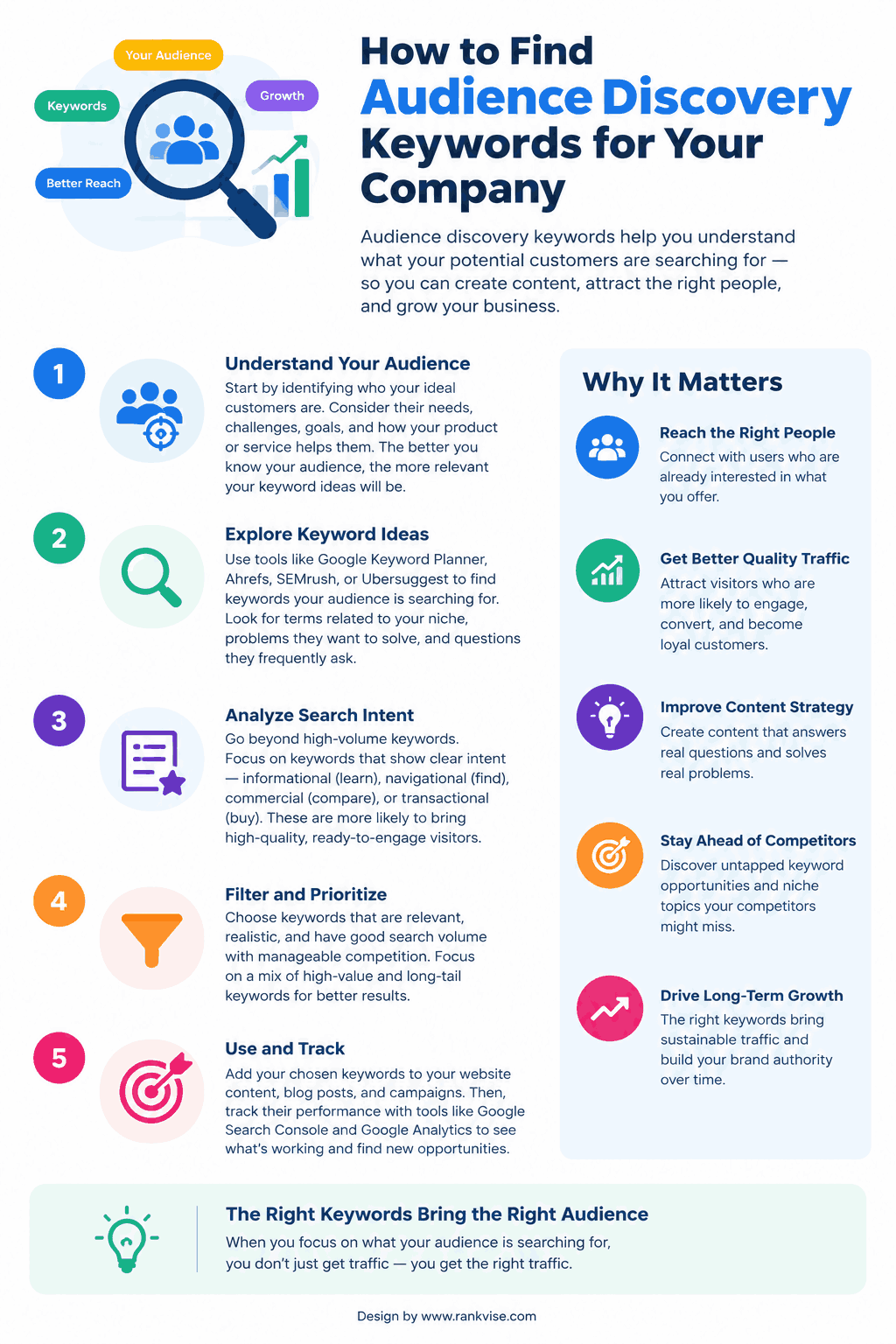
Raw symptom language is not yet a keyword. Turn it into one in three moves.
Collect verbatim. Build a list of exact phrases from the sources above. Aim for 50 or more before filtering anything.
Strip to the searchable core. “Honestly the biggest thing is I never know which campaigns are actually driving revenue” becomes “know which campaigns drive revenue.” Remove the conversational framing, keep the vocabulary.
Generate the question variants. For each core phrase, write the ways someone might search it: “how to know which campaigns drive revenue,” “which marketing channel drives revenue,” “measure campaign revenue.”
Now you have something a keyword tool can work with — but starting from your buyer’s words rather than your own.
Now Use the Tools
This is the point at which conventional keyword research applies, running in the opposite direction from usual.
Take your translated phrases into a keyword tool and check volume, difficulty, and related terms. Three things to look for:
- Phrases with volume you did not expect. These are your priority targets.
- Phrases with low or no reported volume but strong sales-call frequency. Tools underreport long-tail conversational queries, and a phrase you hear on every sales call has demand whether or not the tool shows it.
- Related terms the tool surfaces from your new seeds. This is where the expansion finally works, because you are now seeding with buyer vocabulary.
You will find that discovery keywords typically show lower volume and lower competition than category terms. Both are expected. You are targeting a larger audience across a much wider set of individually smaller queries.
Start From the Bottom
A counterintuitive but useful sequencing tip: build your keyword strategy starting at the decision stage and work upward, rather than starting with awareness.
Working bottom-up anchors everything to revenue. You know what converts, so you know which problems are worth being found for at the discovery stage. Starting at the top produces broad educational content with no line back to anything commercial — which is how awareness content becomes unjustifiable at the next budget review.
Be Honest About the Trade-Offs
Three caveats worth stating plainly before you invest.
Zero-click risk is high. Informational queries trigger AI-generated answers more than any other type, with the large majority of AI Overview appearances sitting on informational searches. A discovery keyword may be answered above the results without anyone clicking. Being the cited source still has value, but plan for citation rather than traffic.
Attribution will not work normally. Direct attribution suits lower-funnel activity and is genuinely insufficient for upper-funnel awareness work. Someone who read your symptom article in March and bought in September will not attribute to it. Agree the measurement approach before you start, or the programme will be judged by a model it cannot satisfy.
It takes longer. Discovery content compounds rather than converting immediately. Treat it as a two-to-four-quarter investment, not a campaign.
How Much to Invest
A reasonable starting split is a minority of effort on the earliest stages, a similar share on solution-aware content, and the largest share still on the decision-stage work that converts today. Something in the region of a quarter to a third of content effort on discovery is a defensible starting point for an established company, weighted higher for a newer brand that needs to fill the pool.
The point is not to abandon your category keywords. It is to stop competing exclusively for a small fraction of your market.
Final Thoughts
The reason audience discovery keywords are undersupplied is not that they are hard to rank for. It is that finding them requires talking to people rather than running a tool.
Spend an hour with your sales team, an hour in support tickets, and an hour in the communities where your buyers complain. Write down exactly what they say. That list will contain phrases no keyword tool would ever have handed you, and it is where the unaddressed part of your market is looking.
FAQs
What are audience discovery keywords?
Search terms buyers use before they know your solution category exists, usually describing a symptom or frustration rather than a product.
How are they different from normal keywords?
Normal keyword research expands outward from your product vocabulary. Discovery keywords use the buyer’s vocabulary, which often shares no words with your category.
Why can’t keyword tools find them?
Tools expand from seed terms you supply. If a phrase shares no words with your seeds, the expansion never reaches it, so it has to come from customer conversations.
Are low-volume discovery keywords worth targeting?
Often yes. Tools underreport conversational long-tail queries, and a phrase that recurs on sales calls has real demand regardless of reported volume.
How do I measure discovery keyword performance?
Not with last-click attribution. Use assisted conversions, branded search growth, and AI citation tracking, and agree the model before you begin.