Skip to content
If your rankings drop, traffic slows, or leads stop coming in, you don’t need guesses. You need data. A website domain SEO analysis shows you exactly what’s wrong and where the opportunity sits.
- Fix technical crawl and indexation errors first to ensure pages can be discovered and ranked.
- Improve site speed and Core Web Vitals to reduce bounce rates and boost rankings quickly.
- Build and clean backlinks, focusing on relevant referring domains and removing toxic links.
- Optimize internal linking and content for intent to push page two keywords into top positions.
Most websites don’t struggle because of one big mistake. They struggle because of small technical errors, weak internal linking, thin content, or poor authority signals that compound over time. You might publish quality content. You might build backlinks. But if your domain has structural issues, Google won’t reward you consistently.
Organic search still drives over 50% of total website traffic, according to research from BrightEdge. That means your growth depends heavily on how search engines evaluate your domain. If your technical foundation is weak, your competitors will outrank you, even with less content.
Here’s the reality in 2026. Google doesn’t just rank pages. It evaluates entire domains. It measures trust. It measures experience. It measures usability. A single crawl issue can block indexing. Slow load speed can increase bounce rates. Poor internal structure can dilute authority. These are not minor issues. They directly affect revenue.
You also face increasing competition. AI-generated content has flooded search results. More businesses invest in SEO every year. According to industry analysis covered by Search Engine Journal, competition for commercial keywords continues to rise across nearly every niche. That means average SEO efforts no longer work. Precision does.
A proper domain SEO analysis gives you that precision.
It answers critical questions:
- Why are certain pages not ranking?
- Why did traffic decline after a redesign?
- Why are competitors with fewer pages outranking you?
- Why does Google ignore some of your content?
When you analyze your domain correctly, you uncover technical errors, authority gaps, keyword opportunities, and structural weaknesses. Then you fix them. That’s how you improve rankings fast.
This guide walks you through the exact process. No fluff. No theory. Just the steps you need to identify problems and strengthen your domain.
Let’s break it down.
What Is a Website Domain SEO Analysis?
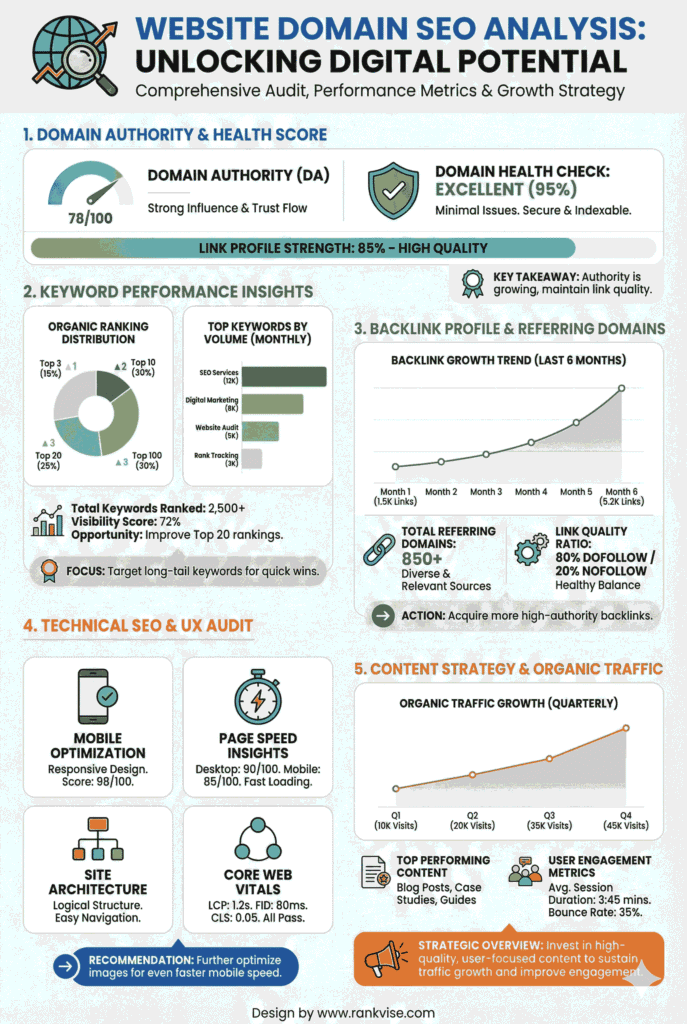
A website domain SEO analysis evaluates your entire domain, not just a single page.
You assess:
- Technical health
- Crawlability and indexation
- Page speed and Core Web Vitals
- Backlink profile
- Keyword visibility
- Content quality
- Internal linking structure
You don’t focus on one blog post. You evaluate how your whole domain performs in search engines.
Search engines like Google rank domains based on trust, authority, usability, and structure. If one area fails, your rankings suffer.
Step 1: Check Technical SEO Errors
Technical problems stop rankings before they start.
Crawl Errors and Indexation Issues
Start with:
- 404 errors
- Redirect chains
- Broken internal links
- Orphan pages
- Blocked pages in robots.txt
- Noindex tags applied incorrectly
Use tools like Ahrefs, SEMrush, or Screaming Frog to scan your domain.
If search engines can’t crawl your pages, they won’t rank them. Fix crawl errors first. Always.
Site Speed and Core Web Vitals
Speed directly impacts rankings and conversions.
In 2024, Google confirmed Core Web Vitals remain ranking factors. Your site must pass:
- Largest Contentful Paint under 2.5 seconds
- First Input Delay under 100 ms
- Cumulative Layout Shift under 0.1
Slow domains lose traffic. Period.
You can test performance using:
- Google PageSpeed Insights
- Lighthouse
- WebPageTest
If your site loads slowly:
- Compress images
- Use proper caching
- Upgrade hosting
- Minify CSS and JavaScript
- Remove unused plugins
Speed fixes often improve rankings within weeks.
Step 2: Analyze Your Backlink Profile
Your domain authority depends heavily on backlinks.
But not all links help.
What to Look For
- Referring domains growth
- Toxic or spam links
- Anchor text distribution
- Lost backlinks
- Link velocity trends
According to 2025 industry studies by Backlinko, the number of referring domains strongly correlates with higher rankings.
If your domain has:
- Too many exact-match anchors
- Spammy directory links
- Sudden unnatural link spikes
You risk penalties or suppressed rankings.
Clean up toxic links. Focus on earning contextual links from relevant websites.
Authority builds rankings faster than content alone.
Step 3: Evaluate Keyword Visibility and Ranking Gaps
Your domain might have content, but does it rank?
Run a domain-wide keyword analysis.
Identify:
- Keywords ranking on page 2 (positions 11–20)
- Declining keywords
- Cannibalized pages
- Missing high-intent keywords
These are fast wins.
If a keyword ranks at position 14, you don’t rewrite everything. You:
- Improve internal links
- Update content depth
- Add fresh data
- Improve title and meta description
You push it to page 1.
According to Search Engine Journal, pages ranking in the top 3 positions capture over 50% of clicks. Moving from position 9 to 3 can double or triple traffic.
Step 4: Audit On-Page SEO Structure
Even strong domains fail because of poor structure.
Check These Elements
- Title tags (under 60 characters, keyword-focused)
- Meta descriptions (compelling and clear)
- H1 usage (one per page)
- H2 and H3 hierarchy
- Image alt text
- Internal linking depth
Many websites bury important pages 4–5 clicks deep. That weakens authority flow.
Fix this by:
- Linking from high-authority pages
- Using descriptive anchor text
- Building topic clusters
Internal linking improves rankings fast because it distributes authority across your domain.
Step 5: Review Content Quality and Search Intent
Content must match search intent.
In 2026, Google prioritizes:
- Helpful content
- Experience signals
- Topical depth
- Updated information
Thin content drags your entire domain down.
Ask Yourself:
- Does this page fully answer the query?
- Is it updated with 2024–2025 data?
- Does it include expert references?
- Is it longer and more complete than competitors?
John Mueller from Google stated:
“High-quality content is something I’d focus on. We want to rank content that is useful for users.”
If your domain has 100 weak articles, your authority weakens. Consolidate thin pages. Expand important ones.
Step 6: Check Internal Linking and Topical Authority
Topical authority improves domain trust.
Instead of publishing random blog posts, build clusters.
Example structure:
- Pillar page: Website Domain SEO Analysis
- Supporting pages:
- Technical SEO checklist
- Backlink audit guide
- Keyword gap analysis tutorial
- Core Web Vitals optimization
Each page links to the pillar. The pillar links back.
This structure tells Google your domain is authoritative on the subject.
Common Domain SEO Errors That Kill Rankings
You see these constantly:
- Multiple H1 tags
- Duplicate meta titles
- Thin category pages
- Slow shared hosting
- No schema markup
- Broken redirects after site migration
- No sitemap submission
- Orphan blog posts
Fixing these often produces ranking gains within 30–60 days.
How Often Should You Run a Domain SEO Analysis?
You should audit your domain:
- Quarterly for growing websites
- Monthly for competitive niches
- Immediately after migrations or redesigns
SEO changes constantly. Competitors improve. Algorithms update. Your domain must stay optimized.
Tools You Can Use for Domain SEO Analysis
You don’t need 10 tools. Start with:
- Google Search Console
- Ahrefs or SEMrush
- Screaming Frog
- PageSpeed Insights
Each gives a different layer of insight.
Together, they show the full picture.
How Fast Can Rankings Improve?
It depends on the issue.
- Technical fixes: 2–6 weeks
- Content improvements: 4–12 weeks
- Backlink authority growth: 3–6 months
But here’s the truth. If your domain has severe technical problems, fixing them alone can trigger immediate indexing and traffic recovery.
You don’t always need more content. Sometimes you just need to remove what’s blocking performance.
A website domain SEO analysis gives you clarity. It shows you what’s blocking growth, what’s underperforming, and where your fastest wins are hiding.
You stop guessing. You stop publishing random content. You stop chasing backlinks without direction. Instead, you make decisions based on real data.
When you analyze your domain properly, you uncover:
- Technical barriers that prevent crawling and indexing
- Weak internal structures that dilute authority
- Content gaps your competitors are exploiting
- Ranking opportunities sitting on page two
- Backlink risks that weaken trust
Fixing these issues creates momentum. Technical cleanups often unlock pages that were already good but invisible. Internal linking improvements strengthen topical authority. Content updates move keywords from positions 12 or 15 into the top five. Authority building compounds over time.
SEO is not about hacks. It’s about structure, consistency, and authority.
Search engines evaluate your entire domain as an ecosystem. If your technical health, content depth, and authority signals align, rankings improve naturally. If one area fails, everything slows down.
You don’t need to overhaul your website overnight. You need a systematic review and prioritized fixes.
Start with technical errors.
Strengthen your internal linking.
Improve pages ranking on page two.
Build high-quality referring domains.
Update outdated content with current data.
Then measure the impact.
The websites that win in 2026 are not the ones publishing the most content. They are the ones with the strongest foundations and the clearest topical authority. They audit regularly. They fix quickly. They optimize intentionally.
Run your domain SEO analysis quarterly. Track improvements. Refine your strategy. Stay consistent.
When your domain is technically sound, strategically structured, and authority-driven, rankings stop fluctuating randomly. Traffic grows. Conversions improve. Growth becomes predictable.
That’s the real goal.
A complete analysis includes technical SEO, backlinks, keyword rankings, on-page structure, internal linking, and content quality evaluation.
Small sites can be audited in a few hours. Large websites may take several days, depending on page count and complexity.
Yes. Fixing crawl errors, speed issues, and indexation problems can improve rankings within weeks.
Page SEO focuses on a single page. Domain SEO evaluates the overall health, authority, and structure of your entire website.
Quarterly for most websites. Monthly for competitive industries.
Yes. High-quality referring domains remain one of the strongest ranking signals.