Skip to content
There is a persistent myth in content marketing: write enough words, and Google will reward you. Build it long enough, and the rankings will come. Spend a few hours inside any active SEO forum, however, and you will quickly find the reality is far more complicated — and far more interesting.
- Diagnose and target search intent before writing; audit the SERP to match query type: informational, navigational, commercial, transactional.
- Build comprehensive, actionable structure: strong hook, H2-driven pillars, practical takeaways, and conclusions that prompt next steps.
- Demonstrate E-E-A-T with specific experience, citations, and accuracy; prioritize readability and technical SEO like TOC, internal links, mobile formatting, schema.
Long-form content does tend to rank well. Studies consistently show that top-ranking pages contain more semantic depth, topical coverage, and structural variety than their shorter competitors. But the causality runs in the opposite direction from what most marketers assume. Content ranks because it is comprehensive and genuinely useful. The length is a byproduct of quality, not the cause of it.
This guide is a practical, no-fluff framework for writing long-form content that earns its place on page one — whether you are a seasoned digital marketer, a freelance copywriter, or a brand strategist building a content calendar.
One resource worth noting upfront: students and academic writers who use platforms such as write my college essay services operate under strict originality, citation, and formatting standards — a discipline that mirrors the E-E-A-T expectations Google now applies to all high-stakes content. The parallel is worth keeping in mind as we work through what actually makes content rank.
Why Most Long-Form Content Fails Before It Starts?
Walk through any competitive SERP today and you will notice something striking: the pages that rank are not always the longest, the best-designed, or even the most technically optimized. They are the ones that most precisely answer the intent behind the search.
This is where most long-form content fails — not in execution, but in diagnosis. Writers and marketers spend hours researching keywords, crafting outlines, and polishing prose, all while targeting the wrong version of the right idea.
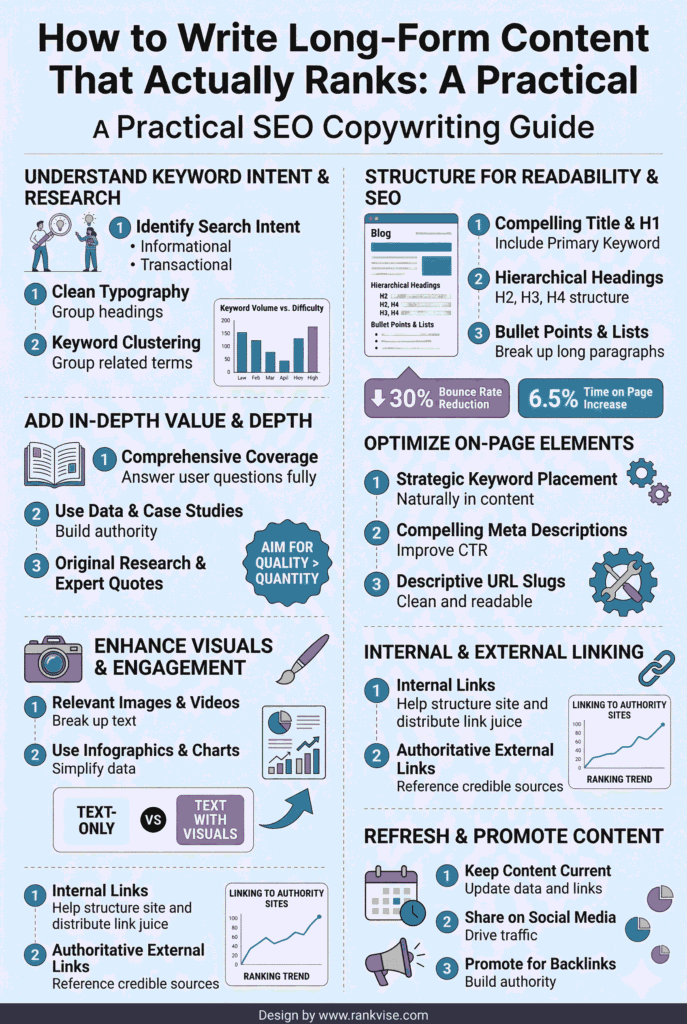
Search intent is not a buzzword. It is Google’s foundational evaluation criterion. Every query belongs to one of four intent categories. Understanding which one you are targeting before you write a single word is the highest-leverage decision you can make in the entire content process.
| Intent Type | What the User Wants | Example Query |
|---|---|---|
| Informational | To learn or understand something | “how does content marketing work” |
| Navigational | To find a specific page or brand | “Ahrefs blog keyword research” |
| Commercial | To research before buying | “best SEO tools for small business” |
| Transactional | To complete an action or purchase | “buy SEO audit template” |
Miss the intent, and no amount of keyword optimization will save you. A 4,000-word guide on how content marketing works will not rank for a transactional query, no matter how beautifully it is written. Google is not in the business of showing users the wrong answer, regardless of how well that answer is packaged.
The practical fix is simple: before writing a single word, run your target keyword through Google and audit what actually ranks. Rankvise’s free KeywordIdeas tool is a useful starting point for identifying search intent signals before you commit to a topic angle.
Keyword Strategy in 2026: Beyond Density, Into Semantics
Keyword density — hitting a specific percentage of keyword repetition — is functionally obsolete. Google’s algorithms have matured well beyond string matching. What the system evaluates now is topical authority: does this page demonstrate a thorough, nuanced understanding of the subject it claims to cover?
This shift has significant implications for how copywriters approach keyword research and placement. Think of your keyword architecture in three tiers.
Primary keyword — the central query your page targets. It should appear in the H1, within the first 100 words, in at least one H2, and in the meta title and description. Beyond that, use it only where it reads naturally.
Secondary keywords — closely related variants that support the primary topic. A post targeting ‘SEO copywriting guide’ might also cover ‘on-page SEO writing,’ ‘SEO content strategy,‘ and ‘writing for search intent.’ These expand your semantic footprint without forcing awkward repetition.
LSI (Latent Semantic Indexing) keywords — conceptually adjacent terms that tell Google your content is contextually grounded. For an SEO copywriting guide, these might include terms like ‘E-E-A-T,’ ‘meta description,’ ‘content structure,’ ‘dwell time,’ and ‘SERP features.’ If you are writing a genuinely thorough piece, they will appear organically.
For hands-on keyword research, Rankvise’s SEO services team works with exactly this tiered semantic approach — building topical clusters rather than chasing individual keyword targets in isolation.
Where Keywords Actually Need to Go
| Placement | Purpose | Priority Level |
|---|---|---|
| Meta title | CTR signal + primary ranking relevance | Critical |
| H1 heading | On-page relevance — must match search intent | Critical |
| First 100 words | Confirms topic match to Google immediately | High |
| At least one H2 | Structural relevance across the article | High |
| Image alt text | Accessibility + supplementary crawl signal | Medium |
| URL slug | Clean crawlability and SERP display | Medium |
| Meta description | Click-through optimization — not a direct ranking factor | Medium |
The guiding principle: write for humans, then review for machines. If a sentence reads awkwardly because of keyword placement, rewrite the sentence. Clarity always outranks cleverness in the eyes of both Google and your reader.
The Architecture of Long-Form Content That Ranks
Structure is not a cosmetic concern — it is a functional one. Google’s crawlers process content hierarchically: they evaluate how ideas are organized, how sections relate to each other, and whether the piece answers increasingly specific questions as it progresses. A wall of text, no matter how expertly written, fails this test.
1. The Hook (First 150 Words)
This section has two jobs, both non-negotiable. First, it must confirm to the reader that they are in the right place. Second, it must generate enough interest to keep them reading. A strong hook establishes the problem, signals the solution, and creates a mild tension that compels forward movement. Every sentence earns its place.
2. The Setup (Background and Context)
Before tactical advice, effective long-form content gives readers a shared frame of reference. This might be a common misconception being addressed, or a piece of data that reframes the reader’s assumptions. This section also introduces secondary keywords naturally, builds topical depth, and gives Google more semantic signal to index.
3. The Core Sections (H2-Driven Pillars)
Each H2 heading should represent a distinct, meaningful sub-topic — not a variation of the same point. Think of each section as answering a follow-up question the reader would naturally ask after the previous one. Research from Contentsquare shows users spend an average of 54 seconds on a web page, mostly scanning — structure your content accordingly.
4. The Practical Layer (Actionable Takeaways)
The single biggest differentiator between content that ranks and content that stagnates on page two is actionability. After every major point, ask yourself: what does a reader actually do with this information? If you cannot answer that concretely, the section needs revision.
5. The Conclusion (With a Forward Prompt)
Strong conclusions do not summarize — they extend. Use the conclusion to reframe the key insight at a higher level of abstraction, then offer a forward-looking prompt: a next step, a related resource, or a question that encourages further engagement.
E-E-A-T: The Trust Signal That Separates Rankings from Traffic
Since Google’s 2024 integration of the Helpful Content system into its core algorithm, E-E-A-T — Experience, Expertise, Authoritativeness, and Trustworthiness — has moved from a quality guideline to an operational ranking consideration. Here is how each component translates into concrete writing choices.
| Pillar | What It Means in Practice | How to Demonstrate It |
|---|---|---|
| Experience | First-hand engagement with the subject | Share specific observations, real results, case-specific examples |
| Expertise | Deep subject-matter knowledge, not surface familiarity | Use precise terminology; address edge cases and counterarguments |
| Authoritativeness | External recognition within your niche | Earn citations from credible sources; get referenced by authoritative domains |
| Trustworthiness | Accuracy, transparency, reliability | Cite sources; disclose methodology; update content when information changes |
One of the most underestimated E-E-A-T signals is content specificity. Vague advice — ‘write quality content‘ or ‘focus on your audience’ — signals to both readers and algorithms that the writer does not have hands-on knowledge of the subject. Specific advice, backed by data or direct experience, does the opposite.
Readability Is an SEO Strategy, Not a Design Preference
Ask most marketers what readability means, and they will reference Flesch-Kincaid scores or sentence length guidelines. These are useful proxies, but they miss the deeper point: readability is the degree to which your content does not resist comprehension. The best long-form content is not simple — it is clear. There is an important difference.
Paragraph length. Online readers behave differently from print readers. Paragraphs of two to four sentences outperform dense blocks. White space gives the eye a rest and the mind a moment to process.
Sentence rhythm. Monotonous sentence length creates ‘drone prose’ — competent, bland, and easy to skim past. Vary deliberately. Short sentences land emphasis. Longer sentences carry nuanced ideas through to their full expression before the reader moves on.
Concrete language over abstract. ‘Implement a robust content strategy’ means almost nothing. ‘Publish two pillar posts per quarter, each targeting a cluster of ten related keywords’ means everything.
Technical SEO Touchpoints for Long-Form Content
Strong writing is the foundation, but technical SEO is the infrastructure. No matter how good your content is, it will underperform if the technical layer undermines discoverability. Here are the touchpoints that matter most specifically for long-form pieces.
Table of Contents with anchor links. For content over 1,500 words, a clickable table of contents improves navigation, increases dwell time, and creates a structural overview that Google frequently pulls into sitelinks and featured snippets.
Internal linking with contextual anchors. Each long-form piece should link to at least three to five related pages on the same domain. Use descriptive, keyword-relevant anchor text — not generic ‘click here’ language. A site-wide SEO audit before publishing reveals exactly where internal link opportunities exist and which pages currently lack incoming links.
Mobile formatting. As of 2026, roughly 59% of all global web traffic comes from mobile devices. Long-form content that reads well on desktop can become an unusable wall of text on a 375px screen. Test on mobile before publishing, and adjust heading hierarchy, paragraph length, and table widths accordingly.
Schema markup. For guides and how-to content, FAQ schema allows Google to display your answers directly in the SERP. HowTo schema works similarly for process-driven content. Both increase SERP real estate without requiring a higher position.
Conclusion: Long-Form Content as a Long-Term Asset
The best long-form content does not just rank — it compounds. A well-constructed, thoroughly researched, clearly written piece builds authority over time, attracting backlinks, generating social references, and gradually accumulating keyword coverage for terms you never explicitly targeted.
This is why the investment in quality SEO copywriting is categorically different from the investment in paid search. A Google Ads campaign stops generating returns the moment you stop paying. A well-built guide keeps returning value for months or years, growing in authority with each update.
Treat every long-form piece as a durable asset, not a disposable deliverable. For marketers who want professional support implementing this approach at scale, Rankvise’s content writing and SEO services are built around exactly this philosophy — depth, consistency, and compounding returns over time.
Research it thoroughly. Structure it with intention. Write it for humans, then optimize it for algorithms. Measure its performance after publishing, and update it regularly. Do that consistently, and the rankings follow naturally.