Growing a business through paid advertising requires more than creative ideas and larger budgets. Lasting results often come from strong planning, clear processes, and reliable campaign management.
Businesses that invest in these areas can respond more quickly to change, improve collaboration, and support sustainable growth. Resources such as AdRevival can help marketers learn more about advertising infrastructure while they build a stronger foundation for future campaigns.
Why a Paid Advertising Foundation matters before scaling
Scaling too early usually hides underlying problems. More spend can increase leads, but it can also multiply inefficiencies. If your tracking is incomplete or your offer is unclear, higher budgets simply make those issues more expensive.
A strong Paid Advertising Foundation helps you answer critical business questions early. You can see which channels drive qualified traffic, which campaigns support customer acquisition, and which messages produce reliable conversions.
It also improves decision-making across the team. Marketing, sales, and leadership gain a shared view of performance. That alignment is essential when growth depends on steady execution, not one-off campaign wins.
What are the core parts of a Paid Advertising Foundation?
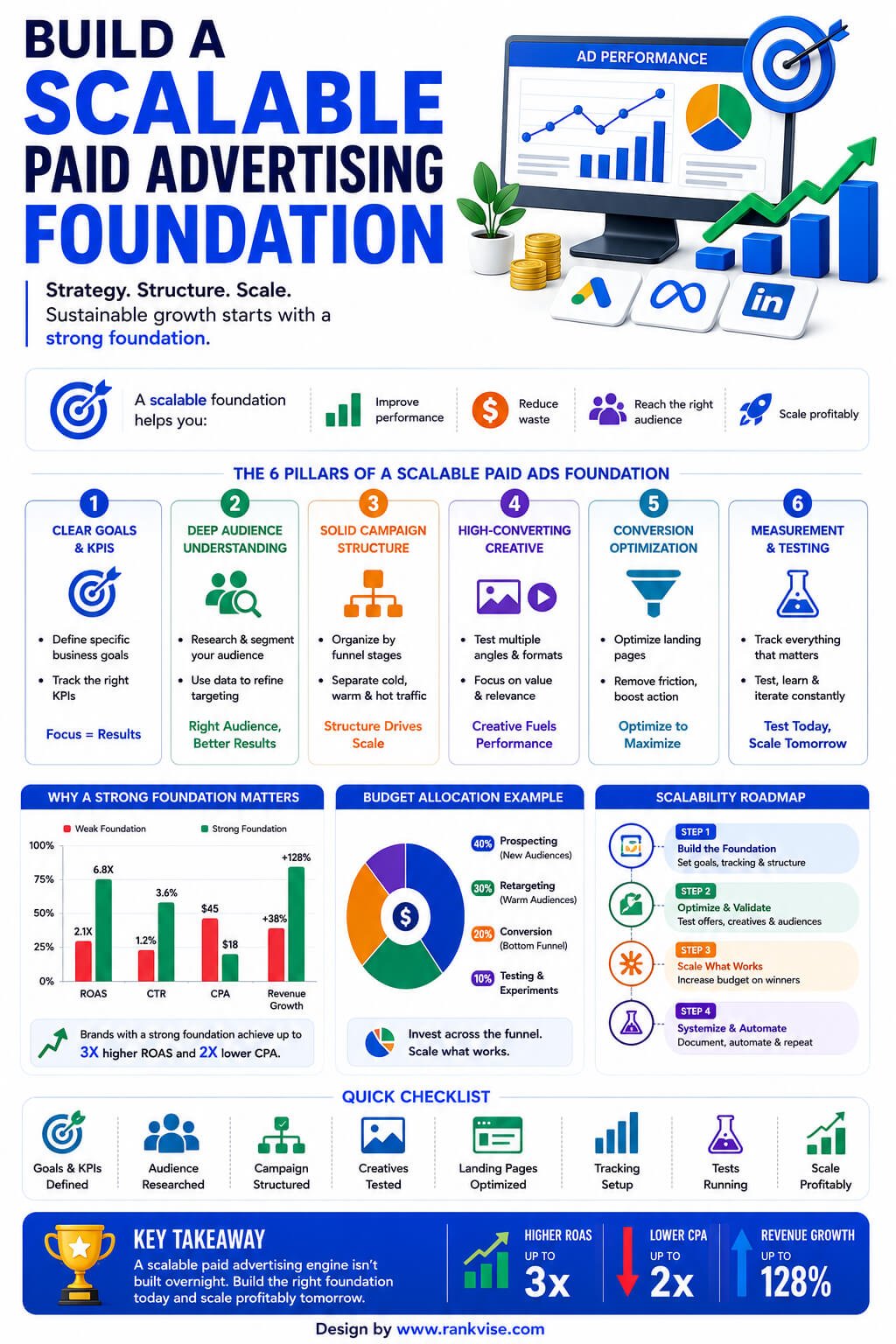
A scalable foundation usually includes five connected elements. Each one supports efficiency, learning, and long-term performance.
- Clear business goals: Define whether success means leads, sales, pipeline, or retention.
- Accurate conversion tracking: Measure actions that reflect real business value, not vanity clicks.
- Logical campaign structure: Organize campaigns by audience, intent, offer, and funnel stage.
- Strong audience targeting: Reach the right people with messaging that matches their needs.
- Landing page optimization: Create a consistent path from ad click to conversion.
If one area is weak, performance suffers everywhere else. That is why strong advertisers build systems, not isolated campaigns.
Start with business goals, not platform settings
Many advertisers begin inside Google Ads or Meta Ads Manager. That is usually backwards. The first step should be clarifying what the business wants paid media to accomplish.
Ask questions that connect advertising to outcomes. Are you trying to reduce acquisition costs, increase qualified demos, or grow repeat purchases? Do you want to enter new markets or improve return from existing demand?
These answers shape everything that follows. They influence channel selection, budget allocation, offer strategy, and measurement priorities. Without this clarity, even well-designed campaigns can produce the wrong type of growth.
Build conversion tracking that supports better decisions
Reliable conversion tracking is the backbone of any Paid Advertising Foundation. If your data is incomplete, optimization becomes guesswork. You may pause winning campaigns or scale poor ones for the wrong reasons.
Track meaningful actions across the full journey. That can include form fills, purchases, booked calls, qualified leads, and revenue events. Whenever possible, connect ad platforms with your CRM or backend sales data.
Your tracking setup should answer practical questions such as:
- Which campaigns drive high-quality leads instead of low-intent volume?
- Which audiences convert faster and at lower acquisition costs?
- Which landing pages influence pipeline, revenue, or repeat purchases?
- Which devices, regions, or creatives support profitable scaling?
When measurement improves, optimization becomes more confident and much faster.
How should campaign structure support future growth?
A messy account can still generate results for a while. However, it becomes harder to scale, diagnose issues, or spot patterns. Clean campaign structure gives you control as budgets and complexity increase.
Organize campaigns around clear business logic. That might mean separating branded and non-branded search, prospecting and retargeting, or top-funnel and bottom-funnel offers. The goal is not complexity. The goal is clarity.
Good structure also improves testing. You can compare creative angles, landing pages, and audience segments without mixing unrelated variables. That helps you understand what is working and why.
A scalable account structure usually makes room for:
- Different funnel stages
- Different audience intents
- Distinct offers or product lines
- Regional or market variations
- Clear reporting by objective
This structure supports growth because it preserves visibility as spend rises.
Improve audience targeting before increasing budget
Poor audience targeting often looks like a creative problem. In reality, the message may simply be reaching the wrong people. A strong foundation matches intent, pain points, and offer relevance.
Start with your best existing customer insights. Look at common traits, buying triggers, objections, and decision timelines. Use those signals to shape targeting, messaging, and offer selection across platforms.
Different audiences respond to different levels of awareness. Some need education before they convert. Others are already comparing solutions and need proof, urgency, or a stronger value proposition.
This is why targeting should align with funnel stage. Broad prospecting, retargeting, and high-intent search each require different expectations and creative strategies.
Why landing page optimization protects ad efficiency
Even strong ads fail when the post-click experience is weak. That is why landing page optimization belongs inside your Paid Advertising Foundation, not outside it. The page must continue the conversation started by the ad.
A high-performing landing page usually does a few things well. It repeats the offer clearly, reduces friction, and makes the next step obvious. It also gives visitors enough trust signals to act confidently.
Common issues include slow loading times, generic copy, weak form design, and unclear calls to action. These problems can quietly damage conversion rates, even when traffic quality is solid.
Focus on improving:
- Message match between ad and page
- Page speed and mobile usability
- Strong headlines and proof points
- Simple forms and clear calls to action
- Testimonials, case studies, or trust indicators
Small landing page gains can improve acquisition efficiency across every campaign.
Use creative and messaging that reflect buying intent
Creative should never operate without strategy. The best ads connect audience pain points to clear business outcomes. They also reflect where the buyer sits in the decision process.
Top-funnel prospects often respond to insight, education, or problem framing. Mid-funnel audiences need differentiation and relevance. Bottom-funnel users usually need proof, trust, and a compelling next step.
When messaging maps to intent, performance becomes more stable. You avoid relying on one ad variation or one temporary offer. That stability supports long-term scaling across new audiences and channels.
What metrics should guide long-term paid growth?
Not every metric deserves equal attention. Click-through rate and cost per click can be useful, but they should not drive strategy alone. A mature Paid Advertising Foundation focuses on metrics tied to business outcomes.
Useful metrics often include cost per qualified lead, conversion rate, customer acquisition cost, return on ad spend, and revenue by campaign. For subscription or repeat-purchase businesses, lifetime value matters even more.
You should also consider marketing attribution carefully. Last-click reporting often overstates bottom-funnel channels and understates discovery campaigns. Use attribution as a guide, not a substitute for judgment.
Create a testing process that compounds learning
Sustainable growth depends on repeatable learning. Random tests create noise. A clear testing framework creates progress that compounds over time.
Test one major variable at a time when possible. That may include audience, offer, creative angle, landing page headline, or bidding approach. Record the reason for each test and the expected result.
A simple testing rhythm helps teams stay disciplined:
- Start with one hypothesis tied to a business goal
- Define the metric that will determine success
- Run the test long enough to gather useful data
- Document the outcome and next decision
- Apply the learning across similar campaigns
This approach turns paid media into a system for continuous improvement.
How to scale without breaking performance
Once the foundation is strong, scaling becomes much safer. The goal is not aggressive spending for its own sake. The goal is profitable expansion supported by reliable signals.
Increase budgets gradually where efficiency remains healthy. Expand winning themes into new audiences, geographies, or formats. Add new creative variations before fatigue lowers results.
You can also scale by improving conversion rates, not just traffic volume. Better pages, stronger offers, and cleaner qualification often unlock growth without major budget jumps.
A practical scaling checklist includes:
- Confirm tracking accuracy before increasing spend.
- Identify campaigns with stable conversion quality.
- Refresh creative before performance declines.
- Expand targeting based on proven customer patterns.
- Review downstream sales quality, not only platform metrics.
This method helps brands grow with control instead of chasing short-term spikes.
Common mistakes that weaken a Paid Advertising Foundation
Many advertising problems are preventable. They happen when teams move too fast or optimize around incomplete data.
The most common mistakes include:
- Scaling before validating tracking and lead quality
- Mixing too many goals inside one campaign
- Sending traffic to generic website pages
- Ignoring creative fatigue and message relevance
- Judging success only by platform-level metrics
- Failing to align sales feedback with ad performance
These issues can reduce efficiency for months before teams recognize the real cause. Fixing the foundation early saves both time and budget later.
Final thoughts on building for long-term growth
A scalable Paid Advertising Foundation is not glamorous, but it is powerful. It gives your business clearer measurement, better campaign control, and stronger opportunities to grow profitably.
The brands that win long term usually do the basics exceptionally well. They align goals, tracking, structure, targeting, and landing pages before pushing spend higher. That discipline creates better results and fewer surprises.
If you want paid media to support durable growth in 2026, start with the foundation. When the system is strong, scaling becomes a strategic choice instead of a risky gamble.
FAQs
A Paid Advertising Foundation is the system behind your ads, including goals, tracking, targeting, structure, and landing pages.
Conversion tracking shows which campaigns drive valuable actions, helping you optimize spend with confidence.
Strong campaign structure improves reporting, testing, and budget control as your account grows.
Landing page optimization improves conversion rates, reduces wasted spend, and supports better acquisition efficiency.
A business should scale after validating tracking, lead quality, messaging, and campaign efficiency.