Skip to content
In the pre-internet era, trust was built slowly and locally. A business earned its reputation through face-to-face interactions, word-of-mouth, and years of consistent service. The feedback loop was tight, the signals were human, and the stakes were neighborhood-sized.
- Prioritize trust signals (E-E-A-T): off-page reviews, authoritative mentions, and consistent brand citations directly boost organic rankings and sustain visibility.
- Systematically collect and respond to third-party reviews: request reviews after positive interactions, choose platform-specific sites, and reply professionally to negative feedback.
- Combine consistent, expert content with technical hygiene: author bylines, original research, schema, mobile optimization, and coherent citations to compound credibility.
None of that logic holds anymore. A brand operating online in 2026 can acquire a customer in Sydney and lose one in Toronto within the same hour. Reviews spread in minutes. A single piece of poorly sourced content can damage credibility that took years to build. And the algorithms that control organic visibility now evaluate trust signals with a sophistication that would have seemed implausible a decade ago.
This is not a crisis for brands. It is a clarification. The rules of trust have not changed they have simply been made visible and measurable. What follows is a practical map of how that system works, what it rewards, and how brands at any scale can build genuine, durable credibility that compounds over time.
The stakes are particularly high in service industries where quality is difficult to assess independently education, legal, financial, healthcare. In these spaces, platforms with dense, independent user verification set the benchmark. A graduate essay writing service like EssayHub, for instance, earns its credibility through thousands of specific, documented user reviews that evaluate writing quality, citation accuracy, and deadline adherence independently of the brand’s own marketing. That density of third-party verification is exactly what Google’s trust algorithms look for and it is a model that applies far beyond the ed-tech niche.
Why Trust Has Become the Primary SEO Variable?
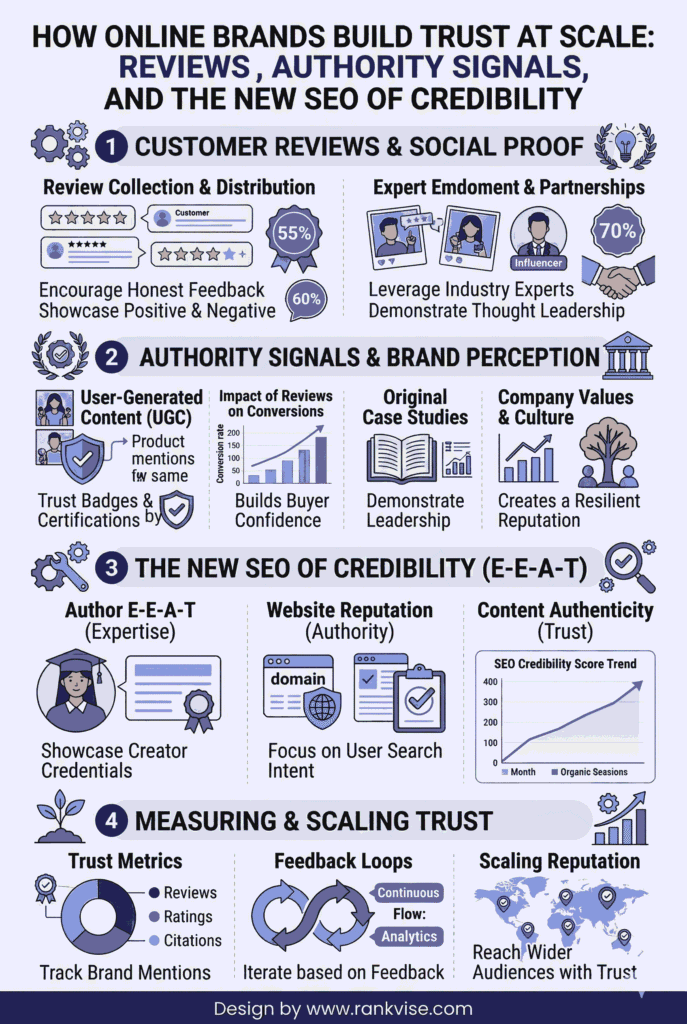
Google has been explicit about this shift for several years, but the practical implications are still underestimated by most marketing teams. The Helpful Content system, integrated into Google’s core algorithm in 2024, directly deprioritizes content that reads as though it was created for search engines rather than for people. The E-E-A-T framework — Experience, Expertise, Authoritativeness, and Trustworthiness is Google’s operational definition of what ‘good for people’ looks like in practice.
This has a concrete consequence that goes beyond content strategy: a brand’s off-page reputation now influences the ranking potential of its on-page content. Google does not evaluate a page in isolation. It evaluates the entity behind the page looking at brand mentions, review sentiment, citation patterns, and the quality of external sources that reference the brand before deciding how much weight to give the content itself.
The practical result is that two brands publishing identical content can expect different organic outcomes if their trust footprints are different. The brand with the stronger review profile, more credible backlinks, and more consistent representation across the web will, on average, rank higher, rank faster, and sustain those rankings through algorithm updates more reliably. Trust is not soft. In 2026, it is the hardest currency in digital marketing.
The Four Pillars of Online Brand Trust
Understanding E-E-A-T at an operational level requires moving beyond the acronym into the specific signals Google’s quality evaluators actually look for.
| E-E-A-T Pillar | What It Means | Where It Is Built |
|---|---|---|
| Experience | The brand has first-hand, demonstrated engagement with its subject | Case studies, documented results, original data, founder stories, specific before/after examples |
| Expertise | The brand or its authors have verifiable, deep knowledge in the domain | Author credentials, specialist content, technical depth, engagement with edge cases |
| Authoritativeness | The brand is recognized as a credible reference point by external parties | Backlinks from relevant domains, press mentions, industry citations, directory listings |
| Trustworthiness | The brand operates transparently and reliably | Customer reviews, privacy policy, HTTPS, consistent NAP across directories, response behavior |
Notice that three of the four pillars are primarily demonstrated off the brand’s own website. Experience can be shown through on-site content, but authority and trustworthiness are built through what external parties say, link to, and verify about the brand. This is the structural reality that most brands underinvest in.
Reviews — The Most Underestimated SEO Asset
Customer reviews are often discussed as a conversion tool: social proof that reassures prospective buyers. That framing is accurate but incomplete. Reviews are also an active trust signal to search engines, and their influence on organic visibility is measurable.
Google uses review data in multiple ways. Star ratings in Google Business Profile influence local pack rankings. Review volume and recency affect how quality evaluators assess trustworthiness. Sentiment analysis of review language helps Google understand what a brand is known for — which can influence the branded keyword associations that shape organic search behavior.
For brands operating outside of local SEO, third-party review platforms — Trustpilot, G2, Capterra, and niche-specific equivalents — serve a similar function. A brand consistently referenced positively across multiple independent platforms is, from Google’s perspective, verified by the crowd. That verification carries algorithmic weight.
Building a Review Strategy That Actually Works
Timing matters. The highest review conversion rates occur when the request is made immediately after a positive interaction — after a successful delivery, the completion of an onboarding call, or the resolution of a support issue. A generic monthly email blast converts at a fraction of the rate of a targeted, contextually triggered request.
Platform specificity matters. Where you ask customers to leave reviews should be determined by where your target audience looks for social proof. For B2B SaaS, G2 and Capterra carry more weight than Google My Business. For consumer brands, Google and Trustpilot matter most.
Response behavior matters. Google’s own documentation indicates that businesses that respond to reviews — both positive and negative — signal a level of engagement that passive brands do not. Responding to negative reviews professionally, without defensiveness, is one of the clearest demonstrations of the Trustworthiness pillar that any brand can make.
Brand Authority Beyond Backlinks
For most of the 2010s, brand authority in SEO terms meant one thing: backlinks. That model still applies, but it has become considerably more nuanced. Google’s current systems evaluate brand authority through a broader set of signals.
Editorial mentions (linked and unlinked). When authoritative publications reference your brand — in an article, a study, a roundup, a product comparison — that mention contributes to your entity footprint even when no hyperlink is present. Google’s ability to recognize unlinked brand mentions as authority signals has grown significantly as its natural language processing has matured.
Citation diversity. A brand mentioned across a variety of independent, topically relevant sources carries more authority than one with a concentrated backlink profile from a small number of referring domains. Diversity signals organic recognition; concentration often signals artificial link building.
Direct branded search volume. The number of people who search for your brand name directly is a behavioral signal that Google uses to infer brand awareness and preference. Growing direct search volume demonstrates — in aggregate real user behavior — that meaningful recognition has been built in your market.
PR and media coverage. Earned media in industry publications does double duty: it generates brand mentions (often with links) from high-authority domains, and it drives the branded search volume described above. This is why PR and SEO are increasingly integrated disciplines rather than separate functions.
For brands building this kind of integrated authority from scratch, Rankvise’s SEO services approach link acquisition, brand citation building, and on-page optimization as a single coordinated strategy — not separate workstreams.
Content as a Trust-Building Mechanism
Trust is not built through a single exceptional piece of content. It is built through a consistent pattern of content that demonstrates the four E-E-A-T pillars repeatedly, across different formats and topics, over time. This has structural implications for content strategy.
Brands that publish sporadically — active during campaigns and dark between them — cannot build the kind of consistent topical authority that search engines reward. Authority is inferred from pattern, not from peaks. The most effective content trust architecture is built around topic clusters: a pillar page addressing a core topic comprehensively, surrounded by cluster content addressing specific sub-topics in depth, all interlinked to create a navigable knowledge hub.
Within that architecture, specific content formats carry particular trust weight. Original data and research generate citations from other publishers who want to reference the findings — building backlinks and brand mentions simultaneously. Case studies with specific, documented outcomes and named clients are the content equivalent of a verified credential. Author bylines with real credentials address the Expertise and Experience pillars directly; Google’s quality raters are specifically trained to look for this signal.
Technical Trust — The Infrastructure Layer
Brand trust is not built on content alone. It also has a technical dimension that is less visible to audiences but equally legible to search engines.
| Technical Signal | Why It Matters | Common Failure Mode |
|---|---|---|
| HTTPS / SSL | Baseline security — browsers flag HTTP sites; Google deprioritizes them | Expired SSL certificate or mixed-content warnings on specific pages |
| Core Web Vitals | Page experience assessment: loading, interactivity, visual stability | Images not compressed; render-blocking JavaScript; no lazy loading |
| Consistent NAP | Name, Address, Phone consistent across all directory listings | Different address formats across Google Business, Yelp, and website |
| Schema markup | Makes trust signals machine-readable for E-E-A-T evaluation | Missing Author schema; no Review schema on pages with user testimonials |
| Mobile optimization | 59% of global traffic is mobile — poor mobile UX undermines all other signals | Desktop-formatted tables and images breaking on small screens |
A thorough technical audit — available via Rankvise’s SEO Audit tool — surfaces exactly these issues before they silently drag down an otherwise strong content and authority-building strategy.
Measuring Trust-Building Progress
One of the challenges of trust-building as a marketing discipline is that its returns are distributed over time and across multiple channels simultaneously. Here is a practical framework for tracking accumulation even when cause-and-effect is not immediate.
| Metric | What It Signals | Tool |
|---|---|---|
| Branded search volume | Growing brand awareness and organic preference among target audience | Google Search Console, Google Trends |
| Review volume & sentiment | Accumulation of trust signals and overall reputation health | Trustpilot, Google Business, Semrush |
| Referring domain count | External authority recognition — how many sites consider you worth citing | Ahrefs, Semrush |
| Brand mention volume | PR and editorial reach beyond direct link acquisition | Brand24, Google Alerts |
| AI Overview appearances | Visibility in Google’s AI-generated answers — the next frontier of trust-based search | Ahrefs, Semrush |
The most telling metric — and the one most frequently overlooked — is branded search volume. A brand genuinely building trust in its market will see its direct name searches grow over time, independent of paid advertising. That organic growth in branded search is the cleanest signal available that trust-building is working.
The Common Trust-Killing Mistakes Brands Make
Anonymous authorship. Publishing content without named authors removes the Expertise and Experience signals entirely. Every piece of editorial content should be attributed to a real person with a visible, relevant credential.
Ignoring negative reviews. An unanswered negative review tells prospects two things simultaneously: this happened, and the brand does not care enough to respond. Both messages damage trust. A thoughtful, professional response to a negative review often does more trust-building work than a positive review would have.
Thin content at scale. Publishing large volumes of short, low-specificity content optimizes for quantity over credibility. Google’s Helpful Content system is specifically designed to identify and discount this pattern. A smaller number of genuinely comprehensive, well-researched pieces consistently outperforms a high-frequency publishing cadence of shallow articles.
Inconsistent brand messaging. When a brand’s messaging varies materially across channels — different promises on the website versus in ads, different voice in blog content versus social media — it creates a subtle but real credibility gap. Consistency is itself a trust signal.
Conclusion: Trust Is the Compound Interest of Digital Marketing
Every review earned, every credible backlink acquired, every well-researched piece of content published, every professional response to a critical customer, and every external verification secured adds a small increment to a brand’s trust capital. Unlike paid media, which stops the moment the budget does, trust compounds.
A brand that has spent three years building a coherent, consistent, credibility-focused digital presence is not competing on a level playing field with a brand that started last month. It is playing a different game entirely. That compounding dynamic is also why the time to start building is always now.
The brands that will dominate the search landscape in 2027 are the ones starting to build genuine trust signals today. Rankvise’s digital marketing services are built on this exact philosophy — long-term authority over short-term visibility, credibility over clicks, and compounding returns over campaign spikes.
Produce credible content, earn legitimate external validation, maintain technical standards, respond to your audience honestly, and build consistently over time. The playbook is not secret. What is rare is the discipline to follow it.