Skip to content
The gaming industry generates over 180 billion USD annually, according to Newzoo. Yet most players still own nothing inside the games they love. Metastream is built to change that reality. It combines live streaming, NFT trading, and community interaction into a single Web3 gaming platform. This isn’t another speculative crypto project. It’s a functional ecosystem designed for gamers, streamers, and developers who want real digital ownership.
- Integrates live streaming with real-time NFT marketplace for seamless discovery and purchase during broadcasts.
- Every asset is blockchain-verified, granting verifiable ownership, provenance, and peer-to-peer transfers.
- Focuses on functional in-game NFTs that provide utility, not just speculative collectibles.
- Built-in community governance, social tools, and creator monetization through live drops and engagement rewards.
- Scalable infrastructure supports low-latency streaming and cross-platform interoperability for asset portability.
This guide breaks down everything you need to know about Metastream. You’ll learn how it works, why it matters, and where it’s headed.
What Is Metastream and Why Does It Matter?
Metastream is a Web3 gaming platform that integrates live streaming with a real-time NFT marketplace. It connects players, content creators, and game developers within a decentralized ecosystem. Users can discover, buy, sell, and showcase NFTs while watching live content.
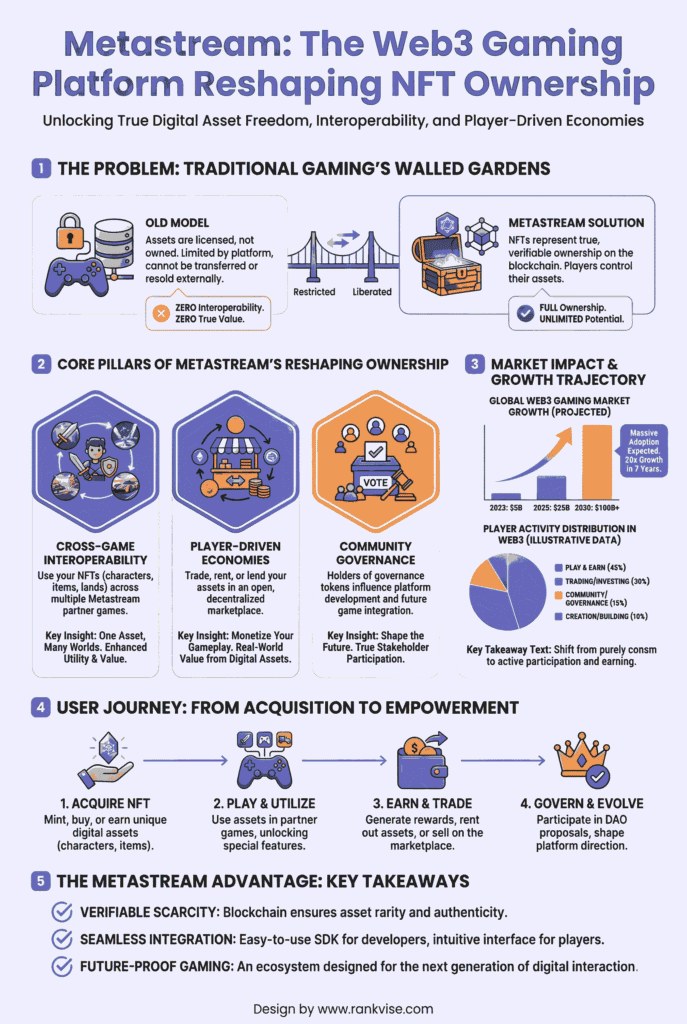
Traditional gaming locks your purchases inside a single platform. You spend money on skins, weapons, and upgrades, but you never truly own them. Metastream flips that model. Every digital asset on the platform exists as an NFT on the blockchain. That means players hold verifiable ownership and can trade freely across the ecosystem.
According to DappRadar, blockchain gaming attracted over 1.3 million daily unique active wallets in early 2024. Platforms like Metastream are riding this wave by making NFT ownership intuitive and social.
How Metastream Merges Live Streaming With NFT Trading
Most NFT marketplaces feel static. You browse, you buy, you leave. Metastream takes a fundamentally different approach. It embeds NFT discovery directly into live streaming experiences.
Imagine watching a live eSports match. During the stream, exclusive game-related NFTs appear in real time. You can purchase them instantly without leaving the broadcast. This creates an experience that feels more like attending a live event than browsing a shop.
This integration solves a key problem in the crypto gaming space. It removes friction between content consumption and asset acquisition. Viewers become participants. Passive audiences turn into active collectors and traders.
Key Features That Set Metastream Apart
| Feature | What It Does |
|---|---|
| Real-time NFT discovery | Surfaces relevant digital assets during live streams |
| Community-driven marketplace | Users shape listings, pricing, and featured content |
| Cross-platform trading | Enables asset movement across supported games and apps |
| Blockchain-verified ownership | Guarantees authenticity and provenance of every NFT |
| Social interaction tools | Lets users collaborate, share, and discuss within the platform |
| Decentralized governance | Gives the community a voice in platform decisions |
These features don’t exist in isolation. They form an interconnected loop where content, commerce, and community reinforce each other.
Why NFTs in Gaming Are Evolving Beyond Collectibles
Early gaming NFTs were digital trading cards. Nice to look at, but limited in function. The next generation of NFTs serves as active in-game assets. Think characters, weapons, land, and experiences that carry real utility.
A 2024 report by the Blockchain Game Alliance found that 62% of blockchain gamers value NFTs primarily for their in-game utility, not speculation. Metastream aligns with this shift. Its NFTs aren’t just collectibles sitting in a wallet. They integrate into gameplay, unlock content, and gain value through community engagement.
This transition from passive collectibles to functional assets is critical. It represents the difference between a novelty and a sustainable economic model.
The Technology Behind Metastream’s Ecosystem
Building a platform that streams live content while processing real-time NFT transactions requires serious infrastructure. Metastream leverages several technologies to deliver a seamless experience.
Blockchain Security and Smart Contracts
Every transaction on Metastream runs through smart contracts. These self-executing agreements eliminate intermediaries and reduce fraud. Ownership records remain transparent and tamper-proof on the blockchain. This gives users confidence that their assets are authentic and legally theirs.
Scalable Content Delivery
Live streaming demands low latency and high reliability. Metastream uses advanced CDN strategies, including tiered caching and edge prefetching, to keep streams smooth during peak traffic. Content reaches users from the nearest server node, reducing buffering and load times.
Peer-to-Peer Asset Sharing
Users can transfer NFTs directly to each other without centralized approval. This peer-to-peer structure mirrors the decentralized ethos of Web3. It also speeds up transactions and lowers costs compared to traditional marketplace models.
Who Benefits From the Metastream Ecosystem?
Metastream isn’t designed for a single user type. Its ecosystem serves multiple stakeholders, each gaining distinct advantages.
- Gamers gain true ownership of in-game assets. They can trade, sell, or showcase items they earn or purchase. Their digital investments carry real, transferable value.
- Streamers and content creators access new monetization channels. They can feature exclusive NFTs during broadcasts and earn from community engagement. Live NFT drops create excitement that boosts viewer retention.
- Game developers tap into a ready-made distribution channel for digital assets. They can launch NFTs tied to specific games, events, or milestones. The built-in community provides instant visibility and feedback.
According to Grand View Research, the global NFT market size reached 26.9 billion USD in 2023. Platforms serving multiple stakeholders are best positioned to capture sustainable market share.
Societal Impact and Ethical Considerations
Any platform that combines social interaction with financial transactions must address ethics. Metastream faces questions around privacy, consent, and responsible engagement.
Digital ownership rights remain a developing legal area. Who arbitrates disputes over NFT authenticity? How does the platform handle stolen or fraudulent assets? Metastream’s decentralized governance model attempts to address these concerns. Community members participate in rule-setting and conflict resolution.
Mental health also enters the conversation. Gamified purchasing environments can encourage impulsive spending. Responsible platforms must balance engagement with user well-being. Transparency around pricing, rarity mechanics, and transaction history helps users make informed decisions.
The conversation around ethical Web3 gaming is still young. Platforms that prioritize trust early will earn long-term loyalty.
Where Is Metastream Headed? Future Outlook
The roadmap for Metastream points toward deeper integration with the broader metaverse ecosystem. Several trends suggest significant growth potential.
Real-time NFT trading during eSports events is gaining traction. As competitive gaming audiences grow (Statista projects 640 million eSports viewers by 2025), the demand for interactive digital experiences will increase. Metastream is positioned at this intersection.
Cross-platform interoperability is another frontier. Imagine using an NFT earned in one game as a character skin in another. Metastream’s architecture supports this kind of asset portability, which could become a major differentiator.
Sports-related NFTs, including assets tied to UFC, NFL, and FIFA events, represent an expanding vertical. Metastream’s live streaming capability makes it a natural fit for sports-adjacent NFT drops during real-time broadcasts.
How Metastream Compares to Traditional NFT Marketplaces
| Criteria | Traditional NFT Marketplaces | Metastream |
|---|---|---|
| User experience | Browse and buy (static) | Stream, discover, and trade (dynamic) |
| Community engagement | Limited social features | Built-in social tools and governance |
| Asset utility | Mostly collectibles | Functional in-game assets |
| Content integration | Separate from content | Embedded in live streams |
| Monetization for creators | Listing fees and royalties | Live drops, engagement rewards, and royalties |
This comparison highlights why Metastream represents an evolution rather than just another marketplace.
FAQs
Metastream is a Web3 gaming platform where users discover, buy, and trade NFTs during live streams. It connects gamers, streamers, and developers in one decentralized ecosystem.
Unlike static NFT marketplaces, Metastream integrates real-time live streaming with NFT trading. This creates an interactive, community-driven experience rather than a simple buy-and-sell interface.
Metastream uses blockchain-verified smart contracts to secure every transaction. Decentralized governance and transparent ownership records add additional layers of trust and security.
Yes, developers can create and distribute game-related NFTs directly through the platform. Live events and community features provide built-in visibility for new asset launches.
The platform supports gaming assets, sports-related NFTs (UFC, NFL, FIFA), digital collectibles, and community-created items. NFTs range from in-game items to exclusive event-based drops.