Skip to content
Everyone says attention spans are shrinking. Marketers chase six-second clips and snappy headlines. But here is a truth the data keeps proving: long advertising works, and it often works better than short-form alternatives.
- Long advertising educates, builds credibility, and increases conversion for complex or high-intent products and services.
- Successful long ads open with a powerful hook, follow a reader journey, use proof, and vary pacing to sustain engagement.
- Choose format by goal: short ads for awareness and reach, long ads for consideration and conversion; combine them into a funnel.
From detailed sales letters that built billion-dollar brands to cinematic video ads that hold viewers for minutes, long form ads have a proven track record. The key is knowing when, where, and how to use them.
This guide explains everything about long advertising. You will learn what it is, why it converts, when to use it, and how to create long format marketing that keeps audiences engaged from the first word to the final call to action.
What Is Long Advertising?
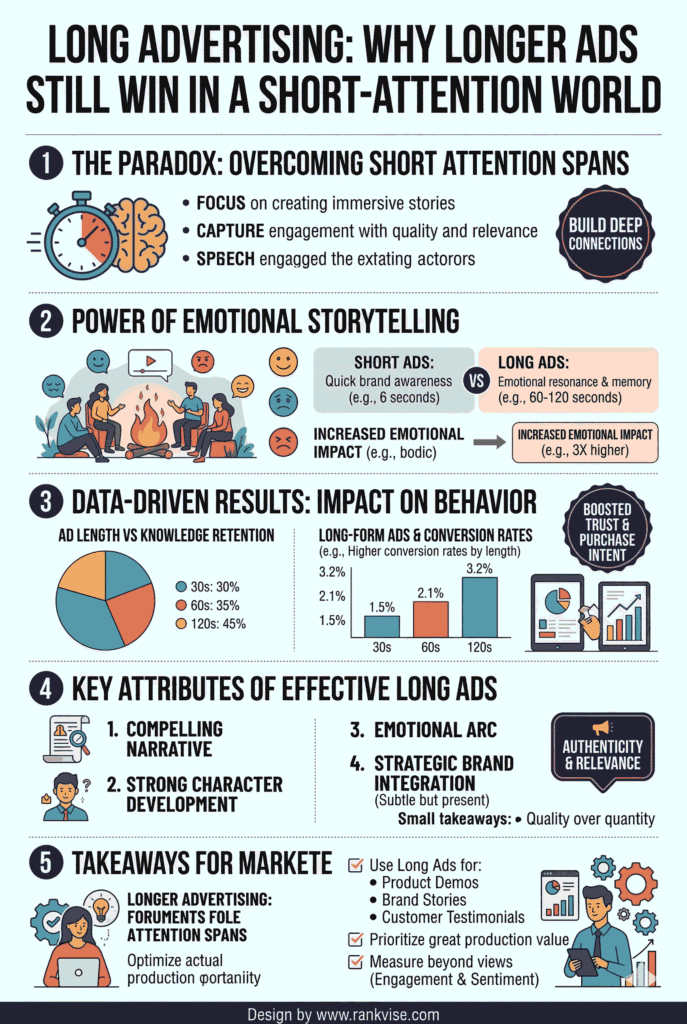
Long advertising refers to any ad format that uses extended content to communicate a message. This includes long copy ads in print or digital, video commercials longer than 60 seconds, detailed landing pages, and narrative-driven brand campaigns.
The format stands in contrast to short-form ads like banner display units, six-second bumpers, and brief social media clips. While short ads aim for quick impressions, long advertising builds understanding, trust, and emotional connection over time.
Think of it this way. A short ad introduces your brand. A long ad convinces someone to buy. Both serve a purpose, but they do very different jobs.
Why Does Long Form Advertising Still Work?
The myth that nobody reads long content has been debunked repeatedly. People do not avoid length. They avoid boredom. If your message is relevant and engaging, audiences will stay with it.
Several factors explain why long advertising continues to deliver strong results.
Complex products need more explanation. A SaaS platform, financial service, or medical device cannot be sold in a six-second clip. Long format marketing gives you room to address objections, demonstrate value, and guide buyers through a decision.
Trust builds through depth. Detailed ad copy signals confidence and expertise. Brands that take the time to explain their offering thoroughly appear more credible than those that rely on vague slogans alone.
Emotional storytelling requires time. The most memorable ad campaigns in history—from Nike’s long-form documentaries to Apple’s cinematic product launches—succeed because they invest in narrative. You cannot tell a meaningful story in five seconds.
Higher purchase intent correlates with longer engagement. Research consistently shows that consumers who spend more time with advertising content convert at higher rates. Long ads naturally filter for serious buyers.
Long Advertising vs Short Advertising: When to Use Each
Choosing between long and short formats is not about preference. It is about strategy. Each format excels in specific situations.
| Factor | Long Advertising | Short Advertising |
|---|---|---|
| Best for | Consideration and conversion stages | Awareness and reach campaigns |
| Audience intent | Warm or high-intent prospects | Cold audiences and new markets |
| Product complexity | High-value or technical products | Simple, impulse-buy products |
| Goal | Educate, persuade, and convert | Grab attention and build recall |
| Platforms | Landing pages, YouTube, email, print | Social feeds, display, pre-roll |
| Content depth | Detailed features, benefits, and proof | Single message or brand impression |
Smart marketers use both. Short ads capture attention and drive traffic. Long advertising closes the sale once the audience arrives.
Key Formats of Long Advertising
Long advertising is not a single format. It spans multiple channels, each with unique strengths and creative demands.
Long Copy Advertising
Long copy ads use extended written content to persuade readers. This format dominated direct response marketing for decades and remains highly effective in digital campaigns today.
Sales pages, advertorials, detailed email sequences, and direct mail letters all fall under this category. The best long copy advertising reads like a conversation. It identifies a problem, agitates the pain, and presents a clear solution with proof.
David Ogilvy, one of advertising’s most respected voices, famously stated that long copy outsells short copy when the product requires explanation. Modern A/B testing confirms this. Landing pages with 1,500 or more words often outperform short pages for high-consideration purchases.
Extended Video Ads
Video ads longer than 60 seconds give brands room to tell complete stories. Platforms like YouTube support ads ranging from two minutes to over ten minutes. Some of the most-shared brand videos in recent years exceed five minutes.
Extended video ads work especially well for brand storytelling campaigns. They combine visuals, music, dialogue, and narrative to create emotional experiences that short clips cannot match. The key is front-loading value so viewers choose to keep watching.
Narrative Brand Campaigns
Some of the most effective long advertising takes the form of multi-part campaigns that unfold over weeks or months. These narrative advertising efforts build anticipation and deepen brand connection through serialized content.
Brands like Patagonia, Dove, and John Lewis have mastered this approach. Each campaign installment adds a new layer to the story. Audiences follow along because they are emotionally invested in the outcome.
Long-Form Advertorials and Sponsored Content
Advertorials blend editorial content with promotional messaging. They appear in magazines, newspapers, and digital publications as detailed articles that inform while subtly selling.
This format thrives because it matches the reader’s expectations. Someone reading an article expects depth and information. A well-written advertorial delivers both while guiding the reader toward a product or service.
How to Create Long Advertising That Holds Attention
Length alone does not equal effectiveness. Poorly executed long ads drive people away faster than no ad at all. Follow these principles to keep your audience engaged throughout.
Lead With a Powerful Hook
Your opening line carries the entire piece. If it fails to grab attention, nothing that follows matters. Start with a bold claim, a surprising statistic, a provocative question, or a relatable scenario.
The best hooks create an open loop in the reader’s mind. They raise a question that demands an answer, pulling the audience deeper into your content.
Structure Content Around the Reader’s Journey
Organize your long ad like a guided conversation. Start with the problem your audience faces. Agitate it by showing the consequences of inaction. Then introduce your solution with clear evidence.
Every section should answer one question the reader naturally asks next. This creates momentum that carries them forward without effort.
Use Proof to Sustain Credibility
Long advertising gives you space to include testimonials, case studies, data points, and demonstrations. Use this advantage. Every claim you make should be supported by evidence within a few sentences.
Real customer stories are particularly powerful. They provide social proof while adding emotional weight that statistics alone cannot deliver.
Break the Monotony With Visual Variety
Even the best writing needs breathing room. In long copy advertising, use subheadings, pull quotes, images, and white space to break up dense text. In long video ads, vary the pacing with scene changes, music shifts, and perspective switches.
Monotony is the real enemy of long advertising, not length.
Close With a Clear Call to Action
After investing time in your content, the audience needs direction. Tell them exactly what to do next. Make the action simple, specific, and connected to the value you have built throughout the piece.
A weak or missing call to action wastes every word and second that came before it.
Real-World Examples of Long Advertising That Delivered Results
Understanding theory is useful. Seeing it in practice is better. These examples show long advertising working across different industries and formats.
Dollar Shave Club’s launch video ran just over 90 seconds but told a complete brand story with humor, personality, and a clear value proposition. It generated 12,000 orders within 48 hours. The extended format allowed the founder to build genuine rapport with viewers.
Patagonia’s “Don’t Buy This Jacket” campaign used long-form advertorials and detailed editorial content to communicate its sustainability mission. The narrative advertising approach increased sales by 30% in the year following the campaign, proving that depth builds buying conviction.
Apple’s product launch events function as long advertising in their purest form. These multi-hour presentations educate, excite, and convert simultaneously. Each product segment uses detailed demonstrations, storytelling, and social proof to justify premium pricing.
Charity: Water’s long-form video campaigns routinely exceed five minutes. They document real stories from communities gaining clean water access. Donors who watch these extended videos contribute at significantly higher rates than those exposed to short clips alone.
Common Mistakes That Ruin Long Advertising
Long format marketing fails when execution breaks down. Avoid these errors to protect your investment.
Being long without being valuable is the cardinal sin. Every paragraph, scene, or slide must earn its place. If a section does not inform, entertain, or persuade, cut it.
Burying the key message deep inside lengthy content frustrates audiences. State your core promise early. Then spend the remaining content proving and reinforcing it.
Ignoring mobile formatting destroys readability. Over 60% of content consumption happens on smartphones. Long copy advertising must use short paragraphs, clear headings, and fast-loading visuals for mobile readers.
Skipping audience research leads to long ads that speak to nobody. Understand your audience’s pain points, desires, and language before writing a single word. Length amplifies relevance, but it also amplifies irrelevance.
Is Long Advertising Right for Your Brand?
Long advertising is not universal. It suits specific scenarios better than others.
Choose long format marketing when your product requires explanation, your audience is already interested, or your goal is conversion rather than awareness. High-ticket items, complex services, and mission-driven brands benefit most from extended content.
Stick with short formats for impulse purchases, broad awareness campaigns, and platforms where users scroll quickly past content. Combine both formats into a funnel where short ads drive attention and long ads drive action.
The most successful brands in 2026 do not pick sides. They use the right length for the right moment in the buyer’s journey.
FAQs
It depends on the goal. Long advertising outperforms short ads for consideration, education, and conversion. Short ads win for quick awareness and broad reach.
Most effective long video ads run between two and five minutes. The key is maintaining value throughout rather than hitting a specific duration.
Yes. Long copy landing pages and sales emails consistently outperform short versions for high-consideration products when the content is relevant and well-structured.
YouTube, email marketing, landing pages, podcasts, and editorial publications are ideal for long format marketing. Each allows extended engagement without platform-imposed time limits.
Lead with a strong hook, structure content around the reader’s journey, use proof and storytelling throughout, and vary the visual or narrative pacing to prevent monotony.