Skip to content
Every email you send ends with a sign off. Most people default to “Best regards” or “Thanks” without a second thought. Those closings are safe, but they are also completely forgettable.
- Use funny sign-offs to stand out and build rapport; they make people remember you.
- Match humor to recipient, email tone, industry, and stakes; reading the room matters.
- Keep sign-offs short, personal, and test them on a colleague before using widely.
- Skip humor for serious news, new contacts, or cross-cultural situations; default to professional closings when unsure.
Funny email sign offs add a spark of personality to your messages. They make people smile, and more importantly, they make people remember you. In a world of overflowing inboxes, that small moment of humour can set you apart.
This guide shares ten genuinely funny email closings you can start using today. It also covers when humour works, when it backfires, and how to match your tone to your audience.
Why Funny Email Sign Offs Actually Work?
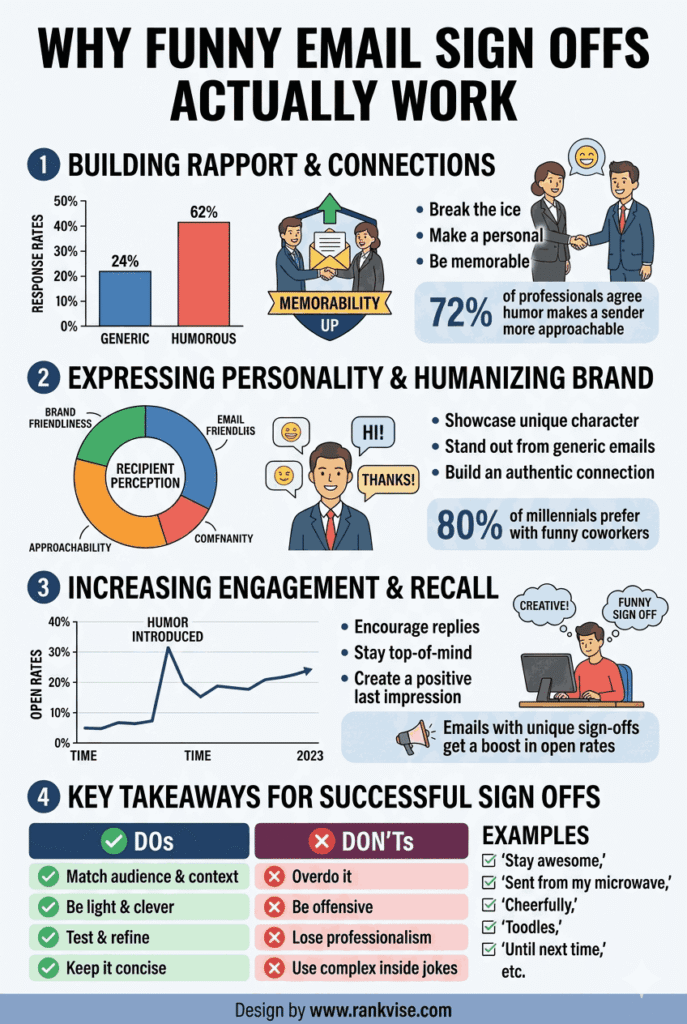
People read dozens, sometimes hundreds, of emails every day. The vast majority blend together. A witty email ending breaks that pattern. It catches the reader off guard in the best possible way.
Humour also builds rapport. A well-placed joke shows confidence and warmth. It signals that you are a real person, not a corporate robot. Research consistently shows that appropriate workplace humour increases likability and trust between colleagues.
Creative email sign offs work especially well in industries where personality matters. Marketing, creative agencies, startups, and sales teams use humour regularly to build stronger relationships through everyday communication.
10 Funny Email Sign Offs You Can Actually Use
Not every humorous closing fits every situation. Some work with close colleagues. Others land well even with clients you know personally. Here are ten options ranked from mildly playful to delightfully unhinged.
1. “May your coffee be strong and your Monday be short.”
This one works on almost any weekday, not just Monday. It is relatable, warm, and universally appreciated. Use it with colleagues, friendly clients, or anyone who has ever needed caffeine to survive a meeting.
2. “Sent from my Samsung Smart Fridge.”
A modern classic. This playful twist on the default “Sent from my iPhone” signature gets a laugh because it is absurd but oddly believable. It works well in casual internal emails and with contacts who appreciate tech humour.
3. “I hope this email finds you before your next meeting does.”
This one resonates with anyone buried in back-to-back calls. It is funny because it is painfully true. Use it with busy colleagues or clients who frequently mention their packed schedules.
4. “Respectfully hitting Send before I overthink this.”
Every professional has agonised over an email for far too long. This sign off names that shared experience out loud. It adds honesty and humour simultaneously. It works particularly well after a longer or more detailed email.
5. “May the inbox odds be ever in your favour.”
A playful nod to pop culture that lands with almost any audience. It acknowledges the universal struggle of email overload without being negative. This humorous email closing works across industries and seniority levels.
6. “Live long and email on.”
Another pop culture reference that works well in tech, creative, and startup environments. It is nerdy enough to make certain audiences smile and mainstream enough to not confuse anyone.
7. “Warm regards (because regular regards felt too cold).”
This one is clever because it plays on the very convention it bends. It shows self-awareness about email etiquette while keeping things light. Use it when you want to be funny without straying too far from professionalism.
8. “Thanks for reading this far. You deserve a snack.”
Simple, charming, and universally relatable. It rewards the reader for their attention in a way that feels genuine. This sign off works best after a longer email where you know the recipient invested real effort in reading.
9. “Digitally yours (but not in a weird way).”
The parenthetical disclaimer is what makes this one work. It takes a slightly formal phrase and undercuts it with self-aware humour. Use it with people who appreciate dry wit and subtle comedy.
10. “I’ll let you get back to pretending to work.”
Bold, playful, and only appropriate with people you know well. This one gets the biggest laughs but carries the most risk. Reserve it for close teammates, friendly vendors, or that one client who always jokes about hating spreadsheets.
When to Use Humorous Email Closings
Humour works best when the relationship supports it. Consider these factors before choosing a funny sign off.
- You know the recipient personally — A witty closing with a colleague you chat with daily feels natural. The same line with a new prospect feels forced.
- The email tone is already casual — If the body of your message is light and conversational, a funny sign off matches. If the email discusses a serious issue, keep the closing straightforward.
- Your industry embraces personality — Creative agencies, media companies, and startups tend to welcome humour. Legal firms, healthcare organisations, and government agencies generally do not.
- The stakes are low — Internal updates, team check-ins, and friendly follow-ups are perfect opportunities. Contract negotiations, complaints, and formal proposals are not.
Reading the room is the single most important skill when using casual email sign offs. When in doubt, save the humour for your next exchange.
When to Skip the Funny Closing
Not every email deserves a punchline. Certain situations demand a more measured tone.
Avoid funny email sign offs when delivering difficult news, responding to a complaint, or writing to someone you have never met. First impressions in professional settings benefit from clarity and warmth, not comedy. You can always introduce humour once the relationship develops.
Cultural context matters too. Humour does not translate equally across all regions and languages. A sign off that lands well in a London office may confuse or offend in a different cultural setting. When communicating internationally, lean toward universally warm closings until you gauge the other person’s style.
How to Create Your Own Witty Email Endings
The best creative email sign offs feel personal. Borrowing from a list is a great starting point, but developing your own signature closing makes a stronger impression.
Start by thinking about what makes your personality or work life distinct. Are you known for your coffee obsession? Your love of spreadsheets? Your inability to keep meetings under 30 minutes? Turn those quirks into one-liners.
Keep it short. The best email closing lines run five to ten words. Anything longer becomes a paragraph, and the humour gets lost. Test your sign off on a trusted colleague before rolling it out widely. If they genuinely laugh, you have a winner.
Funny Sign Offs vs. Professional Closings: Finding the Balance
You do not have to choose one approach forever. The smartest communicators switch between professional and humorous closings depending on the context.
| Situation | Recommended Closing Style |
|---|---|
| First email to a new client | Professional and warm |
| Weekly team update | Playful or humorous |
| Follow-up after a sales call | Friendly but polished |
| Internal Slack-style email chain | Funny and casual |
| Formal proposal or contract | Strictly professional |
| Reply to a colleague you know well | Humorous or creative |
Matching your sign off to the moment shows emotional intelligence. It tells the reader that you pay attention to context, which builds trust over time.
Best Practices for Email Sign Offs in General
Whether you go funny or formal, a few universal rules apply to every email closing.
- Always include your name — Even in casual threads, a sign off without a name feels incomplete and abrupt.
- Keep it consistent within a thread — If you started a conversation with “Best regards,” switching to “Later, alligator” in the third reply feels jarring.
- Match the energy of the conversation — If the other person is formal, mirror that. If they crack a joke, feel free to match their tone.
- Avoid anything that could be misread — Sarcasm rarely translates well in writing. If a sign off requires context or vocal tone to be funny, skip it.
FAQs
Yes, when used with the right audience. Casual team emails and messages to familiar contacts welcome humour. Formal or first-time communications should stay professional.
“May your coffee be strong and your Monday be short” works with almost any colleague. It is universally relatable and carries zero risk of misinterpretation.
Only with clients you have an established, friendly relationship with. Read their communication style first and match their level of formality before adding humour.
Light humour like “Thanks for reading this far — you deserve a snack” adds personality without undermining credibility. Avoid anything too casual until the relationship develops.
If you hesitate before hitting Send, tone it down. Test new sign offs with a trusted colleague first. If they cringe instead of laugh, choose a safer option.