Most founding member launches fail on structure before they fail on copy.
- Make the founding offer about price certainty, founder access, and visible status, not a permanent discount.
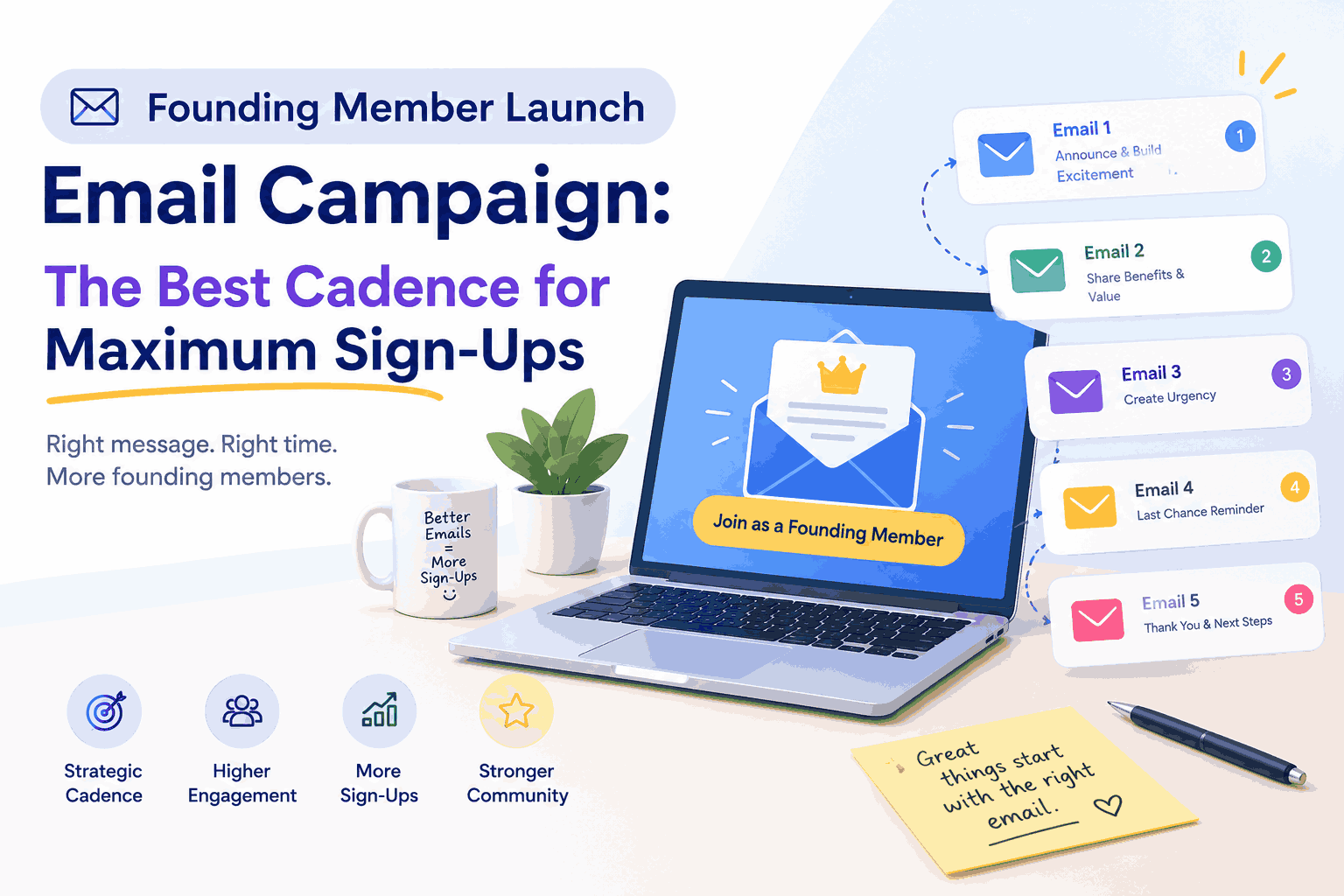
- Plan the sequence backward from the close using three windows and roughly ten emails over about 17 days.
- Honor the close: do not extend deadlines; keeping them real preserves future conversion.
- Use the final 48 hours for your strongest reasoning and segment those emails by user behavior for higher conversion.
The two common errors: treating the founding offer as a discount, and building the email sequence forward from launch day. Both feel natural and both cost sign-ups.
Here is a cadence that works, and the reasoning behind each decision.
A Founding Member Offer Is Not a Discount
If your founding tier is “20% off forever,” you have permanently reduced margin on your best customers in exchange for a temporary conversion bump.
The stronger structure trades three things people cannot get later:
- Price certainty. Locked pricing rather than a discount off an unproven number. The frame is protection from future increases, not cheapness.
- Influence. Direct access to the founder, roadmap input, a private channel. This is the part people actually value and the part most launches leave out.
- Status. Visible recognition — a badge, a listing, being named in the product. Free to give, genuinely motivating.
Founding members are buying early on incomplete evidence. What you owe them in return is access and certainty, not primarily a lower number.
Where discounting is part of the offer, published guidance suggests 10 to 20% below intended pricing is the useful range — enough to motivate action without anchoring your product as cheap.
Three Things to Fix Before Writing Emails
A real close date. Founding cohorts must actually close. This matters more than any copy decision, and the reason is covered below.
A cohort size, if you can. Batched or capped access creates genuine scarcity rather than manufactured urgency. The pattern that worked for large consumer launches — a clear promise plus access granted in batches — works at small scale too.
Published expectations. Say what founding members get, when access begins, and what happens after the window closes. Ambiguity at this stage is the main source of refund requests later.
The Three-Window Structure
Build backwards from the close, not forwards from the open.
| Window | Duration | Emails | Job |
|---|---|---|---|
| Warm-up | 7–10 days before open | 3 | Establish the problem and pre-announce |
| Open | 5–7 days | 4 | Present the offer and handle objections |
| Close | Final 48 hours | 3 | Convert the undecided |
Ten emails over roughly seventeen days. That feels like a lot until you consider that most of your list will see three or four of them.
The Cadence
Warm-up
Email 1 — Day −10: The problem. No offer, no link, no mention of a launch. Name the problem your product solves in the reader’s language. The job is establishing that you understand the situation before you ask for anything.
Email 2 — Day −6: The proof. Something genuinely useful — a small insight, a piece of your own data, a quick win they can implement in five minutes. Demonstrating usefulness for free is what makes the paid version credible.
Email 3 — Day −2: The heads-up. Now tell them. What is opening, when, what founding members get, and how long the window runs. No link yet. This email exists so the open email is not a surprise.
Open
Email 4 — Day 0: Open. State the offer and give the link within the first hundred words. Do not bury it under six paragraphs of narrative — the people most likely to buy are already waiting for it. Explain the founding member terms plainly, then stop.
Email 5 — Day 1: What it includes, and who it is not for. Detail the offer. Then explicitly name who should not join. Disqualifying people increases conversion among the right ones and reduces refunds substantially.
Email 6 — Day 3: Objections. Answer the three questions people are actually stuck on — usually price justification, time commitment, and whether it works for their specific situation. FAQ format is fine here; clarity beats craft.
Email 7 — Day 4: Proof. Who has joined and why, in their words if you have it. If this is a genuine first cohort with no customers yet, use your own credentials and process instead — do not fabricate social proof.
Close
Email 8 — Day 5: 48 hours. Focus on what changes when the window shuts. Not “prices go up” alone, but the access, the cohort, the specific terms that will not return.
Email 9 — Day 6: 24 hours. Segment this one. Short, direct, one link.
Email 10 — Day 7: Final hours. Under 100 words. One link. Sent in the morning of the close day, with the deadline stated in a specific timezone.
After the close
Email 11 — Day 8: It’s closed. Thank the founding cohort publicly, share the numbers if they are good, and offer a waitlist for the next opening at regular pricing.
This email does more work than people expect. It proves the deadline was real, which is what makes your next launch credible.
Most Conversions Land in the Final 48 Hours
This is the pattern across most time-bound offers, and it has two implications.
Do not front-load your best material. Many sequences spend their strongest arguments in the open email, then coast. The close window needs the clearest reasoning, not the leftovers.
Do not shorten the close. A single “last chance” email is not a close window. The people who buy on day seven are not procrastinators — they are the ones who needed more time to decide, and they are usually your most considered customers.
Segment the Final Three Emails
More emails is not the lever. Better-targeted final emails is.
- Clicked the sales page, did not buy — the highest-intent group. Address the specific objection you think stopped them.
- Opened, never clicked — the offer has not landed. Restate it differently rather than repeating it louder.
- Never opened anything — send a different subject line, at a different time of day. Treat this as a reach problem, not a persuasion one.
- Already bought — suppress immediately.
That last one is skipped constantly and does real damage. Nothing sours a new founding member faster than three urgency emails about an offer they already paid for.
The Close Has to Be Real
If your founding window quietly stays open, or the price never actually rises, you have taught your list that your deadlines are decorative.
That cost is not confined to this launch. Every future campaign you run to the same list will convert worse, and the people who bought on day seven — your most deadline-responsive customers — will not do so again.
Audiences are unusually well-calibrated on this now. They have seen every countdown timer and every extended deadline. Honouring the close is a genuine differentiator, and the only way to earn it is to lose the sale you could have had by extending.
What to Measure
- Conversion rate by window, not just overall. It tells you which phase to fix.
- Click-to-purchase rate, which isolates whether the problem is the email or the sales page.
- Unsubscribes per email, watching for the point where cadence tips into irritation.
- Percentage of purchases in the final 48 hours, which sets your expectations for next time.
- Refund and churn rate among founding members, the real measure of whether you sold to the right people.
Common Mistakes
- Running the founding offer as a discount only, which cuts margin permanently on your best customers.
- No warm-up. Opening cold to a list that has not heard from you in months converts badly.
- Burying the link. The buyers are already convinced; make it easy for them.
- Skipping the close window or compressing it into one email.
- Failing to suppress purchasers.
- Extending the deadline, which is the single most expensive mistake on this list.
- No post-close email, wasting the moment when the deadline’s reality is most visible.
Final Thoughts
The cadence matters less than two decisions that precede it: what founding membership actually gives people, and whether the window genuinely closes.
Get those right and a straightforward ten-email sequence built backwards from the close date will outperform a more elaborate one built forwards from launch day. Get them wrong and no amount of email craft compensates.
FAQs
How many emails should a founding member launch include?
Around ten across three windows — three in warm-up, four during the open period, and three in the final 48 hours.
How long should the founding member window stay open?
Five to seven days works for most launches. Long enough for people to decide, short enough that the deadline retains force.
Should founding members get a discount?
Price certainty and access matter more than a discount. Where you do discount, 10 to 20% below intended pricing is the commonly cited range.
When do most sign-ups happen?
Overwhelmingly in the final 48 hours, which is why the close window needs your strongest reasoning rather than your leftovers.
Can I extend the deadline if sign-ups are low?
You can, and it will cost you more than the extra sales are worth. Extending teaches your list that future deadlines are negotiable.