Skip to content
The interview went well. You answered every question confidently. But now comes the part most candidates fumble. The follow up email after an interview can make or break your candidacy.
- Send your thank you email within 24 hours; same-day evening or next morning is ideal.
- Include five essentials: clear subject line, genuine thanks, a specific interview detail, brief reinforcement of fit, and a professional closing.
- Keep emails concise, 100 to 200 words, recruiters skim; respect their time while highlighting your key message.
- Personalize your note by referencing a specific conversation moment and mirror the interviewer's tone and communication style.
- Avoid common mistakes: no generic copy-paste, limit follow-ups to two, proofread, and use a professional email address.
Research shows that nearly 80% of hiring managers consider thank you emails when evaluating candidates. Yet roughly half of all applicants never send one. That gap creates a massive opportunity for you.
This guide gives you 10 ready-to-use follow up email examples. Each one covers a different interview scenario. Pick the one that fits your situation, personalize it, and send it within 24 hours.
Why a Follow Up Email After an Interview Matters?
A post-interview follow up is not just polite. It is strategic. Hiring managers often compare equally qualified candidates. Your email becomes the tiebreaker that tips the decision in your favor.
The follow up accomplishes several goals at once. It reinforces your interest in the role. It reminds the interviewer of your strengths. It demonstrates professionalism and attention to detail. And it keeps your name fresh in their mind during deliberation.
Skipping this step signals indifference. In competitive job markets, indifference costs offers.
When Should You Send a Follow Up Email?
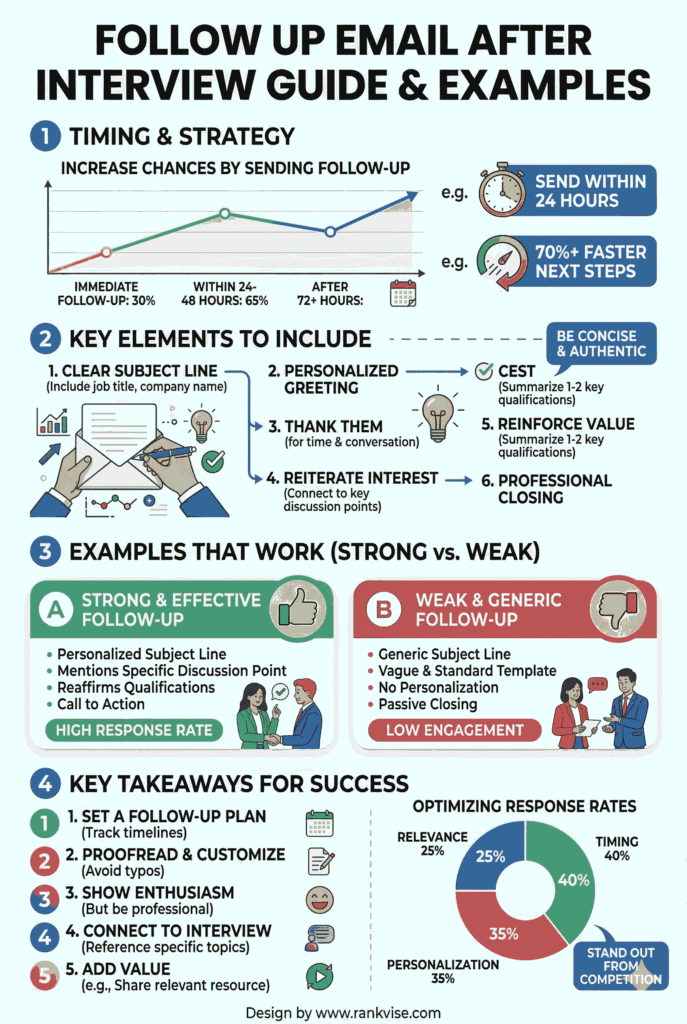
Timing matters almost as much as content. Send your thank you email after the interview within 24 hours. Same-day emails sent in the evening or next morning hit the sweet spot.
Waiting longer than 48 hours weakens the impact significantly. By then, the hiring team may have already formed impressions and moved forward with other candidates.
If you interviewed on a Friday, send your email that evening or Saturday morning. Do not wait until Monday. Hiring managers often review candidates over the weekend.
What Every Follow Up Email Needs
Before diving into examples, understand the five essential components every interview follow up template should include:
- A clear subject line that references the position and your name
- A genuine thank you for the interviewer’s time and the opportunity
- A specific detail from the conversation that personalizes the message
- A brief reinforcement of why you are the right fit for the role
- A professional closing that expresses enthusiasm for next steps
Keep the email between 100 and 200 words. Hiring managers skim quickly. Respect their time while making your case.
10 Follow Up Email After Interview Examples
1. The Classic Thank You Email
Best for: Standard first-round interviews
Subject: Thank You – [Job Title] Interview
Hi [Interviewer’s Name],
Thank you for taking the time to speak with me today about the [Job Title] position. I enjoyed learning about your team’s approach to [specific project or topic discussed].
Our conversation reinforced my excitement about this opportunity. My experience in [relevant skill] aligns well with the goals you described for this role.
I look forward to hearing about the next steps. Please do not hesitate to reach out if you need any additional information.
Best regards, [Your Name]
2. The Value-Add Follow Up
Best for: When you want to reinforce expertise
Subject: Great Speaking With You – [Job Title] Role
Hi [Interviewer’s Name],
Thank you for the insightful conversation about [Job Title] today. After learning more about [specific challenge mentioned], I wanted to share a brief thought.
In my previous role at [Company], I tackled a similar challenge by [brief solution]. I would love the opportunity to bring that same approach to your team.
Thank you again for considering my application. I am excited about the possibility of contributing to [Company Name].
Warm regards, [Your Name]
3. The Post-Panel Interview Email
Best for: After interviewing with multiple people
Subject: Thank You – [Job Title] Panel Interview
Hi [Lead Interviewer’s Name],
Thank you to you and the entire team for such a thorough and engaging conversation today. I appreciated hearing each person’s perspective on the [department/team] goals.
[Interviewer 2’s Name]’s insights on [topic] were especially interesting. I believe my background in [relevant experience] would complement the team’s direction.
Would you kindly extend my thanks to everyone who participated? I am eager to explore how I can contribute.
Best, [Your Name]
4. The Second Interview Follow Up
Best for: After advancing to a later interview round
Subject: Grateful for the Second Conversation – [Job Title]
Hi [Interviewer’s Name],
Thank you for inviting me back for a second interview. The deeper dive into [specific responsibility or project] gave me a much clearer picture of the role.
I am even more confident that my experience in [skill or achievement] positions me to deliver results quickly. The team culture you described genuinely resonates with how I work best.
I am very enthusiastic about this opportunity and look forward to hearing from you.
Best regards, [Your Name]
5. The Short and Simple Follow Up
Best for: Brief or informal interviews
Subject: Thank You – [Job Title] Discussion
Hi [Interviewer’s Name],
Thank you for your time today. I enjoyed our conversation about the [Job Title] role and learning more about [Company Name].
I am excited about the opportunity and confident I can contribute meaningfully. Please let me know if there is anything else you need from my end.
Thanks again, [Your Name]
6. The Phone Interview Follow Up
Best for: After an initial phone screening
Subject: Thank You for the Phone Call – [Job Title]
Hi [Interviewer’s Name],
Thank you for the phone conversation today about the [Job Title] position. Even in a brief call, I could sense the energy and ambition behind your team’s mission.
I am very interested in moving forward and would welcome the chance to discuss my qualifications further in person or over video.
Looking forward to the next steps.
Best, [Your Name]
7. The Video Interview Follow Up
Best for: After remote or virtual interviews
Subject: Thank You – [Job Title] Virtual Interview
Hi [Interviewer’s Name],
Thank you for the virtual meeting today. Despite the screen between us, I felt a genuine connection to your team’s vision for [project or initiative discussed].
I am particularly drawn to [specific aspect of the role]. My work on [relevant accomplishment] prepared me well for exactly this kind of challenge.
I appreciate your time and look forward to hearing what comes next.
Warm regards, [Your Name]
8. The Referral-Based Follow Up
Best for: When a connection referred you to the role
Subject: Thank You – [Job Title] Conversation
Hi [Interviewer’s Name],
Thank you for meeting with me today to discuss the [Job Title] role. I am grateful that [Referrer’s Name] connected us, and our conversation confirmed why they spoke so highly of [Company Name].
The work your team is doing in [area discussed] excites me. I would love to bring my [specific skill] experience to support those efforts.
Thank you for your consideration. I hope to speak again soon.
Best regards, [Your Name]
9. The Follow Up When You Forgot Something
Best for: When you want to add a point you missed during the interview
Subject: One More Thought – [Job Title] Interview
Hi [Interviewer’s Name],
Thank you again for today’s conversation. After reflecting on our discussion about [specific topic], I realized I did not mention a relevant experience.
At [Previous Company], I [brief achievement or project that directly addresses a need they mentioned]. I believe this background adds to what I can bring to your team immediately.
I appreciate your time and remain very interested in this opportunity.
Best, [Your Name]
10. The “No Response Yet” Gentle Nudge
Best for: Following up a week or more after no reply
Subject: Checking In – [Job Title] Application
Hi [Interviewer’s Name],
I hope you are doing well. I wanted to follow up on our conversation from [date] about the [Job Title] role. I remain very interested in the position and would love to know if there are any updates on the hiring timeline.
I understand these decisions take time. Please let me know if I can provide any additional information to support the process.
Thank you for your consideration.
Best regards, [Your Name]
Common Mistakes to Avoid in Interview Follow Up Emails
Even well-intentioned emails can backfire. Watch out for these pitfalls that undermine your candidacy.
Sending a generic copy-paste message that mentions nothing specific from your conversation signals laziness. Hiring managers spot templates instantly. Always reference at least one unique detail from your interview.
Writing an essay overwhelms busy recruiters. Keep your thank you note after the interview concise. Anything over 200 words risks losing the reader before your key message lands.
Following up too aggressively damages your impression. One thank you email plus one gentle follow up after a week is the maximum. Sending three or four messages feels desperate.
Using an unprofessional email address undermines everything else. Send from an address that includes your real name. Retire the novelty email from college before your job search begins.
Forgetting to proofread creates doubt about your attention to detail. One typo in a short email stands out harshly. Read your message twice before hitting send.
How to Personalize Your Follow Up for Maximum Impact
Templates save time. Personalization wins offers. The best interview follow up emails blend both.
Reference a specific moment from the conversation. Maybe the hiring manager mentioned a new product launch. Perhaps they shared a challenge their team faces. Tie your skills directly to that detail.
Mirror the interviewer’s communication style. If they were formal, keep your tone polished. If they were casual and friendly, match that energy while staying professional.
Research the company’s recent news before writing. Mentioning a recent achievement or announcement shows genuine interest that goes beyond the job listing.
Should You Follow Up by Email or Handwritten Note?
Email is the standard for virtually all industries in 2026. It arrives instantly, is easy to forward to other decision-makers, and fits the pace of modern hiring.
Handwritten notes add a memorable touch for senior-level roles or traditional industries. However, mail delivery times mean your note may arrive after the decision is already made.
The safest approach is to send an email within 24 hours. If you want to stand out further, mail a handwritten card as a bonus. Never rely on a physical note as your only follow up.
FAQs
Keep it between 100 and 200 words. Hiring managers prefer concise messages that express gratitude, reference a specific conversation detail, and reinforce your fit.
Absolutely. Phone screenings deserve the same follow up as in-person meetings. A brief thank you email reinforces your interest and keeps you top of mind.
Use a clear format like “Thank You – [Job Title] Interview.” This helps the hiring manager locate your email quickly among dozens of daily messages.
Send one thank you email within 24 hours and one polite check-in after seven to ten business days. Beyond that, wait for the employer to contact you.
Yes. Hiring managers frequently cite follow up emails as a deciding factor between equally qualified candidates. A thoughtful message demonstrates professionalism and genuine enthusiasm.