Skip to content
Writing Facebook ad copy that converts isn’t about tricks or hacks. It’s about understanding your audience and communicating value clearly. The social media landscape has evolved dramatically, and so have user expectations. Today’s Facebook users scroll faster, filter more aggressively, and demand authenticity from brands. Your ad copy needs to cut through the noise immediately, or it gets lost in an endless stream of content competing for attention.
The most successful advertisers approach Facebook ad copy as a conversation, not a broadcast. They speak directly to specific pain points, offer genuine solutions, and make it easy for people to take the next step. Whether you’re launching a new campaign or optimizing existing ads, the principles and strategies outlined here will help you create copy that resonates with your target audience and drives meaningful results.
What Makes Facebook Ad Copy Effective in 2026
Facebook advertising changed significantly with Meta’s shift toward AI-driven delivery. Previously, advertisers relied heavily on manual interest and behavior targeting. Now, the platform increasingly uses your creativity and copy itself to determine who sees your ads.
This means your ad copy and visuals must be clear enough for the algorithm to understand your offer and match it with the right audience automatically.
The platform also discourages repetitive creativity. Running the same visual with only minor text changes is far less effective than it used to be. Instead, advertisers need genuinely different messaging angles rather than slight headline tweaks.
While performance benchmarks vary by industry, the broader takeaway remains consistent: strong creative and copy matter more than ever, especially as competition for attention continues to rise.
Understanding the Components
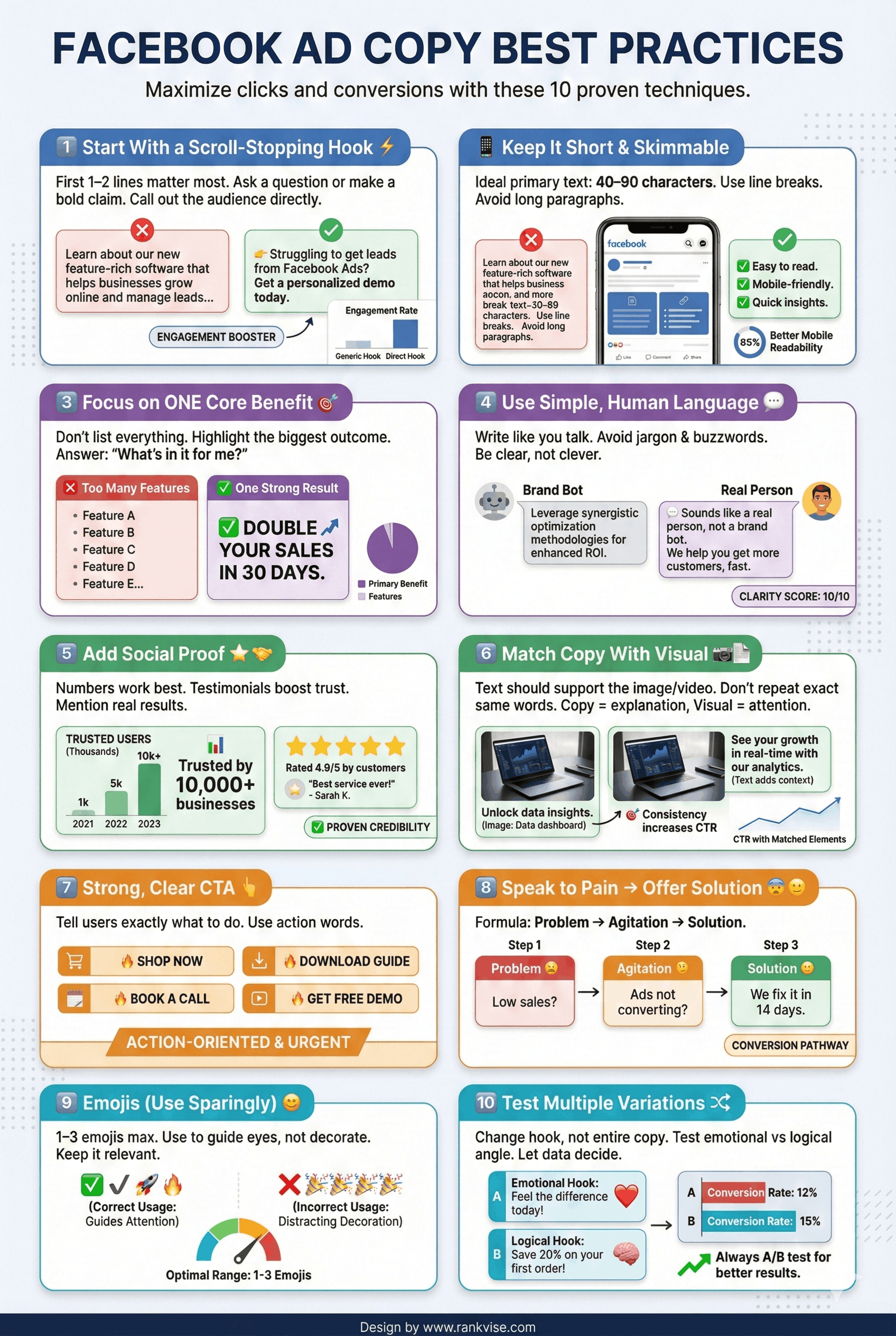
Facebook ads consist of several distinct components that work together to deliver your message. Understanding how each element functions (and how they interact) is essential for creating high-performing campaigns.
Primary Text: Your Main Message
The primary text appears above your ad creative and carries the bulk of your messaging weight. This is where you articulate your value proposition and connect with your audience’s needs.
Strong primary text focuses on benefits rather than features, clearly explaining how your product or service improves someone’s life or solves a specific problem.
Action verbs create momentum. Instead of passive descriptions, use language that suggests movement and progress. Questions can work well too, especially when they touch on concerns your audience actually has.
Headline: Capturing Attention
Your headline acts as a hook that pulls people from scrolling to reading. It needs to be immediately intriguing while remaining relevant to what you’re offering.
Powerful headlines often leverage curiosity, address pain points directly, or promise a specific benefit.
Keep headlines tight and impactful. The headline should work with your creative to stop the scroll and encourage people to engage with your primary text.
Description and CTA: Supporting Your Offer
The description field provides additional context that reinforces your primary message. This is where you can address potential objections, add credibility signals, or expand on the value proposition.
Your call to action guides users toward the next step; make it crystal clear what you want them to do and why they should do it now.
Think of your ad components as parts of a single conversation. The headline grabs attention, the primary text makes your case, and the description closes the deal.
Real-World Performance: What Actually Works
A sustainable fashion brand demonstrated the power of authentic content over polished production. They shifted from heavily produced lifestyle imagery to more organic-looking creative, and saw meaningful improvements in acquisition efficiency and retention.
The B2B sector has seen similar success with problem-focused messaging. A SaaS platform that emphasized pain points and education rather than direct demos achieved stronger lead quality and better funnel performance.
User-generated content also remains one of the most reliable creative formats for lead generation. Relatable, authentic messaging often outperforms overly polished or influencer-style ads because it feels more trustworthy.
Core Principles That Drive Conversions
Addressing Pain Points and Desires
People make purchases to either solve problems or achieve goals. Your ad copy should speak directly to these motivations.
When you demonstrate genuine understanding of what your audience struggles with, they’re more likely to see you as a credible solution provider.
Highlighting aspirations can be equally powerful. When people see your offering as a path to something they want, they become emotionally invested in taking action.
Social Proof and Strategic Specificity
Humans look to others when making decisions. Incorporating credibility signals can dramatically improve ad performance, whether mentioning customer outcomes, notable results, or industry recognition.
However, subtlety matters. These elements should feel naturally woven into your narrative rather than forced.
Specific claims tend to carry more weight than vague promises because they give people clearer expectations.
Creating Urgency Without Being Pushy
Urgency motivates action, but aggressive tactics often backfire.
The goal is to give people a legitimate reason to act now rather than later. Limited-time offers or exclusive deals work best when they’re genuine.
False urgency erodes trust and damages your brand’s reputation. The most effective urgency tactics feel helpful rather than manipulative.
Testing and Optimizing Your Facebook Ad Copy
Continuous improvement separates good advertisers from great ones. Systematic testing helps you understand what resonates with your audience and what falls flat.
Strategic Use of Emojis and Formatting
Emojis add visual interest and can help your ads stand out in crowded feeds. Used strategically, they convey emotion and personality while making text more scannable.
However, overuse dilutes their impact and can make your brand appear unprofessional. Select emojis that align with your message and brand voice, using them to emphasize key points rather than decorating every sentence.
Formatting techniques improve readability dramatically. Line breaks separate ideas and prevent dense text blocks that intimidate readers. Strategic spacing guides the eye through your message naturally.
If you’re experimenting with new messaging angles or want a faster way to generate fresh variations, tools like HOLO AI’s Facebook Ad Maker can be a helpful starting point for creating copy ideas while still keeping your brand voice consistent.
Setting Up Effective A/B Tests
A/B testing removes guesswork from optimization. Create variations that differ in one key element: headline, call to action, or primary text angle.
This controlled approach lets you isolate what actually drives performance improvements. Start with high-impact variables before testing minor details.
Give tests adequate time and traffic to reach meaningful conclusions. Premature decisions based on limited data often lead to poor optimization choices.
Reading the Data: When to Scale or Kill
Monitor key metrics like click-through rates, conversion rates, and cost per acquisition to gauge ad performance.
Strong performers deserve increased budget allocation, while consistently underperforming ads should be paused or reworked.
Look for patterns across multiple campaigns; sometimes insights from one test inform strategies across your entire advertising approach.
Proven Strategies
Write for Specific Audience Segments
Audience segmentation allows you to craft messages that speak directly to different groups.
Understanding the unique motivations, pain points, and communication preferences of each segment lets you create a copy that feels personally relevant.
Using your audience’s language rather than internal jargon makes your ads more relatable.
Lead with Value, Not Features
Features describe what your product does. Value explains why that matters.
Leading with value connects your offering to tangible improvements in someone’s life.
Instead of listing specifications, articulate the outcomes people care about. Think about the transformation you enable.
Use Clear, Action-Oriented CTAs
Ambiguous calls to action create friction and reduce conversions.
Tell people exactly what you want them to do using direct, active language. Match your CTA to where users are in their journey.
Someone ready to buy needs a different prompt than someone just learning about your brand.
Match Ad Copy to Landing Page Experience
Consistency between your ad and landing page is crucial for maintaining trust.
When someone clicks your ad expecting one thing and lands on a page that delivers something different, they bounce.
Your landing page should pick up where your ad leaves off, reinforcing the same message and delivering on the promises made.
Optimize Copy Length for Your Goal
Copy length should match your campaign objective.
Awareness campaigns often work well with shorter, punchier copy. Conversion campaigns may benefit from longer copy that addresses objections.
Every sentence should earn its place.
Advanced Copywriting Techniques
The Problem-Agitate-Solution Framework
This classic framework remains effective because it mirrors how people naturally think about purchases.
Start by identifying a problem your audience faces. Agitate that problem by exploring its consequences. Then present your product or service as the solution.
The key is authenticity. Overly dramatic agitation feels manipulative.
Storytelling in Short Form
Stories engage people in ways that facts alone cannot.
Even within the constraints of Facebook ad copy, you can craft brief narratives that illustrate your value proposition.
A customer success story or relatable struggle can humanize your brand and make your message more memorable.
Navigating 2026’s Algorithm Changes
Meta’s AI-driven delivery has enabled simplified campaign structures. Many advertisers now consolidate efforts rather than running overly segmented campaigns.
However, this simplification demands higher-quality creative input.
Focus on creating fundamentally different psychological angles: pain points, pleasure, testimonials, curiosity, and direct questions.
Creative refresh cycles have become stricter, meaning advertisers must continuously bring new ideas into rotation.
Meta is also expanding automated ad features, which makes it even more important for copywriters to provide strong source messaging and strategic direction.
Common Mistakes to Avoid
Overly complex language alienates potential customers. Clear, simple language almost always outperforms complicated explanations.
Vague messaging fails to communicate value. Tell people exactly what you offer and why it matters.
Missing or unclear calls to action leave people unsure what to do next.
Inconsistency between ad copy and landing pages creates distrust.
Ignoring audience segmentation wastes budget. Tailored messages consistently outperform one-size-fits-all approaches.
Putting It All Together
Creating consistently effective Facebook ad copy requires a systematic approach.
Start by deeply understanding your target audience’s pain points, desires, and decision-making process.
Use this foundation to craft primary text that addresses their needs directly, headlines that capture attention, and descriptions that reinforce your value proposition.
Test systematically to identify what resonates with your specific audience. Competition for attention is fierce, so don’t assume strategies will work without validation.
Remember that great ad copy serves your audience first and your business second. When you focus on genuinely helping people solve problems or achieve goals, the commercial results tend to follow naturally.
FAQs
Clear, audience-focused messaging is paramount, as Meta’s AI relies heavily on your copy and creative to determine the right audience.
Optimize length based on your goal; shorter copy works for awareness, while longer copy is effective for conversion campaigns where you need to address objections.
Yes, use them strategically to add visual interest and personality, but avoid overuse to maintain a professional appearance.
It’s a classic copywriting technique where you identify an audience problem, emphasize its impact, and then present your product as the clear solution.
Consistency is crucial for trust; a mismatch causes users to bounce immediately and severely reduces conversion rates.