Skip to content
The office is no longer a building. It is a browser tab, a phone screen, or a tablet on a factory floor. That shift created a massive challenge for businesses everywhere: how do you give every employee instant access to the data, tools, and workflows they need, regardless of location?
- Cloud-native, mobile-first dashboards unify HR, payroll, scheduling into one self-service interface, reducing process friction and single-login complexity.
- Embed security into architecture with MFA, SSO, encryption, and role-based permissions to protect data without degrading user experience.
- Design for the least technical user first and prioritize mobile UX so frontline and office staff adopt the same platform easily.
- Real-time data and unified reporting accelerate operational decisions, boost productivity, lower support costs, and enable proactive workforce management.
The answer is a concept gaining serious traction across industries, known as dashboard anywhere. It represents a new approach to enterprise platforms where employees interact with payroll, scheduling, performance metrics, and HR services from any device, at any time, without friction.
This is not just a technology upgrade. It is a fundamental rethinking of how companies operate in a distributed world.
What Does Dashboard Anywhere Actually Mean?
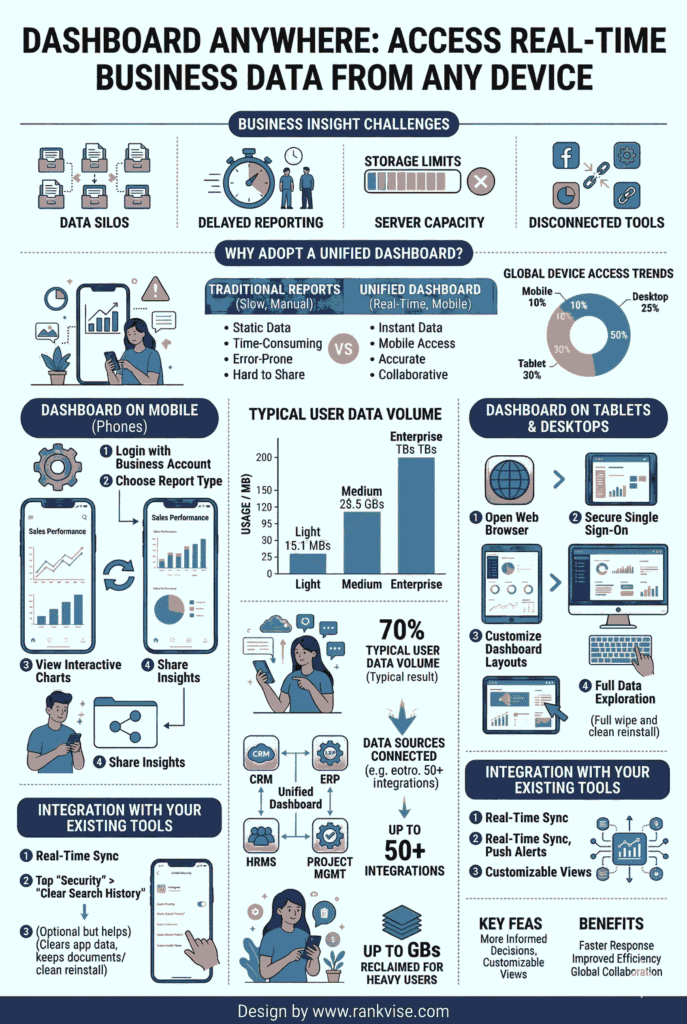
Dashboard anywhere refers to cloud-based platforms that centralize workforce tools into a single, accessible interface. Employees log in from a laptop, phone, or shared terminal and reach everything they need in one place.
Think of it as a digital command center for the modern worker. Instead of toggling between five different systems for payroll, benefits, scheduling, and company updates, a dashboard anywhere solution unifies all of it.
The core principles behind this approach include real-time data access across devices, role-based views that adapt to each user, mobile-first responsive design, and enterprise-grade security that travels with the user. These are not theoretical ideals. Companies are already building platforms around them.
Why Businesses Are Moving Toward Remote Dashboard Access
Remote and hybrid work is no longer a temporary experiment. According to Zscaler security cloud data, remote user traffic has settled at roughly 49% as of mid-2025, up from around 20% before the pandemic. That is a permanent structural change.
This shift means businesses cannot rely on on-premise portals or VPN-dependent tools. Employees expect the same seamless experience they get from consumer apps. If checking a pay stub requires three logins and a desktop computer, adoption drops fast.
A well-designed cloud-based dashboard solves this by meeting employees where they already are. Field workers check schedules on their phones. Office staff review reports on laptops. Retirees access benefits from home. Everyone uses the same system.
FCA’s Dashboard Anywhere: A Real-World Case Study
One of the strongest examples of this philosophy in action comes from the automotive sector. FCA, now part of Stellantis, built an employee self-service portal called Dashboard Anywhere that serves as a blueprint for inclusive enterprise design.
What makes this platform remarkable is its audience. It was not designed solely for knowledge workers sitting at desks. FCA needed a system that connected blue-collar plant workers and white-collar office staff through one digital environment.
Key Capabilities of the FCA Platform
The platform delivers a wide range of workforce management features through a single login.
- Payroll and tax document access, including W-2s, overtime tracking, and bonus details
- Benefits enrollment and management for health, dental, vision, retirement, and life insurance
- Real-time scheduling with shift swap coordination and time-off requests
- Document storage covering employment contracts, safety certifications, and policy handbooks
- Company-wide communications, wellness programs, and career development updates
- Automotive-specific tools like employee vehicle purchase programs and order tracking
This level of integration turns the portal from a simple HR tool into a genuine workforce management platform. Employees handle tasks that once required phone calls to HR in under a minute.
How Access and Security Work Together
FCA’s system uses multi-factor authentication, single sign-on integration, and session timeout controls. Employees access the portal through a primary URL using their employee ID and password. Password recovery is self-service, reducing IT support tickets significantly.
The security model proves an important point. Strong protection does not have to mean poor user experience. When security is built into the design from the start, it feels invisible to the end user.
Five Design Principles Behind Effective Dashboard Anywhere Platforms
FCA’s success is not accidental. It follows design principles that any organization can replicate when building a mobile dashboard solution.
- Design for the least technical user first. If a factory worker with limited tech experience can navigate the platform without training, everyone else will find it intuitive. Simplicity scales upward far better than complexity scales downward.
- Build for mobile before desktop. More than half of enterprise portal interactions now happen on mobile devices. Responsive design is not optional. It is the foundation.
- Unify data into a single source of truth. Employees should never wonder which system has the correct information. One login, one dashboard, one answer.
- Embed security into the architecture. Bolt-on security creates friction. Native multi-factor authentication, encryption in transit, and role-based permissions protect data without slowing users down.
- Customize for industry-specific needs. Generic portals miss critical workflows. FCA’s vehicle program management is a perfect example. Your industry likely has equivalent specialized processes that belong inside the dashboard.
Comparing Dashboard Anywhere to Traditional Enterprise Portals
Traditional employee portals were built for a different era. They assumed desktop access, office hours, and a relatively uniform workforce. Modern dashboard anywhere platforms break all three assumptions.
| Feature | Traditional Portals | Dashboard Anywhere Platforms |
|---|---|---|
| Device access | Desktop only | Any device, fully responsive |
| Availability | Business hours | 24/7 global access |
| User diversity | One-size-fits-all | Role-based, multi-language |
| Security model | VPN-dependent | Cloud-native, MFA-enabled |
| HR integration | Partial, siloed | Comprehensive, unified |
| Scalability | Limited concurrent users | Thousands of simultaneous sessions |
The difference is not subtle. Organizations still running legacy portals face higher support costs, lower adoption rates, and frustrated employees who compare the experience unfavorably to consumer-grade apps.
How Real-Time Data Access Improves Decision Making
Dashboard anywhere platforms do more than convenience. They change how quickly organizations respond to problems.
When a shift manager can view real-time attendance data on a tablet at the production line, staffing gaps get filled in minutes instead of hours. When an HR director reviews benefits enrollment trends from a home office, policy adjustments happen before open enrollment closes.
Speed matters. A 2024 McKinsey report found that companies with strong digital employee experiences saw 25% higher productivity and significantly lower turnover. The connection is direct: when employees can self-serve routine tasks, they spend more time on meaningful work.
Enterprise Portal Security in a Remote-First World
Security concerns remain the top barrier to adopting remote dashboard access. Decision makers worry about data exposure, unauthorized access, and compliance violations.
Effective dashboard anywhere platforms address these fears through layered protections. End-to-end encryption secures data during transmission. Multi-factor authentication verifies user identity at every login. Role-based permissions ensure employees only see information relevant to their position. Regular penetration testing and compliance audits maintain ongoing integrity.
The automotive industry’s security standards are among the strictest in manufacturing. The fact that FCA’s platform meets those requirements while remaining user-friendly proves that enterprise portal security and accessibility are not mutually exclusive.
The Market Opportunity Ahead
The global enterprise portal market is projected to reach 25.88 billion USD by 2028, growing at a compound annual rate of 12.7%. Several emerging technologies will accelerate this growth.
AI-powered content personalization will let dashboards anticipate what each employee needs before they search for it. Predictive analytics will flag potential issues like benefits enrollment deadlines or scheduling conflicts proactively. Integration with IoT devices will extend dashboard anywhere functionality to manufacturing floors, warehouses, and field operations.
Organizations that invest in scalable, mobile-first workforce platforms now will be positioned to adopt these capabilities as they mature. Those still running fragmented legacy systems will face increasingly expensive catch-up costs.
How to Build Your Own Dashboard Anywhere Strategy
You do not need to be a global automaker to benefit from this approach. Any organization with distributed employees can start with these steps.
First, audit your current employee-facing systems. Count how many separate logins, platforms, and processes your team uses for routine HR and operational tasks. The higher the number, the greater the opportunity.
Second, prioritize mobile access and self-service. Every feature that eliminates a phone call to HR or a visit to an office saves time and money at scale.
Third, involve frontline employees in the design process. The people who will use the platform daily know which pain points matter most. Technical teams often overlook the simplest usability issues.
Fourth, choose cloud-native architecture from the start. Migrating on-premise systems later is far more expensive and disruptive than building for the cloud initially.
Finally, treat security as a feature, not a restriction. When authentication feels seamless and data protection works quietly in the background, adoption follows naturally.
FAQs
It is a cloud-based portal that lets employees access HR tools, payroll, scheduling, and company data from any device with internet access, without needing a specific office location.
No. Traditional portals often require desktop access and VPN connections. Dashboard anywhere platforms are mobile-first, cloud-native, and available 24/7 from any device.
Modern platforms use multi-factor authentication, end-to-end encryption, and role-based permissions. Regular security audits ensure compliance with industry-specific data protection standards.
Yes. Cloud-based workforce platforms now offer scalable pricing that fits businesses of all sizes. Even teams of 50 to 100 employees see measurable productivity gains from centralized self-service tools.
Automotive, manufacturing, healthcare, logistics, and retail lead adoption because they manage diverse workforces across multiple locations, shifts, and skill levels simultaneously.