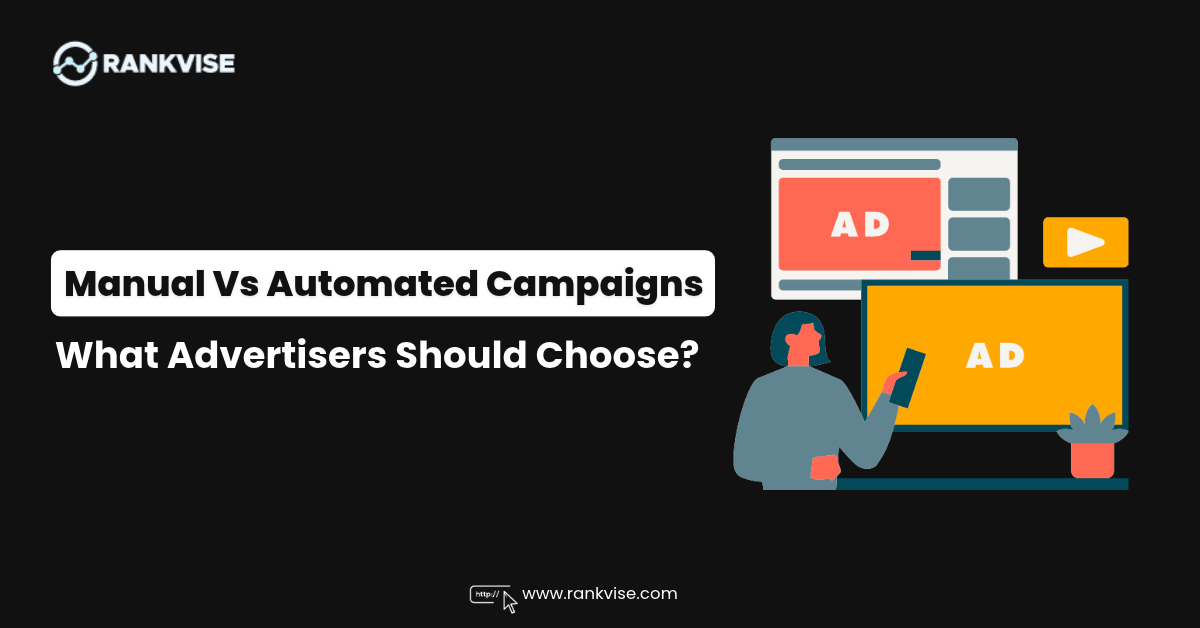
Running ads today means deciding how much control to retain and how much to hand over to the algorithm. Manual campaigns give you more control over targeting, optimization, and bidding, but they require constant monitoring, leaving little time for other marketing tasks.
Automated campaigns, on the other hand, make data-driven decisions and free up advertisers to build strategies that improve overall business performance.
They save time and often tap into advertising opportunities that advertisers might have missed, but they require a decent budget and time to train and learn. So which is better: manual or automated advertising? Both have pros and cons.
In this post, we’ll walk through manual and automated campaign approaches to help you choose the option that best matches your advertising requirements.
What are Manual Advertising Campaigns?
In manual advertising campaigns, you’re responsible for setting up the campaign and handling the targeting. Overall, you decide your audience, locations, timing, and bidding. It takes more time than automated campaign management, but it gives you more control and transparency over your ads.
When to run manual advertising campaigns:
- When you don’t have enough conversion data to train the system’s algorithm.
- When you want to advertise highly regulated products or services.
- When you want full control over your advertising budget.
- When you’re testing a new traffic source.
Manual advertising campaigns give you greater control over your online advertising, but they require constant monitoring and management, leaving little to no room to work on customer relationship management processes or to focus on other business strategies.
What are Automated Advertising Campaigns?
In automated advertising campaigns, the ad network’s algorithm handles targeting and optimization decisions, freeing you from basic advertising operations. You provide your budget, offerings, and ad goal (awareness, sales, or signups), and the system’s algorithm makes the advertising decisions. Automated campaigns are ideal for advertisers who don’t want to constantly monitor campaigns and want time to focus on other marketing strategies.
When to run automated campaigns:
- When you have enough historical conversion data, budget, and time to train the advertising system.
- When you want to automate optimization using real-time data.
- When you have enough information about your target audience.
- When you’re targeting a lookalike audience.
- When you want less manual work and faster optimization.
By running automated campaigns, you let the system participate in real-time auctions and compete for the ad slot against other AI-powered systems. Sometimes, with insufficient data, the algorithm may bid on low-value slots, preventing you from getting the most from your automated campaigns. So, monitoring campaign performance regularly helps you avoid irrelevant spending.
Pros and Cons of Manual Campaign Management
Here are some pros and cons of manual campaign management.
Pros
- Gives tighter control over budget
- Allows you to advertise within a fixed budget
- Makes it easier to implement specific campaign strategies in regulated verticals such as iGaming, dating, and adult
- Works well when conversion data is limited
Cons
- Requires continuous monitoring and tracking
- Becomes time-consuming and inefficient when you have to analyze a large amount of data
- Optimization can’t take place in real-time
Pros and Cons of Automated Campaign Management
Here are some pros and cons of automated ad campaign management.
Pros
- Easier to target lookalike audiences
- Can process large datasets
- Performs 24/7 real-time optimization based on performance
- Frees advertisers from continuous monitoring
Cons
- Less control over the ad campaign
- Bids on irrelevant placements when the system doesn’t have accurate and sufficient datasets to train the system
- Can become costly while the algorithm learns
Manual Vs. Automated Campaigns: Key Differences
Here are some factors we’ve used to compare manual and AI advertising campaigns to help you understand which aligns better with your advertising requirements.
| Factors | Manual Campaigns | Automated Campaigns |
| Control | Full Control Over Campaigns | Moderate |
| Optimization | Advertisers Take the Optimization Decisions After Going Through the Bulk of Data | Algorithm Makes the Optimization Decisions Within Seconds Based on Real-Time Data |
| Time & Efficiency | Time-Consuming | Faster Decisions |
| Data Dependency | Decisions are Based on In-House Data or Gut Feeling | Advertising Decisions are Entirely Data-driven |
| Best for | Advertisers Looking for More Control and Transparency | Advertisers Seeking 24/7 Campaign Optimization Based on Real-Time Data |
Manual Vs. Automated Campaign: Which is Better?
It depends on your online advertising goals, budget, and experience. Manual campaigns work best if you have a tight budget, are testing a new traffic source, need precise targeting, or have limited data. Automated campaigns are better suited if you have sufficient budget and conversion data and want continuous optimization based on real-time data.
AI-powered campaign management can enhance performance, but you can’t set it and forget it after providing a few basic details. An AI system learns from past conversion data to make accurate bidding decisions. However, when there isn’t enough data to train the algorithm, it can overspend your budget and waste money.
A hybrid campaign management system is often best: let the algorithm handle targeting and bidding, but keep a close eye on bids to ensure they are placed for the right slots. This way, you can automate your campaigns while maintaining more control and transparency.
Run, Optimize, and Scale Your Ad Campaigns with Confidence!
As ad platforms lean further into automation in 2026, the question is no longer which option is better but which one aligns with your goals, budget, and advertising experience.
A hybrid campaign management system gives advertisers more control and flexibility, and lets them reach, target, and retarget their audience without sifting through large datasets. So, instead of asking which one is better, aim to combine both approaches. Doing so will improve your 2026 advertising performance and results.
FAQs
What is the difference between manual and automated campaigns?
In manual advertising campaigns, you handle the entire advertising process from setup to optimization, while in automated campaigns, you let the system handle advertising operations.
Are automated campaigns better than manual campaigns?
Automated campaigns are ideal when you have enough past conversion data to train the system and want less manual intervention. Manual advertising provides more control and transparency over campaign operations. A hybrid ad campaign management approach is often the best strategy. It gives you more control and improves efficiency.
Should small businesses automate their campaigns?
Small businesses can also automate their campaigns if they’ve sufficient conversion data and budget to train the AI algorithm.
What should advertisers consider before automating a campaign?
Advertisers should consider their budget, conversion data, advertising goals, and tracking before automating their campaigns.
What are the benefits of automated advertising campaigns?
The biggest benefit of automating ad campaigns is continuous optimization, meaning the system makes changes even when you’re sleeping, improving efficiency and ROAS.