Skip to content
Your CEO wants thought leadership. Your SEO lead wants 40 new pages. Your product team wants a landing page refresh by Friday. And somehow you are also supposed to make it sound premium, keep it on-brand, and ship it yesterday.
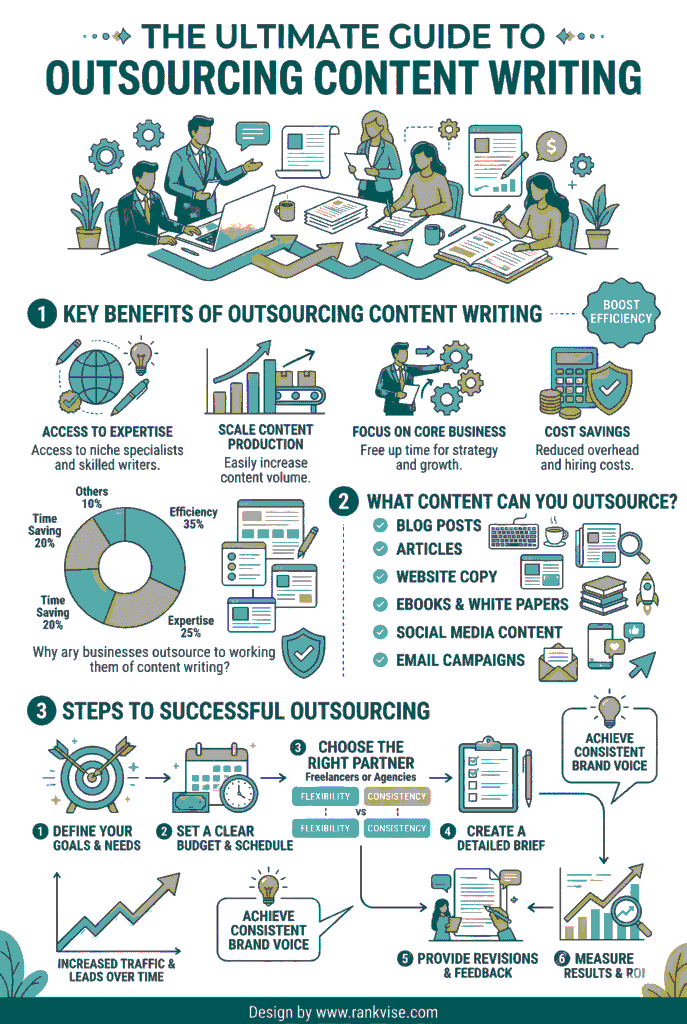
- Outsource when content demand outpaces hiring to maintain a stable, scalable pipeline without burning out internal teams.
- Bring in specialists for technical or high-skill topics to speed production and preserve content quality.
- Use clear briefs, standards, and review workflows so outsourced writers deliver consistent, conversion-focused drafts.
So, businesses do what regular humans do when the workload gets silly: they outsource. If even students sometimes hire someone to write college essay online when life piles on, marketing teams should pull in outside writing help when needed, too.
Here are the most common reasons for outsourcing content creation in 2026. Look for the signs you’re ready to hand content off.
Your content pipeline outgrows your headcount
A lot of teams still plan content like it’s 2020: one in-house writer, one editor, and a conviction that they’ll publish weekly. Then, 2026 shows up with more channels, more pages, more formats, more stakeholders…
I’ve watched a SaaS team go from 4 posts a month to 18 pieces across SEO, product updates, and lifecycle emails, without a single new hire. The content lead was spending mornings writing, afternoons wrangling reviews, and nights rewriting stakeholder “suggestions” into accessible English. Spoiler: that strategy didn’t end well.
At some point, math wins. If content demand rises faster than hiring approvals, you need to outsource content writing to keep the business moving. The goal is to organize a pipeline that does not collapse every time someone takes a vacation.
You need specialist knowledge that your team does not have
General business writing is rarely enough in 2026. Companies want writers who can work on specific beats: fintech compliance, B2B cybersecurity, developer tooling, healthcare claims, supply chain ops, etc. And they want it done without compromising on quality.
One marketing manager told me, “I can’t keep teaching writers what SOC 2 means.” So, they brought in a writer who already spoke the language and an equally competent editor who could fact-check their content.
If your internal team is constantly Googling basics, content cycles stretch, and you can’t be sure quality remains high, this is your signal to look for external expertise.
Your internal reviews are slowing everything down
Some companies do have capable writers. The bottleneck is the review chain. Content sits in limbo waiting for product, legal, brand, sales, and “one more person who has thoughts.”
External writers often deliver better first drafts because they follow a stricter brief, and they know their job is to make approval easy.
A quick way to make outsourcing review-friendly is to standardize what “ready for review” means. Here’s a checklist you can hand to any writer for that purpose:
- Clear target keyword and search intent stated at the top
- One primary CTA written in the brand’s tone
- Claims tied to internal sources, screenshots, or product docs
- Style rules applied (capitalization, formatting, terminology)
- A short “open questions” section for stakeholders to answer
If your team keeps losing days to review purgatory, try tightening briefs and bringing in outside help to turn content into a repeatable process.
You want flexible capacity without long hiring cycles
Hiring is slow. Good hiring is even slower. In the meantime, content requests keep coming.
That is why teams hire freelance writers when they need flexibility, like when they face a product launch month, a new vertical push, a seasonal traffic play, a rebrand, or a backlog of 80 “we should really update this” pages.
I’ve seen companies use a simple “bench” model: two regular freelancers who know the product plus one specialist writer they pull in for technical pieces. The content lead stays in control of strategy and editing; the writers handle production. It’s predictable, budgetable, and far less dramatic than emergency hiring.
Treat freelancers like part of the system: give them examples and support them with constructive feedback.
You need a consistent brand voice across a growing team
Voice breaks when more people touch content. That is predictable but still painful.
Outsourcing forces you to define your voice clearly because you have to explain it to someone who cannot read your mind.
I’ve watched teams implement the voice definition by building three assets: a brand voice page, a terminology list, and a “good vs. not quite” examples doc. Suddenly, everyone writes more consistently, including the internal team.
If you want a simple starting point, publish something like a casual brand voice guide. First, get the brand baseline on paper, then tighten tone rules as you go, like a basic brand setup that’s easy to understand for everyone involved.
Your conversion copy needs a different skill set than blog writing
SEO writing and conversion copy are cousins, not twins. One can rank and still flop on sign-ups. The other can be brilliant and still miss search intent.
Teams outsource copywriting because they need someone who lives in landing pages, pricing pages, onboarding flows, and lifecycle emails. These writers think in offers, objections, and clarity, not only headings and keywords.
Let’s take this example: a company had strong traffic but weak trial starts. So, they decided to outsource a rewrite of their top two landing pages. They aimed at message hierarchy and friction reduction. As a result, traffic stayed flat, but trials jumped by 18% in six weeks.
If your site sounds fine but does not convert, you may not have a content problem. You may have a copy problem.
You want faster experimentation without burning out your team
In 2026, content teams are expected to test constantly: new angles, new formats, new positioning, and new CTAs. That is healthy. It also burns people out when the same small team has to ideate, write, edit, publish, and report every experiment.
Outsourcing gives you room to run controlled tests. The trick is to set up a lightweight experiment loop.
Here’s a simple testing loop that works well with outsourced writers:
- Pick one variable (angle, CTA, structure, lead, feature emphasis)
- Create two briefs that differ only in that variable
- Publish within the same week and track the same KPI
- Keep what wins, and update your templates
- Log the result in one shared place so lessons do not vanish
If you want to tighten planning, make it a habit to create a content calendar that keeps work predictable. Once you do that, writers will get scheduled briefs, and you stop doing emergency requests.
You need scale for SEO updates and topic coverage
Beyond publishing new posts, SEO in 2026 is also about updating what already exists, expanding coverage clusters, improving internal linking, and adding sections that match what people search for now.
This is a big reason teams outsource article writing. They may have a great strategist in-house, but they need hands to execute: refresh 30 pages, add missing sections, rebuild intros, update examples, improve readability, and align with the new product reality.
I’ve seen teams run a quarterly refresh sprint with outsourced writers. Each writer gets 6–10 pages, a consistent update checklist, and a hard deadline. The in-house editor reviews for voice and accuracy. This way, rankings stabilize, traffic bumps are minimized, and nobody has to cancel their weekend.
You want predictable output with measurable standards
The biggest fear with outsourcing is inconsistency: random quality, random tone, random adherence to briefs…
That fear usually comes from unclear standards. When companies define what good means, outsourced work becomes easier to manage than internal work.
Here are some quality gates I’ve seen teams use to spot issues early, before a draft turns into an expensive rewrite:
- The draft invents facts or makes claims without support
- The writer changes key terminology across the piece
- The intro rambles and dodges the topic
- Headings do not match search intent
- The CTA looks stapled on or off-brand
- The piece repeats the same idea in new clothes
If you want a deeper system, build a standardized brief template. It helps writers hit the target on the first draft, and it helps editors give faster feedback.
You need high-performing commercial pages
Some teams can write blog posts all day. Commercial pages are a different beast: they need to be persuasive enough and comply with what your brand can promise.
That is why businesses outsource copywriting services. One strong copywriter can outperform a committee of decent writers, mainly because they make decisions and defend them with logic.
One example: an agency rebuilt a services page set for a client with 12 locations. Same offerings, same pricing range, same sales team. Yet, leads improved because each page addressed local intent and common objections, and the copy stopped sounding like a brochure from 2009.
If your “money pages” look like they were written to satisfy everyone, they usually satisfy no one. Outsourcing can fix that.
You want a clearer division between strategy and production
A mature content team separates “what we should publish and why” from “who writes the drafts.”
Say your senior content people spend most of their time writing. As a tradeoff, you lose the part only they can do: positioning, topic selection, distribution plans, performance analysis, stakeholder alignment, and editorial direction.
On the other hand, outsourcing lets you keep the high-level tasks in-house and delegate production. That is one of the biggest benefits of outsourcing content creation in 2026.
To implement this change, you need a brief workflow that keeps everyone on the same page. Spell out the intent, the angle, the must-include points, and what ‘done’ means. That’s the same kind of structure you see in SEO copywriting, and it’s what makes outsourced drafts easy to review.
What to take away
Outsourcing content in 2026 usually starts with a very basic problem: there’s more to ship than your team can write, edit, and publish. Sometimes you need volume. Sometimes you need a specialist who knows the topic well. Or you need conversion pages that pull their weight.
Efficient setups keep the steering wheel in-house. You own the priorities, the voice, and the final call. Outside writers take the drafting load and bring extra expertise, as long as you give them a clear and detailed brief, well-communicated internal guidelines, and a steady review process.