Skip to content
3 years ago, I watched a marketing director confidently explain why her team didn’t need to worry about emerging platforms. “We’ve mastered Facebook,” she said. “That’s enough.” Six months later, her company’s engagement metrics tanked. Her competitors had already built communities on TikTok and were experimenting with AI-driven personalization.
- Rapid platform and algorithm changes make long-term mastery obsolete; marketers must update skills continuously.
- Fundamentals still matter, but effectiveness depends on adapting those fundamentals to shifting platforms.
- Top performers use directional knowledge and 75 percent certainty decisions instead of chasing deep mastery.
- Active learning infrastructure—monitoring, experiments, distributed knowledge—beats hoarding expertise in specialists.
- Successful marketers treat learning as an ongoing operational function, building systems to manage perpetual change.
She wasn’t fired, but her relevance quietly eroded until she eventually moved to a smaller firm. That conversation stuck with me because it represented something larger than one person’s miscalculation—it illustrated a fundamental shift in how the marketing world operates.
The pace of change in digital marketing stopped being manageable around 2021. Not because the change itself accelerated dramatically, but because the cost of falling behind became immediate and visible in ways that older industries never experienced. A manufacturing company might take two years to feel the impact of ignoring a new production method. A digital marketer? They feel it in real-time dashboards and algorithm changes.
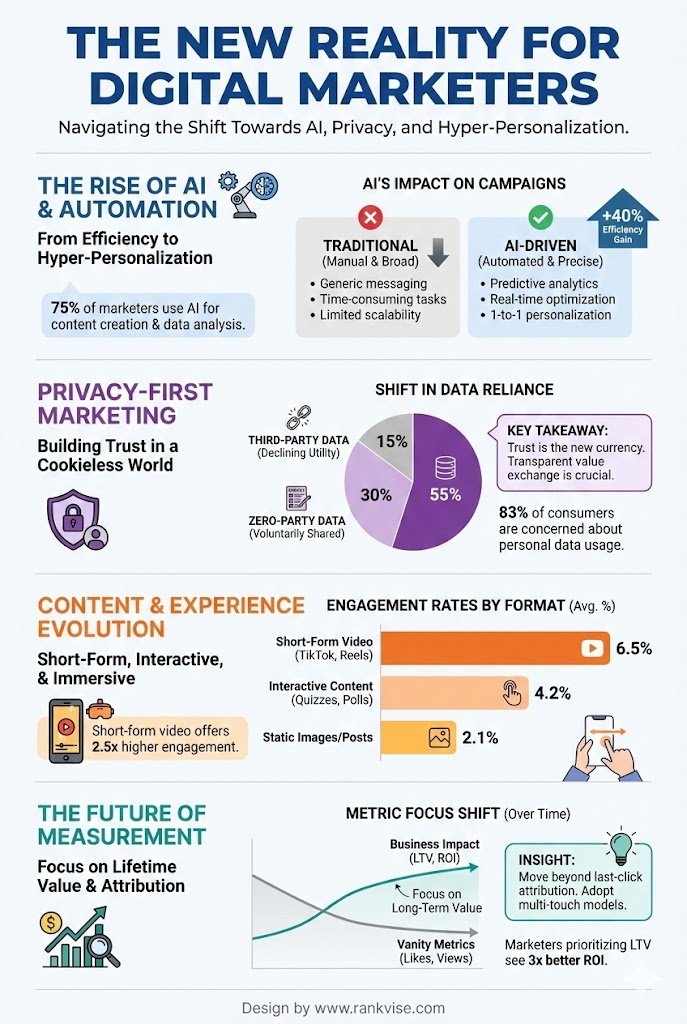
The Compressed Timeline Problem
When I started working in marketing a decade ago, you could build a genuinely solid career on a foundation of knowledge that would last you a long time. Learning SEO fundamentals in 2012 meant understanding principles that would hold relevance for five, sometimes ten years. The best practices didn’t transform overnight. There was breathing room. Now that breathing room is gone.
Consider what’s happened in the last eighteen months alone. ChatGPT’s explosion forced marketers to rethink content creation workflows overnight. Google’s core algorithm updates in March 2024 fundamentally shifted what “good content” means in search rankings. Meta’s pivot toward AI-recommended content over algorithm-curated feeds meant that organic reach strategies built over years became partially obsolete. Meanwhile, platforms like LinkedIn transformed their recommendation engines, and Instagram tested features that contradicted everything marketers had learned about optimal posting times and content length.
This isn’t hyperbole. These weren’t theoretical discussions in webinars. These were immediate, measurable changes that affected campaign performance within weeks.
The traditional learning model in marketing assumed something like this: invest time in understanding a skill or platform → apply it for several years → extract value from that investment. That linear progression has fractured. The investment-to-return timeline has compressed into months, sometimes weeks. By the time a marketer fully understands a platform’s algorithm, the algorithm has been updated, and the institutional knowledge becomes partially obsolete.
Fundamentals Still Matter, But the Ground Keeps Shifting
What makes this particularly disorienting is that the fundamentals still matter. You still need to understand audience psychology, messaging strategy, data analysis, and creative thinking. But those fundamentals now exist in a constantly shifting environment. It’s like learning to sail while the ocean is being redesigned.
The organizations handling this well aren’t those with the most knowledge accumulated over time. They’re the ones with what we might call “active learning infrastructure.” They’ve built systems that incorporate feedback loops, encourage experimentation with new tools without requiring instant ROI validation, and distribute learning across teams rather than concentrating it in specialists. Companies like Hubspot, Sprout Social, and Adobe have published detailed case studies showing that teams with regular learning sprints actually outperform those that don’t, even in the short term — similar to how discussions around service is KingEssays sometimes appear in conversations about structured project support within learning workflows.
But individual marketers aren’t always positioned to build that infrastructure alone. So what does “learning” actually mean now?
The New Definition of Expertise
The most effective digital marketers I know aren’t the ones with the deepest expertise in any single area. They’re the ones with what I’d call “directional knowledge”—a working understanding of how different channels, platforms, and technologies connect and influence each other. They stay alert to shifts without obsessing over mastery. They’re comfortable with incomplete information. They make decisions based on 75 percent certainty rather than waiting for 95 percent.
This requires a different psychological approach to professional development. It means accepting that you’ll never feel like you’ve “learned” a subject the way previous generations could. It means being comfortable with permanent partial competence.
What This Looks Like in Practice
Here’s what this looks like in practice:
Active monitoring systems (newsletters, industry Slack communities, quarterly reports from major platforms) replace deep-dive courses as primary learning tools. A marketer might spend 15 minutes reviewing three different sources on an algorithm change rather than investing three weeks in a comprehensive course that will partially contradict itself in six months.
Experimentation frameworks replace mastery requirements. Testing new features on 10-20 percent of campaigns and measuring results against baselines becomes the primary learning mechanism.
Network-dependent knowledge becomes as valuable as individual expertise. Knowing someone who understands a particular platform or technology becomes a strategic asset.
Tolerance for tool proliferation increases. Rather than learning platforms deeply, marketers learn to evaluate whether a new tool addresses a specific pain point and integrate it quickly.
Continuous curriculum updating becomes essential. Educational content from accredited sources like Google Analytics Academy or HubSpot’s certification programs faces rapid obsolescence, which means marketers need to approach even “official” training with the understanding that parts of it may shift within months.
What the Data Says
The data supports this shift in emphasis. According to the 2024 LinkedIn Workplace Learning Report, 76 percent of professionals say learning agility matters more than specific technical knowledge when evaluating career advancement. That’s a significant shift from even five years ago, when technical depth was the traditional measure of expertise.
The hardest part of this new reality isn’t the learning itself. It’s the psychological adjustment. Many experienced marketers entered the field expecting a trajectory where early investment in knowledge would compound over time. They were right—it did, and still does. But the compounding now includes a depreciation factor that didn’t exist before. Knowledge depreciates faster than it accumulates for anyone not actively updating it.
Comparing Different Learning Approaches
A practical breakdown of how different approaches now stack up:
| Approach | Time Investment | Relevance Span | Competitive Advantage | Stress Level |
| Deep mastery of single platform | 200+ hours | 12-24 months | High initially, then drops | High |
| Directional knowledge across channels | 50-80 hours | 18-36 months | Moderate but sustained | Moderate |
| Reactive learning only | 10-20 hours | 3-6 months | Low, always catching up | Very high |
| Active monitoring with experimentation | 60-100 hours | 24-36+ months | High and adaptable | Moderate |
The irony is that the marketers most stressed about staying current are often those trying to achieve the “deep mastery” approach in an environment that no longer rewards it fully. The ones who seem more relaxed are those who’ve accepted that their job now involves permanent partial knowledge and have built systems to manage it.
The Paradox of Learning Less While Learning More
This doesn’t mean learning less. If anything, it means learning differently—more frequently, more broadly, more responsibly. It means treating your marketing knowledge like a living system rather than a building you construct once and then maintain.
The future of this trend seems inevitable. Tools will continue evolving. Platforms will continue experimenting with their algorithms. New channels will emerge. The baseline expectation for staying relevant will only increase. Organizations that thrive will be those that treat learning not as a checkbox or annual initiative but as a core operational function. Marketers who thrive will be those who stop trying to become complete masters and instead become skilled navigators of uncertainty.
The Real Lesson
That marketing director I mentioned at the beginning? Last I heard, she’d moved to a consultancy focused on helping mid-market companies build learning infrastructure. She’d made peace with the pace of change and found a way to build a career around managing it rather than fighting it. That’s probably the actual lesson here—not that you need to learn faster, but that you need to learn how to learn continuously without burning out.
The marketers who’ll be most valuable in five years won’t be those with the deepest technical knowledge today. They’ll be the ones who’ve built resilient systems for perpetual learning and developed the judgment to know what’s worth learning at any given moment. That’s a different skill entirely, and it’s becoming less optional every day.