Skip to content

Global passenger volumes at airports, land border crossings, and seaports have grown substantially over recent decades, placing enormous pressure on border control authorities and travel industry operators to process travelers faster without compromising security. Manual document inspection — an officer reviewing a passport page by page, cross-referencing data against watchlists by hand — cannot scale to meet these demands. Queues lengthen, processing times increase, and the probability of human error rises proportionally with fatigue and volume.
The consequences of failures at this stage are significant in both directions. Delays and bottlenecks erode traveler experience, create economic costs for airports and carriers, and reduce the operational capacity of border agencies. Security failures — missed watchlist matches, undetected document fraud, incorrect identity data entered into border management systems — carry consequences that extend well beyond operational inconvenience. Here’s when automated document processing technology becomes not a convenience, but a critical infrastructure requirement.
MRZ reading is the automated process of extracting and validating the standardized machine-readable data encoded in the lower portion of travel documents — and it sits at the heart of modern border control and travel processing workflows. Given this, understanding how the technology works in practice, where it delivers the most value, and what a reliable implementation requires is essential for operators across the travel and border management ecosystem.
What Is MRZ Reading?
The machine-readable zone (MRZ) is a standardized section found on passports, travel documents, visa stickers, and many national identity cards. It consists of two or three lines of characters — printed in a fixed-width OCR-B font — that encode key personal and document data in a format designed for rapid automated reading. The specific structure and content of the MRZ is defined by ICAO Document 9303, the international standard published by the International Civil Aviation Organization that governs travel document specifications globally.
MRZ reading is the automated process of capturing an image of this zone — via a document scanner, a camera, or an optical reader — and extracting the encoded data using optical character recognition (OCR) optimized for the OCR-B character set and MRZ layout. The extracted fields typically include the document holder’s surname and given names, document number, nationality, date of birth, sex, document expiration date, and an optional personal number or additional national identifier. Each of these fields is accompanied by a checksum digit that allows the extracted value to be mathematically validated, confirming that the data has been read correctly and has not been altered.
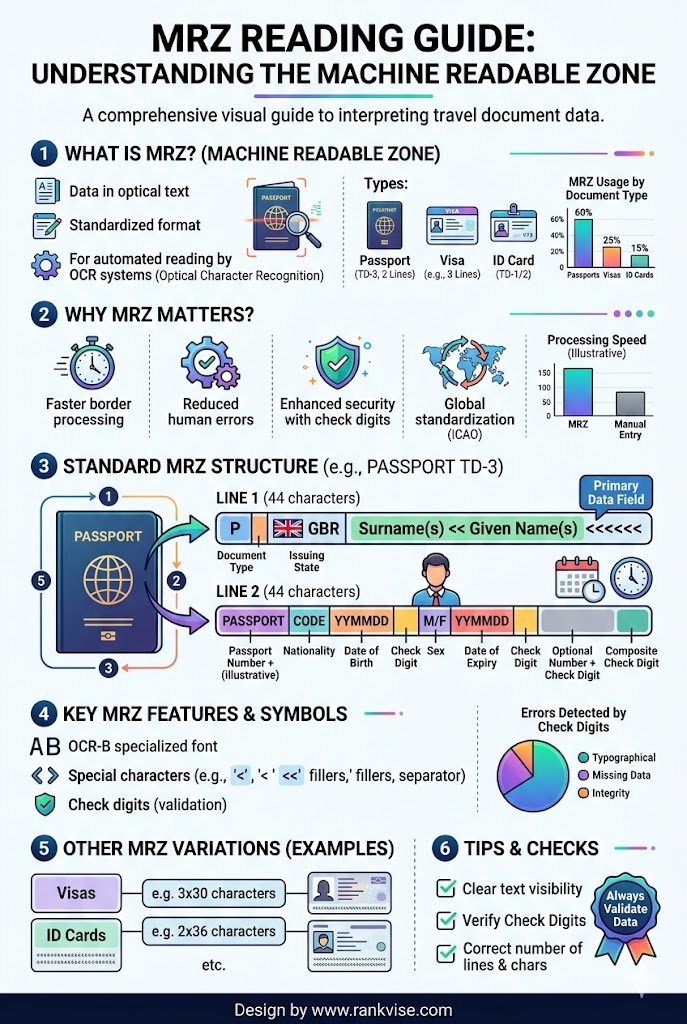
In other words, MRZ reading does not simply extract text — it extracts, structures, and validates travel document data in a single automated step. This makes it significantly more reliable than manual transcription, which is subject to misreading, transposition errors, and inconsistent data entry practices across different operators and shifts.
Real-World Applications in Travel and Border Control
MRZ reading technology is deployed across a wide range of operational contexts within the travel and border management ecosystem. Understanding where and how it is applied helps clarify both the breadth of its relevance and the specific performance requirements that each context imposes.
Automated Border Control and e-Gates
Automated border control (ABC) gates — the self-service passport control kiosks increasingly common at international airports — represent one of the most visible real-world deployments of MRZ reading technology. A traveler presents their passport to an integrated document reader, the MRZ is scanned and validated in seconds, and the extracted data is cross-referenced against border management databases and watchlists before the gate opens. The entire process takes a fraction of the time required for a manual officer check.
Thanks to this automation, airports can process significantly higher passenger volumes through the same physical infrastructure, reducing queuing times during peak periods without requiring proportional increases in border officer staffing. The most widely used options deploy MRZ readers integrated directly into gate hardware, with backend connections to national border management systems for real-time database queries.
Airline Check-In and Boarding
MRZ reading is deployed at airline check-in counters and boarding gates to verify travel document validity, confirm passenger identity against booking records, and capture the document data required for Advanced Passenger Information (API) submissions to destination country authorities. API regulations in many countries require carriers to transmit structured passenger data — including passport number, nationality, and date of birth — before departure, making accurate automated MRZ extraction a compliance requirement rather than an optional efficiency measure.
Apart from this, self-service check-in kiosks at airports use integrated passport readers to allow travelers to verify their own documents and print boarding passes without agent assistance — reducing counter queuing and staffing requirements during peak periods.
Hotel and Hospitality Registration
Hotels in many jurisdictions are legally required to record guest identity data at check-in, including document type, document number, nationality, and date of birth. MRZ reading technology enables front desk staff or self-service check-in kiosks to capture this data accurately in seconds, rather than relying on manual transcription that is both slower and more error-prone. What is also important here is that MRZ-extracted data populates property management systems directly — eliminating a manual data entry step that frequently introduces errors into guest records and compliance documentation.
Visa Application and Processing
Consular offices and visa application centers use MRZ reading to capture applicant passport data at the point of application submission, pre-populating visa application forms and reducing both processing time and data entry error rates. When a visa sticker is subsequently issued and affixed to the passport, it also contains an MRZ that can be read at border control to validate the visa data electronically — providing an additional layer of document authenticity verification.
Key Features of Reliable MRZ Reading Solutions
Deploying MRZ reading in a travel or border control context imposes demanding performance requirements. The most highly demanded options are solutions that combine high accuracy with speed, reliability under variable conditions, and seamless integration with backend systems. A reliable MRZ reading solution should have:
- Full ICAO TD1, TD2, and TD3 format support: Travel documents use different MRZ formats depending on document type — passports use TD3 with two lines of forty-four characters, while ID cards use TD1 with three lines of thirty characters — and the solution must handle all formats correctly.
- Checksum validation for all fields: Every extracted field must be validated against its corresponding checksum digit using ICAO-defined algorithms, confirming data integrity before it is passed to downstream systems.
- High accuracy under variable image conditions: Worn documents, low-contrast printing, and variable lighting at check-in counters or border gates can all degrade image quality — the solution must maintain reliable extraction under these conditions.
- Sub-second processing speed: In high-throughput environments such as airport gates and check-in counters, processing latency directly affects queue management — extraction and validation should complete in well under one second per document.
- Integration with watchlist and database query systems: MRZ-extracted data should feed directly into border management or identity verification systems for real-time cross-referencing against watchlists, sanctions databases, and travel authorization systems.
- Audit logging with structured output: Every MRZ read event should generate a structured, timestamped record for operational monitoring and compliance purposes.
- Hardware and platform flexibility: Solutions should be deployable across a range of hardware configurations — from dedicated document readers to integrated camera systems and mobile devices — to accommodate the diverse physical environments of travel industry deployments.
Pay attention to whether the vendor’s solution has been validated against real-world travel document populations from the issuing countries most relevant to your operational context. Performance benchmarks derived from controlled testing may not reflect accuracy under the actual document mix and physical conditions of a live deployment.
How to Implement MRZ Reading Effectively
We recommend a structured approach to implementation that addresses both technical performance and operational integration requirements:
- Define your document population and throughput requirements first. You should attentively analyze which document types and issuing countries represent the majority of your traffic, and confirm that the solution meets your accuracy and speed requirements for that specific mix
- Integrate with backend systems before go-live. If you want MRZ reading to deliver its full operational value, you need to connect it to the downstream systems — border management databases, property management systems, airline departure control systems — that will consume the extracted data
- Plan for document condition variability. Typical integrations underperform in production when testing has been conducted only on pristine documents — validate the solution against worn, creased, and low-contrast documents representative of real-world conditions
- Implement a manual processing fallback. When a document cannot be read automatically — due to physical damage or unusual formatting — a clear escalation path to manual officer review should be available without disrupting overall throughput
- Monitor extraction accuracy and exception rates post-deployment. It will be helpful to track the rate of failed reads, checksum failures, and manual escalations as ongoing operational metrics — these figures reveal whether the solution is performing as expected under live conditions and where calibration may be needed.
Conclusion
MRZ reading technology is a foundational component of modern travel and border control infrastructure — enabling automated border gates, airline check-in systems, hotel registration workflows, and visa processing applications to extract and validate travel document data accurately and at speed. Its value lies not just in the efficiency gains it delivers, but in the consistency and auditability it brings to processes where data accuracy has direct security and compliance implications.
The majority of travel industry operators and border management authorities already rely on MRZ reading as a core processing capability. For organizations that have not yet deployed or upgraded this technology, the question is not whether automation delivers value — it demonstrably does — but whether the current implementation meets the accuracy, speed, and integration standards that modern operational demands require.