Skip to content
The recruiting landscape has changed completely since 2024. The once compulsory Linkedin Premium, if one was serious about acquiring top talent, lost its monopoly over candidates’ contact information.
- Use multi-platform sourcing—GitHub, Twitter/X, Medium, and communities reveal candidates LinkedIn misses.
- Leverage contact intelligence tools to aggregate and verify emails from public sources quickly and cheaply.
- Master Boolean and X-Ray searches to uncover candidate profiles across the indexed web beyond LinkedIn.
- Automate research, outreach, and CRM workflows while maintaining compliance with GDPR and regional privacy laws.
This shift is driven by three forces.
- The first way is that candidates are having professional presence in many platforms, GitHub, Twitter/X, Medium and the bubble of community-related open source, projects, and issues discussions.
- Second, sophisticated contact intelligence tools collate data from dozens of public sources.
- Thirdly, the price differential is significant, LinkedIn Recruiter costs a minimum of £100 + per month, per seat, while more modern alternatives cost between 60-80% less.
This makes it a strategic imperative for even the recruiting teams that are going through budget pressures to understand these alternative sourcing methods.
Why LinkedIn Premium Lost Its Recruiting Edge
LinkedIn Premium served recruiters well for over a decade, but the value proposition has eroded. According to Gartner’s Future of Work report, InMail response rates dropped from 18-25% in 2020 to just 8-12% by 2025. Candidates became desensitised to generic recruiting messages.
Search functionality restrictions ramped up, instituting result caps that limit the identification of all potential candidates. Over the years LinkedIn turned into a content sharing platform and the candidates started to have very basic information.
The cost pressure is substantial. LinkedIn Recruiter access for a five-person recruiting team costs £30,000-£45,000 per year. It’s no longer the best choice for a lot of recruiting situations.
The Social Media Email Discovery Revolution
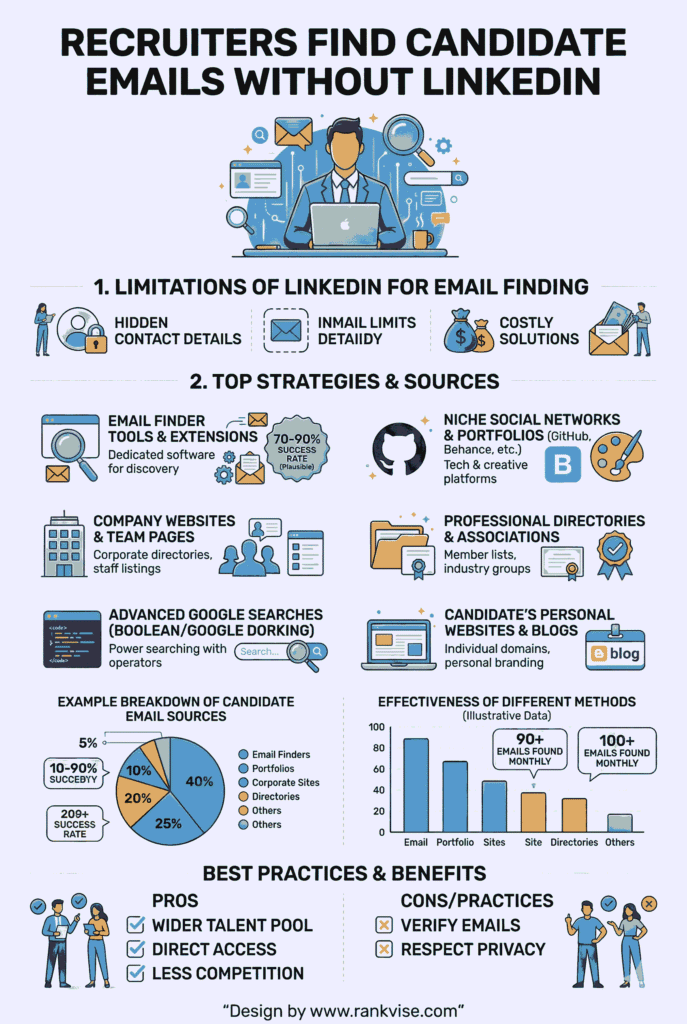
These days, recruiters try to find potential candidates across all professional aspects of the internet. Developers, for instance, have GitHub profiles, designers showcase work on Dribbble, marketers write on Medium, executives Twitter/X, all of which signal skills and job activity that LinkedIn profiles usually don’t.
Contact intelligence tools solved this problem
SignalHire’s social media email finder represents the new generation of recruiting technology. By pulling data from multiple public sources, professional directories, company websites, social media profiles, and public records, these tools offer verified contact information no matter where candidates go online.
The workflow is simple:
- A recruiter finds an interesting candidate inside GitHub, Twitter and any other professional platform. Instead of searching for possible contact details for 15-30 minutes, they just put the profile link in the email finder.
- The tool returns confirmed email addresses, phone numbers, current employers, and more profile information within seconds.
Multi-platform aggregation provides a competitive advantage
While competitors rely solely on LinkedIn, recruiters using social media email finders access candidates across dozens of platforms. This expanded reach is particularly valuable for technical roles, where developers showcase their work on GitHub or Stack Overflow more actively than on LinkedIn.
The cost differential is substantial. When LinkedIn Recruiter comes in at £100-150 per seat per month, contact intelligence platforms offer a better per-seat-per-month price of £40-70. That is £2,400-£4,800 in yearly savings for a five-person recruiting group, and the same or higher sourcing ability.
Boolean Search and Alternative Sourcing Methods
I think one of the most powerful but least used recruiting techniques is Boolean search. Using advanced Boolean operators along with search engines to reveal candidate pools that your competition totally misses out on.
Core Boolean operators every recruiter must master:
- AND – Requires all terms (software engineer AND python AND machine learning)
- OR – Includes any term (developer OR engineer OR programmer)
- NOT – Excludes terms (java NOT javascript)
- Quotation marks – Exact phrase matching (“senior data scientist”)
- Parentheses – Groups operations (python AND (pandas OR numpy))
Boolean strings that use multiple operators are more effective. Instead for instance searching for a senior python developer in London you can search for
“senior python developer” AND (pandas OR numpy OR scikit-learn) AND London AND (resume OR CV OR profile)
This search returns profiles from across the entire indexed web, not just LinkedIn.
X-Ray search techniques amplify Boolean power. By combining Boolean strings with site-specific search operators, recruiters access candidate information hosted on specific platforms:
site:github.com “machine learning engineer” python tensorflow
This finds a machine learning engineer working on GitHub with Python and TensorFlow experience. And similar searches work for Medium articles, company career pages, professional directories, and conference speaker lists.
Recruiters who master Boolean sourcing consistently identify 30-50% more qualified candidates than those relying solely on platform-specific search. Marketing automation principles apply directly to recruiting; initial setup investment yields compounding time savings.
For recruiters sending north of 100+ outreach emails on a weekly basis, verification services priced around £20-40 per month are table stakes. A high bounce rate over 5% can mark your domains as potential spammers, taking months to restore reputation.
Automation and Compliance Essentials
Successful recruiting these days isn`t so much about quality, but about quantity. Those candidates are getting approached multiple times/week. The first candidates to engage, with tailored, pertinent messages, are the winners. Manual processes cannot compete.
Automation enables scale without sacrificing personalisation. AI-powered tools in digital marketing have proven this model, automation handles repetitive tasks while humans focus on strategy.
Key automation applications:
- Research automation scrapes multiple platforms simultaneously, reducing 20-30 minutes of manual research to 30 seconds
- Email sequences ensure consistent follow-up. Response rates average 15-25% for initial contact, with most responses occurring after 2-4 touchpoints
- CRM integration eliminates data entry, automatically creating candidate records with full contact information
- Chrome extensions add contact discovery directly into workflows, displaying verified contact information in sidebar panels
These automation tools follow principles that transform marketing efficiency. Small business digital marketing success came from automating repetitive tasks while maintaining personalisation.
In the case of recruiters who have implemented extensive automation, sourcing and administrative time gets cut down by 40-60%. This freed up time now reallocates to phone calls with candidates, hiring manager touchpoints, and relationship development.
- Compliance cannot be ignored. In Europe, GDPR, in California, CCPA, and many regional laws create hefty legal obligations to collect, store, and use personal information.
- Understanding the legal basis for B2B recruiting contacts. The GDPR differentiates personal data on the basis of personal/non-professional versus professional. According to the GDPR Article 6 (1) (f), contacting someone about employment opportunities using business email and professional data is a valid interest.
According to Deloitte’s 2025 Global Human Capital Trends report, 68% of organisations cite compliance concerns as a major factor in their technology recruitment decisions.
Key compliance requirements:
- Source transparency – Document where contact information originated
- Purpose limitation – Use data only for stated recruiting purposes
- Data minimisation – Collect only necessary information
- Retention limits – Delete candidate data after a reasonable period (1-2 years)
- Opt-out mechanisms – Provide clear unsubscribe options
- Security measures – Protect candidate data with appropriate technical safeguards
Trusted contact intelligence platforms only collect information available on publicly accessible professional platforms and offer a data processing agreement. When recruiting internationally, ensuring GDPR compliance for all candidates not only makes compliance easier but also increases candidate trust.
Build searchable string libraries that are repeatable by type of role, by combination of skills. Create email templates based on candidate personas. Set up a ritual for weekly sourcing; focus on consistency, not intensity. Measure response rates, conversion rates, and time-to-fill per source.
The most sophisticated recruiting teams have talent pipelines for key roles, pools of 50-100 highly qualified candidates per key role. Our pre-qualified pipelines allow us to cut time-to-fill for Software Engineer roles, which are usually opened on a quarterly basis, from 45–60 days down to 20–30 days.
Conclusion
In 2026, you won’t need to have LinkedIn Premium to be an effective recruiter. There are other approaches, social media email finders, unambiguous pinpointing of the Boolean search, and entire automation that provide comparable (or better) outcomes at just a fraction of the price.
The top recruiters think of sourcing like a science, like a discipline, one that requires the rigour marketers have learned to apply to lead generation. They create sustainable workflows, utilize automated processes wisely, adhere to compliance guidelines stringently and take performance metrics religiously.
More importantly, they also know that candidate contact data is getting more and more commoditised. Research quality, messaging relevance, and follow-up consistency are what fuel competitive advantage. This excellence, at scale, is made possible by technology.
For talent acquisition teams willing to leave behind their overdependence on LinkedIn, there is a set of tools and methodologies available now that can help create sourcing functions that are more successful, more efficient, and less expensive. The question is not whether you should take these methods but how fast you can implement them before your competitors have a pipeline that is too large to overcome.