Skip to content
Most online stores are flying blind. They watch traffic numbers go up and down, fiddle with ad budgets, and still wonder why so many visitors leave without buying anything. The problem is not the traffic — it is the information gap. You do not really know who your customers are, what they want, or why they chose you over someone else. An ecommerce quiz closes that gap in one of the most natural ways possible: by asking.
- Quizzes collect zero-party data customers willingly share, giving richer context than tracking pixels.
- Personalized recommendations from quizzes increase trust and drive higher conversion rates.
- Well-designed quizzes use conditional logic and specific questions to create actionable segments.
- Quiz platforms must integrate with your store, email, and analytics to turn answers into campaigns.
- Aggregated quiz responses inform product development, ad targeting, and long-term customer strategy.
When a shopper answers a few well-chosen questions, you are not just helping them find a product. You are collecting zero-party data — information your customer gives willingly — that tells you more about their needs, motivations, and preferences than any tracking pixel ever could.
Done right, a quiz becomes a two-way conversation that benefits both sides. The customer gets a recommendation that feels made for them. You get insights that make every future marketing decision sharper.
Let us walk through how this all works, in a question-and-answer format that mirrors the very thing we are talking about.
Why does personalization matter so much right now?
Research from McKinsey found that 71% of consumers expect companies to deliver personalized interactions, and 76% get frustrated when that does not happen. That frustration does not just mean a bad mood — it translates directly into lost revenue and customers switching to a competitor who made the effort.
The same research shows that companies excelling at personalization generate 40% more revenue from it than their slower-growing peers. Personalization is not a feature customers appreciate; it is a standard they hold you to.
An ecommerce quiz is one of the most accessible tools for delivering that standard. Rather than relying on behavioral guesses pulled from browsing history, a quiz lets customers tell you directly who they are and what they need. That distinction matters — because data with context beats data without it every single time.
What exactly does an ecommerce quiz tell you about your customers?
According to research by Typeform on ecommerce personalization, product recommendation quizzes capture what is known as zero-party data, which goes well beyond basic demographics. Here is what a good quiz can surface:
- Customer preferences and goals — what outcome they are trying to achieve (better skin, more energy, the right fit, etc.)
- Pain points and hesitations — what is stopping them from buying today
- Lifestyle signals — how they use products, how often they shop, what they have tried before
This is the kind of information that lets you segment your audience not by age bracket or location, but by actual intent. A customer who tells you they want a lightweight moisturizer for oily skin is giving you a far richer signal than someone who simply clicked on a skincare page and left.
Platforms like Speero describe this as “closing the Customer Experience Gap” — giving marketers the data points needed to speak to each person individually, not as a generic segment.
How does a quiz actually improve conversion rates?
When a shopper lands on a product page with 47 options, choice overload sets in. They cannot tell which one is right for them, so they leave. A quiz does the filtering for them. It asks three to five questions, then surfaces the one or two products that genuinely match their answers.
According to insights from Okendo’s ecommerce quiz research, 58% of customers feel that a brand-centric product finder quiz meets or even exceeds their expectations. That confidence carries through to the purchase. When someone arrives at a product page already knowing it was matched to their answers, they are far more likely to add it to the cart without second-guessing.
Research from Mageplaza’s analysis of Shopify quiz apps also noted that online shoppers who were prompted to take a quiz showed a 22% increase in sales compared to those who were not. That is not a marginal lift — that is the kind of result that justifies building a quiz into your store from day one.
Try It Yourself: Take the Aerre Style Quiz
Want to see a well-crafted ecommerce quiz in action? Aerre, a fashion and lifestyle brand, uses an interactive quiz to help shoppers find pieces that genuinely suit their personal style, body type, and preferences — rather than leaving them to scroll through a catalog alone.
👉Take the Aerre Style Quiz here
What makes this quiz worth paying attention to is how it balances simplicity with depth. Shoppers answer a short set of questions about their aesthetic preferences and lifestyle, and they walk away with curated product recommendations that feel personal. For Aerre, this is not just a conversion tool — it is a customer insight engine that feeds directly into how they develop and present new collections.
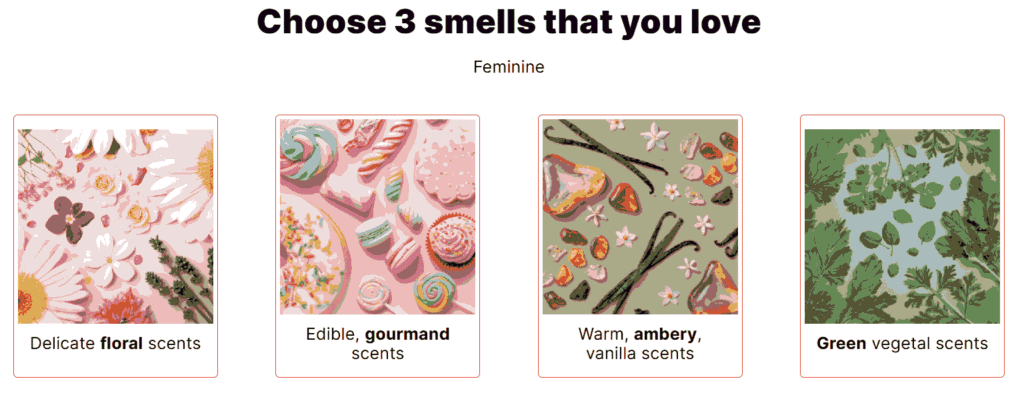


This approach reflects a broader truth: the brands doing best with quizzes are not just using them as recommendation widgets. They are treating every completed quiz as a data point that informs everything from product development to email marketing.
What makes a quiz genuinely useful for gathering insights?
A quiz with vague, surface-level questions generates vague data. A quiz built with intention creates a segmentation engine. According to Chanti Zak’s guide to ecommerce quizzes, writing quiz questions as if they are a dialogue between you and your ideal customer is what separates a quiz that converts from one that just entertains.
Here is what separates a useful quiz from a forgettable one:
- Conditional logic — questions that adapt based on previous answers, so the quiz feels personal rather than one-size-fits-all
- Specific, actionable questions — not “what do you like?” but “what is your biggest skin concern right now?”
- A results page that explains the recommendation — not just naming a product, but telling the customer why it is right for them
The follow-up matters just as much. The quiz data should flow into your email platform so future campaigns are built around what each subscriber actually told you, not guesses based on clicks.
What features should you look for in an ecommerce quiz builder?
Choosing the right tool is where many brands stumble. A basic quiz tool might look fine in demos, but fall short when you need it to actually connect with your store and marketing stack. According to Quizell’s checklist of must-have quiz features, here are the 10 best ecommerce quiz builder features to prioritize:
- Drag-and-drop builder — no-code editing that your marketing team can use without developer help
- Conditional logic/branching — quiz paths that adapt to each respondent’s answers
- Real-time product recommendations — results that pull directly from your live product catalog
- Built-in lead capture — email collection woven naturally into the quiz flow
- Mobile-responsive design — critical, since two-thirds of online orders are placed on smartphones
- Analytics and reporting — completion rates, drop-off points, and revenue attribution
- Platform integrations — native connections with Shopify, WooCommerce, Klaviyo, and your CRM
- Brand customization — fonts, colors, and layouts that match your store, not a generic template
- A/B testing capability — the ability to test question variations and optimize over time
- Zero-party data export — the ability to push quiz answers into your marketing tools for segmentation
Understanding the 9 best ecommerce quiz builder features for conversion (a subset of the full list above) comes down to logic, personalization, mobile-readiness, lead capture, integrations, analytics, customization, product sync, and A/B testing. These are not optional extras — they are the foundation of a quiz that actually works.
How do you turn quiz data into long-term customer insight?
Every completed quiz is a data point. Patterns across hundreds of completed quizzes tell you something far more valuable — what your customers collectively need, where your product range has gaps, and which segments are growing.
Practically, this means:
- Segmenting your email list based on quiz answers, so campaigns speak to specific needs
- Informing product development with the preferences and gaps customers reveal
- Improving ad targeting by knowing the real demographics and motivations of quiz completers
Frequently Asked Questions
Three to seven is the sweet spot. Fewer feels generic; more risks losing shoppers before they finish.
No. Most modern quiz builders — Octane AI, Digioh, ConvertFlow, Lantern — are no-code and can be launched within a few hours.
Yes, when the payoff is clear. A personalized recommendation at the end drives completions, and a discount code on the results page helps even more.
A survey asks for feedback after the fact. A quiz helps the customer find something they need right now — it feels like a tool, not a chore, which is why completion rates are typically much higher.
Connect your quiz tool to your email platform (Klaviyo, Mailchimp, etc.), tag contacts by their answers, and send campaigns that speak directly to what each person told you.