B2B climate tech companies run into a communications problem that most general PR firms can’t solve: buyers are skeptical, sales cycles drag on for months, and the underlying science has to hold up under real scrutiny. The strongest PR agencies serving B2B climate tech businesses in the US pair deep sector knowledge with media relationships that reach actual buyers, not just broad public audiences. The five agencies below differ meaningfully in specialization, team size, and service model, and those differences are worth comparing carefully.
- Select an agency based on stage and goals: brand visibility, credibility, or measurable pipeline and account-based tactics.
- Prioritize sector fluency, trade media relationships, and technical ESG content to win placements and support sales enablement.
- Consider geography and team size: US presence helps earned media; large firms offer scale while small teams provide senior attention.
1. twentytwo & brand.
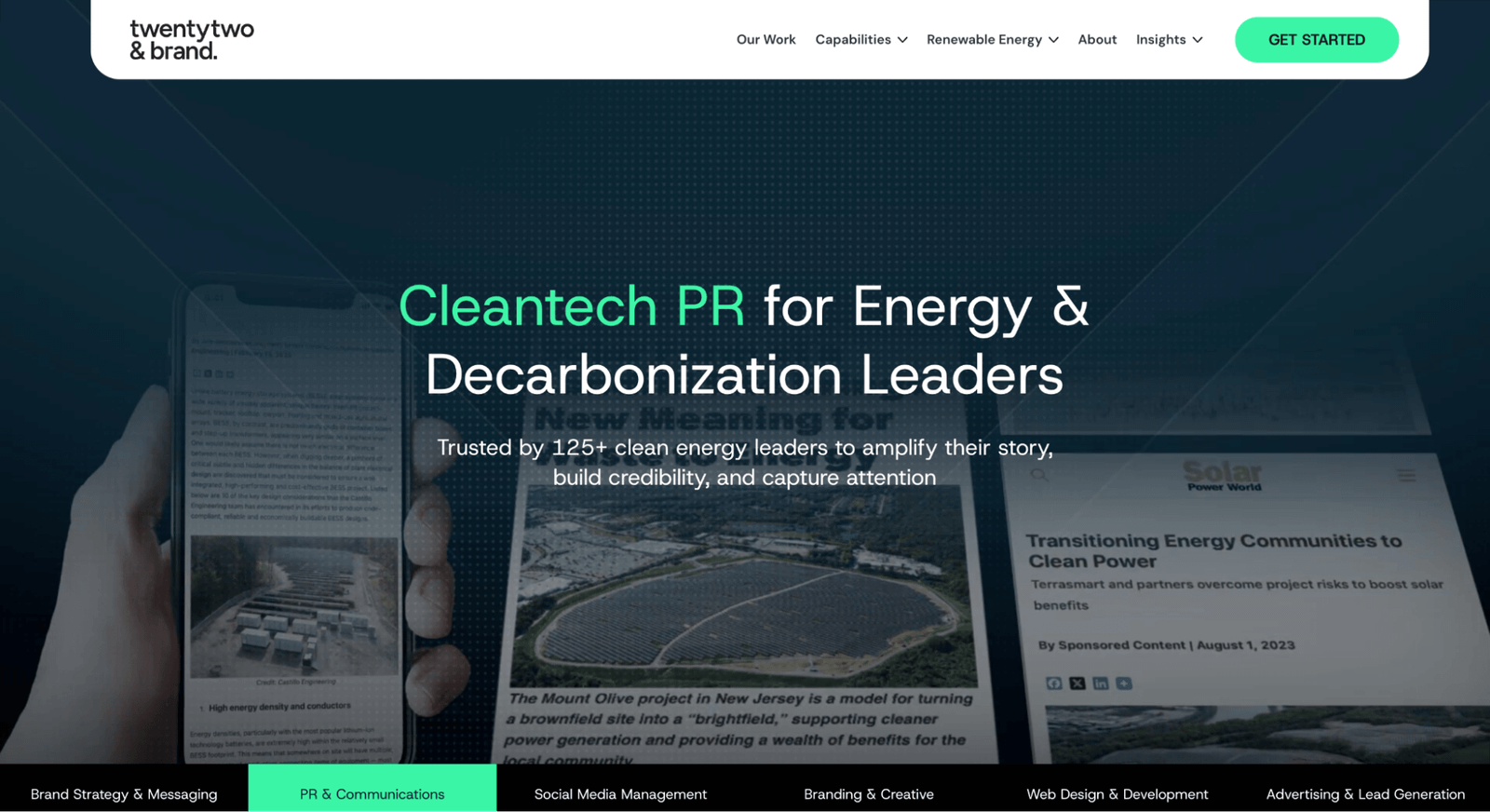
A U.S.-based agency built for cleantech and climate companies working in complex B2B markets.
- Focus: PR, branding, digital marketing, advertising, and lead generation for cleantech, renewable energy, clean energy, and energy transition sectors
- Audience fit: B2B companies that need communications and demand-generation support in one place, from early-stage visibility through market growth
twentytwo & brand runs integrated campaigns that connect brand-building to pipeline, rather than treating PR as a standalone function. Its deep familiarity with the energy transition means messaging is calibrated for sophisticated industrial and enterprise buyers, not general consumers. Clients aren’t waiting for an account team to get up to speed on energy storage or carbon markets. That sector focus shows in the work; messaging tends to be technically grounded while still being accessible to business buyers who care more about return on investment than specs.
2. Highwire

A San Francisco-based communications agency with a dedicated energy and clean energy practice serving enterprise and Fortune 100 clients.
- Focus: Strategic communications, brand journalism, content marketing, SEO, and reputation management for B2B technology companies
- Audience fit: Mid-market to enterprise B2B companies, including those in energy, clean energy, cybersecurity, and financial services
- Consideration: Main roots are in broad B2B technology PR; the energy and clean energy practice is a newer addition rather than a founding specialization
Highwire counts Amazon, Walmart, and Deloitte among its clients; energy-sector clients include PG&E and AES. Founded in 2008, the agency now runs 177 employees, giving it genuine operational scale. Its acquisition of Candor Content sharpened its content and brand journalism capabilities, and its proprietary CLEAR methodology shapes how client programs are built and run. The recent Highwire Health launch shows the agency keeps pushing beyond its tech-PR roots. Climate tech companies that also need visibility across broader enterprise ecosystems will find that cross-sector access genuinely useful.
3. Greenhouse Communications / Greenhouse PR

A mission-driven communications agency focused on accelerating the low-carbon economy, with a global team and B Corp certification.
- Focus: Full-service communications, media relations, content production, paid media, events, and email for clean energy and sustainable businesses and NGOs
- Audience fit: Businesses, entrepreneurs, and NGOs working on climate, clean energy, and sustainable finance
- Consideration: Headquarters in Bristol, England, with London offices; North American presence exists but the agency’s base is European
Clients include Ecover, Triodos Bank, Energy Saving Trust, and Ecosia. Founded in 2003 and fully employee-owned, Greenhouse works across four continents with around 66 staff. Its B Corp certification and specialist focus on climate set it apart as a partner that understands clean energy at an organizational level, not just as a content category. B2B companies with a primarily North American focus should clarify how the agency structures its US-market work before signing on.
4. Content Coms
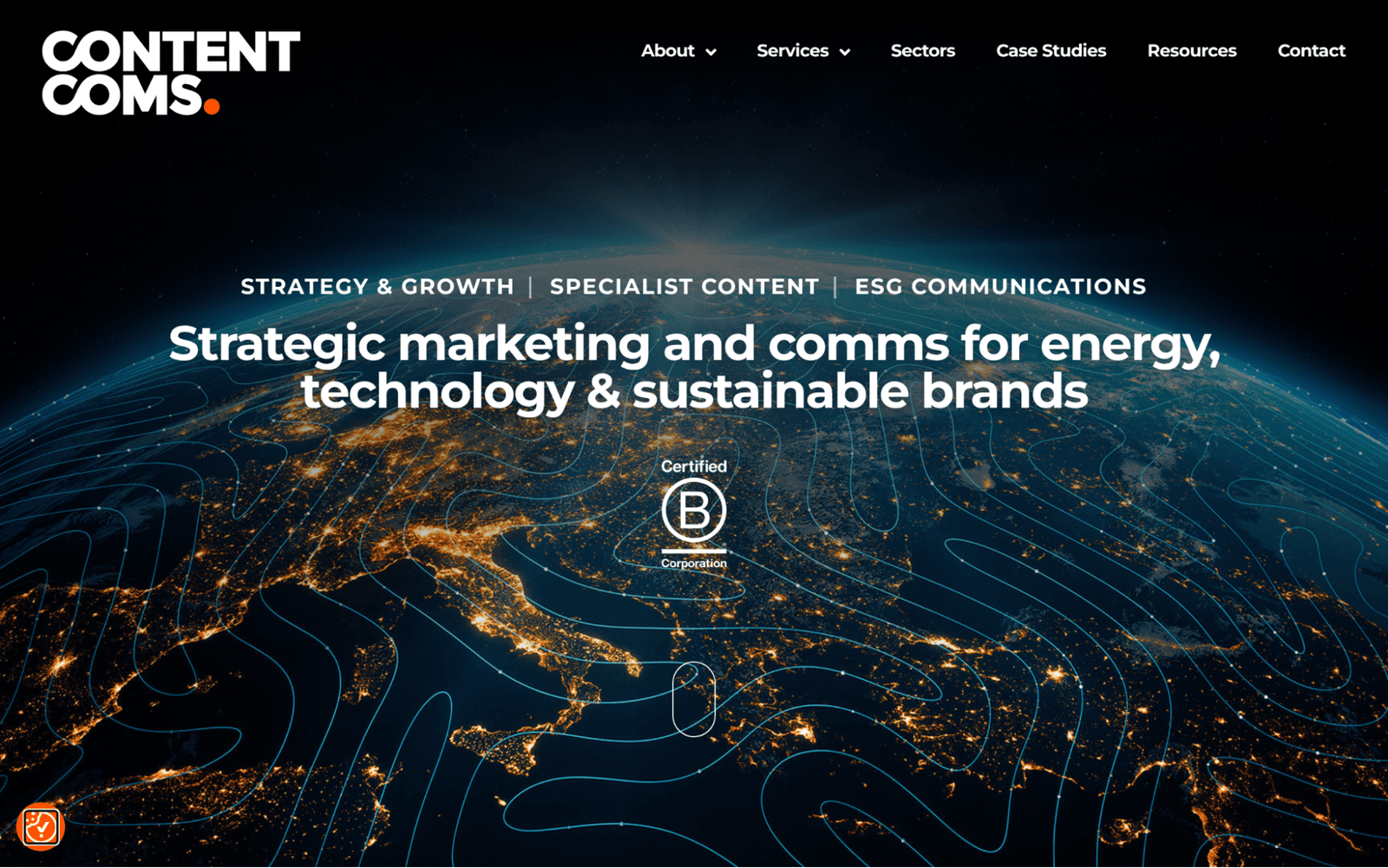
A B Corp-certified specialist in PR and content marketing for energy, low-carbon, and industrial technology brands.
- Focus: Digital PR, content planning, ESG communications, impact reporting, market intelligence, and lead nurture for energy and technology sectors
- Audience fit: Manufacturers, industrial innovators, and clean energy businesses needing ESG content alongside traditional PR
- Consideration: Headquartered in Wiltshire, UK; teams with 9 employees and approximately $1 million in revenue, so capacity is limited compared to larger agencies
Clients include Tarkett Ltd and Ibstock plc; the agency also founded the workplace content hub Work in Mind in 2018. Content Coms carries nearly 30 years of sector experience, with real depth in industrial and energy communications. Its multi-award-winning ESG reporting work is a genuine differentiator for B2B companies facing pressure to report clean energy performance in a credible, defensible way. US-based companies should think carefully about the UK base; time zone gaps and local media relationships have real consequences for earned coverage in American trade publications.
5. New Perspective
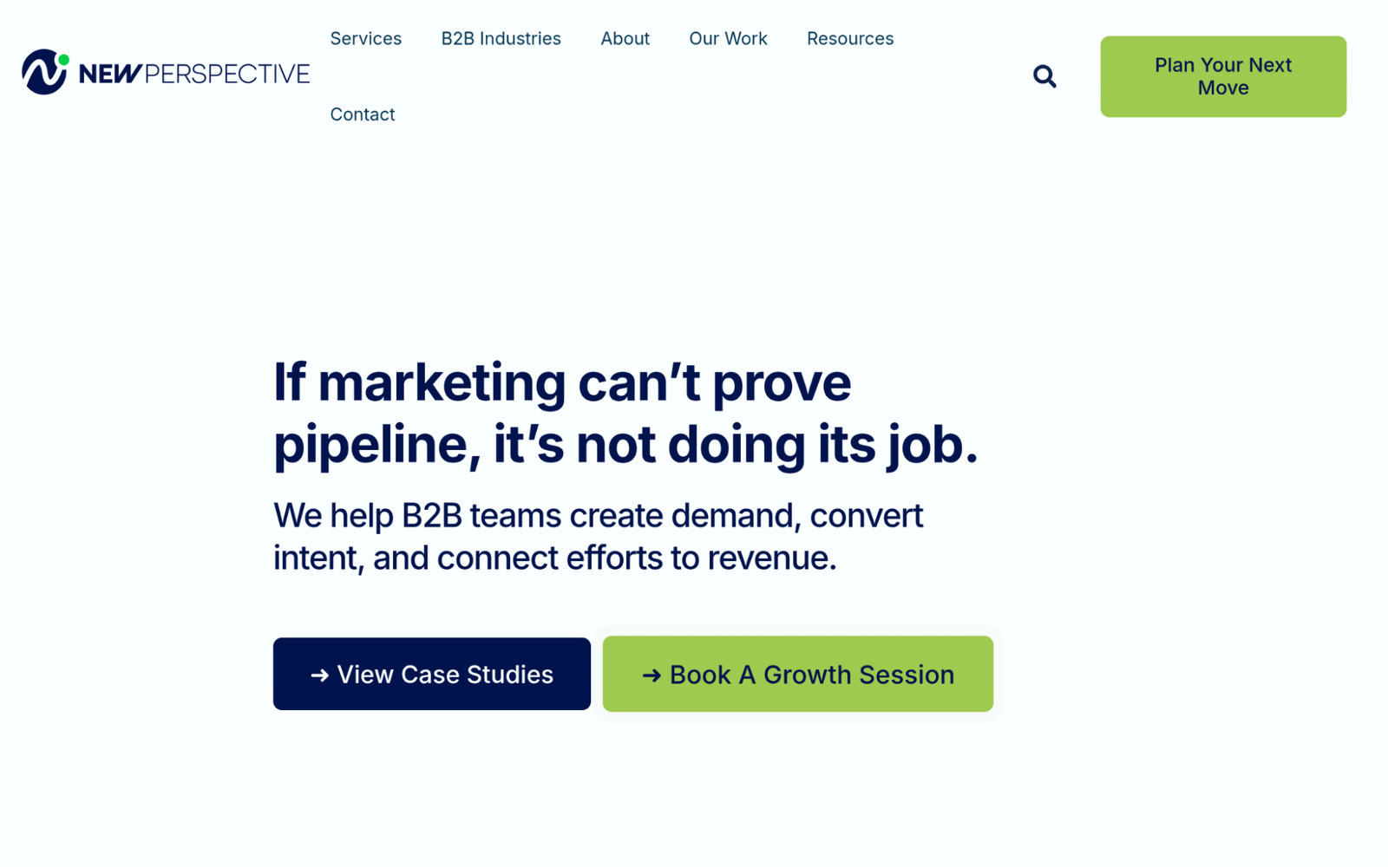
A Worcester, MA-based digital marketing agency with a measurable track record in cleantech and advanced manufacturing.
- Focus: Digital strategy, demand generation, content, web design, HubSpot services, SEO, paid search, and account-based marketing for cleantech and SaaS companies
- Audience fit: B2B cleantech companies looking for pipeline growth through inbound marketing and ABM, particularly those scaling toward or through an IPO. Carbon Clean generated over $113 million in pipeline value in 60 days, WindESCo saw a 163% increase in qualified leads quarter-over-quarter, and Agrify was supported from startup to IPO.
- Consideration: Primarily a digital marketing agency rather than a traditional PR firm; earned media and media relations are not the main services
New Perspective was founded in 2003 and ranks in the top 10% of HubSpot-accredited agencies worldwide. Senior operators are embedded directly in client programs from day one, not handed off to junior staff after the pitch. The case study results they publish are specific and verifiable, which is a meaningful signal in a space full of vague performance claims. Climate tech companies whose top priority is sales pipeline over brand press coverage will find this a practical fit.
Finding the right climate tech PR partner for B2B growth
The right agency depends on what a company actually needs right now. Pre-Series B, the priority is often brand visibility and leadership credibility to earn trust from investors and early customers. But a company with an established product and a long sales cycle probably needs demand generation and account-based tactics running alongside any PR effort.
Geography matters more than some buyers realize. An agency headquartered in the UK can do excellent work for US companies, but earned media placements in American trade publications, relationships with domestic journalists, and understanding of US policy and regulatory context all require active investment. Agencies based in the US tend to carry those relationships by default.
Team size matters too. A 177-person agency brings specialists and scale; a 9-person agency offers focus and consistent senior attention. Neither is the right answer by default; it comes down to whether a company needs a broader bench or wants fewer hands on the work.
Capabilities that matter in climate tech PR
Climate tech PR firms serving B2B businesses in the US are not interchangeable with general B2B communications shops. A few specific capabilities separate agencies that actually produce results from those that produce coverage.
- Sector fluency. Reporters covering energy transition and industrial decarbonization can spot shallow expertise quickly. An agency that understands the difference between a PPA and a VPPA, or between scope 2 and scope 3 emissions, earns different placements than one that can’t.
- Trade media relationships. General business press matters less for most B2B climate tech companies than placement in outlets like Canary Media, Heatmap, Utility Dive, or Greentech Media. Agencies that work in this space regularly already have those relationships.
- ESG and technical content. B2B buyers in energy and clean energy sectors read white papers, technical briefs, and case studies. An agency that can produce technically credible content, not just press releases, extends the communications function into actual sales enablement.
- Integrated measurement. PR that doesn’t connect to pipeline or revenue is hard to justify in a capital-constrained environment. The strongest agencies in this space track coverage quality, share of voice, inbound traffic, and lead attribution in the same dashboard.
And for companies with complex regulatory or policy dimensions – carbon markets, permitting, incentive programs – an agency that understands the policy context can develop proactive narratives instead of reacting to headlines.
Bottom Line
These agencies take genuinely different approaches: some are full-service US-based cleantech specialists, others bring enterprise scale with newer clean energy practices, and a few operate primarily from UK bases with varying North American reach. B2B climate tech companies tend to get better results from agencies where sector knowledge is already baked in, not acquired mid-engagement. Budget, team size, and whether the goal is brand visibility or measurable pipeline growth should drive the final decision more than any single agency’s credentials.