Your SDRs spend two hours a day hunting for email addresses and phone numbers. Half the numbers ring the wrong person. A fifth of the emails bounce.
- Prioritize data accuracy over database size; test accuracy in your target market before signing any contract.
- Choose tools by region, sales motion, and team size; shortlist two or three and run structured tests on real contacts.
- Ensure legal compliance and sourcing transparency: check GDPR, DNC screening, security certifications, and vendor data collection practices with your legal team.
That is not a prospecting problem. It is a data problem.
The right sales intelligence tool fixes this. It gives your team accurate contacts, company insights, and buying signals in one place. The wrong tool drains budget and burns your sending domains.
This guide compares the best B2B contact data and sales intelligence tools in 2026. You will learn what each one does well, where it falls short, and how to choose the right fit.
What Are B2B Contact Data and Sales Intelligence Tools?
These tools help sales and marketing teams find and understand the right buyers.
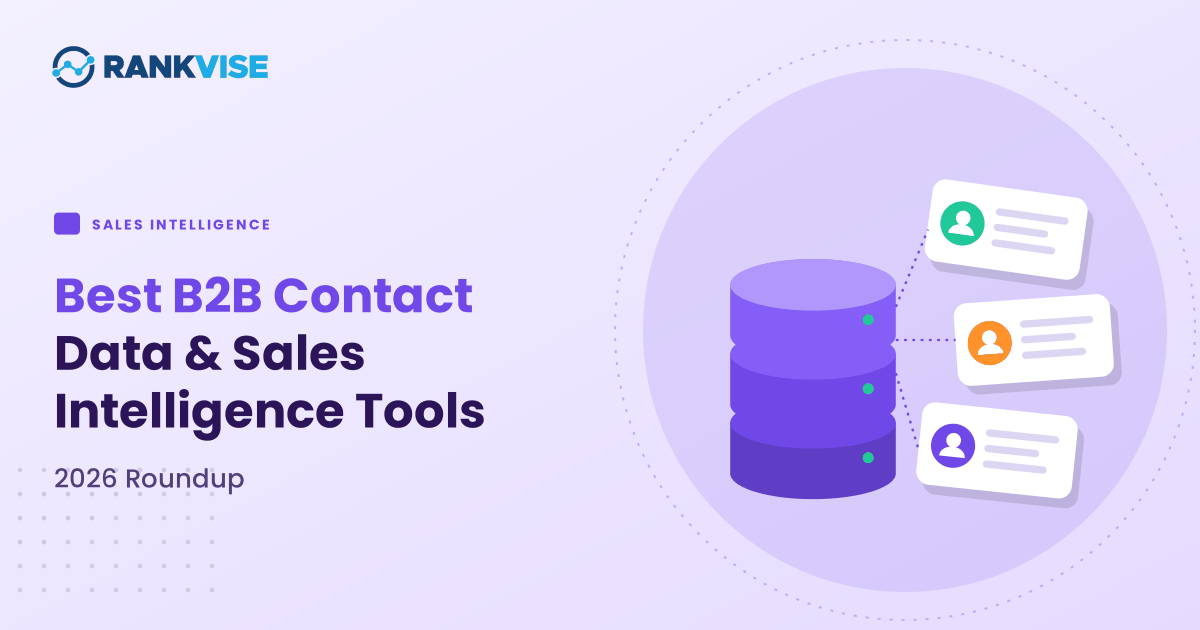
At a basic level, a B2B contact database gives you names, job titles, email addresses, and phone numbers. Sales intelligence goes further. It adds context about companies and buying behaviour.
Most modern platforms combine several data types:
| Data type | What it tells you |
|---|---|
| Contact data | Who to reach: name, title, email, direct dial, mobile |
| Firmographics | Company size, industry, revenue, location |
| Technographics | Which software a company uses |
| Org charts | Who reports to whom, and who makes decisions |
| Intent data | Which companies are researching topics related to your product |
| Buying signals | Funding rounds, hiring sprees, leadership changes, expansions |
The industry has shifted from simple contact lists to “contact plus context.” Knowing who to call matters. Knowing why and when to call matters more.
Why Data Quality Matters More Than Database Size
Every vendor claims hundreds of millions of contacts. Those numbers are hard to compare and easy to misread.
Size means little if the data is wrong. B2B data decays quickly as people change jobs and companies restructure. ZoomInfo estimates that email addresses decay at around 43% a year.
Poor data creates real costs:
- Wasted rep time on bad numbers and wrong contacts.
- High bounce rates that damage your sending domains.
- Missed quota because reps work the wrong accounts.
- Compliance risk when data is collected or used improperly.
When you evaluate tools, test accuracy in your target market. Do not rely on database size claims alone.
The Best B2B Contact Data and Sales Intelligence Tools
Here are the tools B2B teams shortlist most often, grouped by what they do best.
1. ZoomInfo
ZoomInfo is one of the largest and best-known sales intelligence platforms. In May 2025, it changed its Nasdaq ticker to “GTM” and launched GTM Studio. It now positions itself as a full go-to-market intelligence platform, not just a data provider.
Best for: Enterprise teams selling into North America that want contacts, intent data, and org charts in one platform.
Key strengths:
- Deep North American contact and company coverage.
- Detailed org charts that help map buying committees.
- Intent data, technographics, and buying signals built in.
- Workflow tools to plan and launch campaigns from the data.
Trade-offs to consider:
- Pricing is not published and typically requires annual contracts.
- Coverage and accuracy are reported to be weaker outside North America.
- Many advanced features sit in higher tiers or add-ons.
2. Apollo.io
Apollo combines a large B2B contact database with built-in sequencing, a dialer, and AI writing tools. It is known for published pricing and a free plan.
Best for: Startups, SMBs, and lean sales teams that want data and outreach in one tool.
Key strengths:
- Easy entry point with a free plan and self-serve paid tiers.
- Prospecting data and email sequences in the same platform.
- Fast setup with no long sales process.
Trade-offs to consider:
- Phone data is often reported as weaker than email data.
- Data quality varies by region, so verify before sending.
- Less depth than specialised enterprise data providers.
3. Cognism
Cognism is a strong choice for teams selling into Europe and the UK. Its standout product is “Diamond Data”, mobile numbers Cognism says are verified by humans. The company claims about 98% accuracy for this data, though that figure is self-reported.
Best for: B2B teams that need compliant, phone-verified data for European markets.
Key strengths:
- Strong European and UK mobile number coverage.
- A compliance-first approach built around GDPR.
- Screening against Do Not Call lists in multiple countries.
Trade-offs to consider:
- US coverage is generally seen as thinner than ZoomInfo’s.
- No published pricing, and contracts are usually annual.
- No free trial, based on independent reviews.
4. Lusha
Lusha focuses on quick, simple contact lookups. Its browser extension lets reps find emails and phone numbers while browsing LinkedIn or company websites.
Best for: Individual reps and small teams that want fast enrichment without a complex platform.
Key strengths:
- Very quick lookups through its Chrome extension.
- Good reputation for direct dial and mobile accuracy.
- Published pricing, including a free plan.
- Strong privacy certifications.
Trade-offs to consider:
- Smaller database than the enterprise leaders.
- Limited intent data and account intelligence on lower plans.
5. LinkedIn Sales Navigator
Sales Navigator is not a contact database in the usual sense. It does not give you emails or phone numbers. But it is one of the most important sales intelligence tools for B2B teams.
Best for: Account research, relationship-based selling, and tracking job changes.
Key strengths:
- The freshest job title and company data, because people update their own profiles.
- Alerts for job changes, company news, and account activity.
- Advanced lead and account search filters.
- Integration with major CRMs.
Trade-offs to consider:
- No verified emails or phone numbers.
- Works best paired with a contact data tool.
6. Clay
Clay is a data enrichment and workflow platform rather than a single database. It connects to many data providers and runs “waterfall” enrichment. If one source cannot find a contact, it checks the next.
Best for: RevOps and growth teams that want maximum coverage and custom research workflows.
Key strengths:
- Pulls from many data sources in a single workflow.
- Waterfall enrichment improves email and phone match rates.
- AI research agents can gather custom account insights at scale.
Trade-offs to consider:
- Has a learning curve. It suits technical or ops-minded users.
- Costs depend on credit use across providers.
7. Other Tools Worth Considering
Depending on your needs, these tools also appear on many shortlists:
- UpLead: Mid-market data with real-time email verification before export.
- Hunter.io: Email finding and verification for marketers and SDRs. No phone data.
- RocketReach: Broad email and phone lookup across a large profile database.
- Seamless.AI: Real-time contact search, though reviews report mixed data quality and aggressive renewals.
- HubSpot Breeze Intelligence (formerly Clearbit): Automatic enrichment inside HubSpot CRM.
Quick Comparison of B2B Data Providers
| Tool | Best fit | Regional strength | Standout feature | Pricing approach |
|---|---|---|---|---|
| ZoomInfo | Enterprise teams | North America | Org charts and intent data | Annual contracts, not published |
| Apollo.io | SMBs and startups | North America, broad global | Data plus sequences | Free plan, self-serve tiers |
| Cognism | Europe-focused teams | Europe and UK | Human-verified mobile numbers | Annual contracts, not published |
| Lusha | Individual reps | Global | Fast browser extension | Free plan, self-serve tiers |
| Sales Navigator | Account research | Global | Freshest job change data | Per-seat subscription |
| Clay | RevOps teams | Global (depends on sources) | Waterfall enrichment | Credit-based |
How to Choose the Right Sales Intelligence Software
The best tool depends on your market, team size, and sales motion. Use these questions to narrow the field.
1. Where Are Your Buyers?
Regional accuracy varies a lot. A tool that is excellent in the US may be weak in Germany or India.
- Mostly North America: ZoomInfo or Apollo.
- Mostly Europe or UK: Cognism.
- Global or mixed: Test several tools, or use Clay to combine sources.
2. Is Your Motion Email-Led or Phone-Led?
- Cold email teams need high email accuracy and built-in verification.
- Cold calling teams need verified direct dials and mobile numbers.
Few tools excel at both. Ask for phone connect rates, not just email accuracy claims.
3. What Is Your Budget and Team Size?
- Small teams or solo reps: Apollo, Lusha, or Hunter offer low-cost entry points.
- Mid-market teams: UpLead, Lusha team plans, or Apollo’s higher tiers.
- Enterprise teams: ZoomInfo or Cognism, with annual contracts.
4. Do You Need Intent Data and Signals?
If you run account-based marketing or target a small list of high-value accounts, intent data and buying signals matter. ZoomInfo and dedicated signal tools lead here.
If you run high-volume outbound to a broad market, contact accuracy may matter more than intent.
5. How Well Does It Fit Your Stack?
Check native integrations with your CRM and sales engagement platform. Two-way sync keeps your records clean and avoids duplicates.
How to Test a B2B Data Provider Before You Buy
Never sign an annual contract based on a demo. Run a structured test.
- Build a test list. Pick 100–200 contacts from your real target market.
- Pull the same list from each tool. Compare coverage side by side.
- Verify the emails. Run them through an independent email verifier.
- Test the phone numbers. Have reps call a sample and track correct connects.
- Check job titles. Compare against LinkedIn to see how current the data is.
- Calculate cost per usable contact. Divide the price by the number of accurate contacts, not total records.
This simple test often changes the winner. A cheaper tool with better accuracy in your market beats a bigger brand with weak local data.
Compliance: A Non-Negotiable Checklist
B2B data carries legal responsibilities. Rules differ by country, and fines can be serious.
Before choosing a provider, check:
- GDPR (EU and UK): How the vendor collects data and supports legitimate interest.
- CCPA and US state laws: Opt-out handling and data subject requests.
- India’s DPDP Act: Relevant if you prospect or store data on Indian contacts.
- Do Not Call lists: Whether phone numbers are screened against national DNC registries.
- Data sourcing transparency: Whether the vendor explains where its data comes from.
- Security certifications: Such as SOC 2 or ISO 27001.
This is general guidance, not legal advice. Involve your legal or compliance team for regulated markets.
Common Mistakes When Buying B2B Contact Data
- Choosing by database size. Accuracy in your market matters far more.
- Skipping email verification. Even premium data needs checking before a campaign.
- Ignoring credit limits. Credit-based pricing can run out fast at scale.
- Overlooking auto-renewals. Read contract terms and cancellation windows carefully.
- Buying one tool for everything. Many teams combine a primary database with Sales Navigator or an enrichment layer.
Real-World Scenario: Choosing Data for a Global SaaS Team
Consider a B2B SaaS company selling HR software. Its sales team targets mid-sized companies in the US, UK, and Germany.
The team tested three tools on 150 contacts from each country:
- ZoomInfo delivered the best US coverage and useful intent signals.
- Cognism produced the most accurate mobile numbers in the UK and Germany.
- Apollo was the most affordable, but needed more verification.
Instead of choosing one tool, they chose a split setup. ZoomInfo covered North America, Cognism covered Europe, and every rep used Sales Navigator for account research. All exported emails went through a verification step before any campaign.
The lesson: test in your real markets, then build the mix that fits.
Conclusion: Buy Accuracy, Not Just Volume
The best B2B contact data and sales intelligence tools do more than supply names and numbers. They help your team reach the right buyer, at the right time, with the right context.
Start with your target regions and sales motion. Shortlist two or three tools. Run a real accuracy test before signing any contract.
Clean, accurate data makes every other part of your sales process work better.
Frequently Asked Questions
What is the best B2B contact data provider?
It depends on your market. ZoomInfo leads for North American enterprises, Cognism for Europe, and Apollo for budget-conscious teams.
What is the difference between a contact database and sales intelligence?
A contact database gives names, emails, and phone numbers. Sales intelligence adds company insights, intent data, and buying signals.
Is ZoomInfo worth the cost for small businesses?
Often not. Small teams usually get better value from Apollo, Lusha, or Hunter, which offer free plans and lower prices.
Which B2B data provider is best for Europe?
Cognism is widely used for Europe and the UK because of its GDPR focus and human-verified mobile numbers.
How do I check the accuracy of B2B contact data?
Test 100–200 real target contacts. Verify emails, call a sample of numbers, and compare job titles with LinkedIn.