Picture this. A freelancer sends over a 1,500-word draft on Tuesday afternoon. It’s clean, well organised and technically correct. It’s also oddly flat. Every paragraph opens the same way, every list has exactly three items, and there isn’t one sentence that sounds like a person with an opinion wrote it.
Most editors have been there by now. The draft might have come from a freelancer, a junior writer, or a chatbot nobody mentioned. The question is always the same: is this ready to go out under our name?
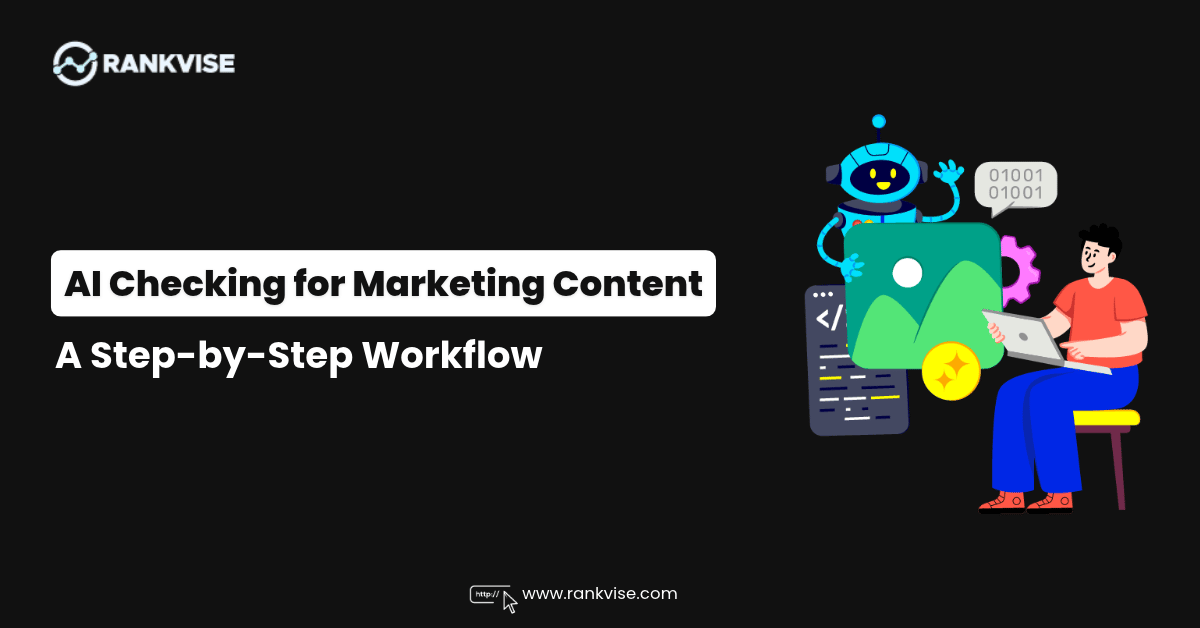
That’s where AI checking comes in. Used well, it’s a quick sanity check that shows you where a draft reads like machine text, so you can fix those spots. Used badly, it turns into a numbers game that wastes time and punishes honest writers. This guide walks through a workflow that keeps it useful.
Why AI checking became part of the editorial process
Not long ago nobody had a line for this in their content checklist. Now plenty of teams do, and the reasons are practical.
Brand voice. Generic text is the biggest giveaway. If your blog sounds like every other blog on the topic, readers leave and nobody remembers you.
Trust. Agencies and in-house teams promise original thinking. Handing over a draft that is mostly unedited machine output undercuts that promise, even when the facts are right.
Search quality. Google has said it cares about helpful, people-first content rather than how a page was produced. But thin, repetitive pages tend to perform badly no matter who or what wrote them. That’s an editing problem, and a quick check can point you straight to it.
Rules set by others. Schools, universities, publishers and some clients have policies on AI use. Writers need to know how their work reads before they submit it.
What AI detectors measure, and what they can’t
Most detectors look at how predictable a piece of text is. Language models pick likely next words, so their output tends to be smooth and even. Human writing is messier. Sentence lengths jump around, word choices get odd, and tangents happen. Detectors pick up on those patterns and return a probability or a percentage.
Two things are worth remembering.
The score is an estimate, not a verdict. A detector can’t see how a draft was written. It only sees the finished text. Formal, tightly edited writing such as academic prose, legal copy or product documentation can look predictable even when a person wrote every word. False positives are a known problem, which is why no serious editor should treat a score as proof of anything.
Different tools disagree. Paste the same paragraph into three detectors and you’ll often get three different answers. That doesn’t mean one is broken. They’re trained on different data and use different thresholds.
So think of a detector as a smoke alarm, not a judge. It tells you where to look. You still have to do the looking.
A five-step workflow that actually works
Step 1: Start with a human brief
Most flat drafts are flat because the brief was thin. Before anyone writes or prompts anything, put down who the reader is, what they already know and what you want them to do next.
Then add two or three specifics only your team can supply: a client result, an internal benchmark, a mistake you made last quarter. Those details are what make content read as written by a person. No tool can supply them for you.
Step 2: Run a first check on the full draft
Once you have a draft, check the whole thing, not just the intro. Intros are often the most polished part and the least representative.
Look for a tool that highlights which sections look machine-like instead of giving you only one headline number. That section-level view is what you actually need. Save the result or take a screenshot so you can compare after your edits.
Step 3: Read the flagged passages like an editor
Don’t rewrite blindly. Read each flagged paragraph and ask three questions:
- Could this sentence appear on any competitor’s blog?
- Is there a claim with no example behind it?
- Does the paragraph say anything, or does it just sound thorough?
Often the flagged parts are exactly the ones that say very little: broad statements, tidy summaries, lines like “there are many factors to consider.”
Step 4: Rewrite with specifics
Replace the vague sentence with a concrete one. Instead of “many businesses struggle with email deliverability,” write about a situation you actually saw, such as a client whose sales emails landed in spam for a month after a domain change.
Add a short opinion. Cut the paragraph that exists only to pad the word count. Mix up the rhythm: a longer sentence, then a short one. Read the piece aloud. If you get bored or run out of breath, your reader will too.
Step 5: Re-check once, then stop
Run the check one more time. If the flagged sections have shrunk, good. If a section you wrote yourself from experience keeps scoring high, don’t keep rewriting just to please the tool.
Chasing a perfect score turns writing into a game and usually makes the text worse. Make the call on editorial merit and move on.
How to choose among AI content detection tools
There are dozens of options now, and picking one feels harder than it should. A roundup of AI content detection tools is a decent starting point, but your own test will tell you more. Here’s what I’d check:
- Section-level feedback. A single score hides too much.
- Length limits. Many free tools cut off long drafts.
- Language support. This matters if you publish in more than English.
- Privacy. Find out where pasted text goes and whether it’s stored. That matters for unpublished client work.
- Consistency. Paste the same known-human text and known-AI text a few times. A tool that gives wildly different results each run isn’t worth trusting.
- Reports. Being able to save or share a report is handy when a client asks questions.
A practical tip: pick two tools and use both. When they agree, take the result seriously. When they disagree, trust your editor’s ear.
Checking essays and long academic-style writing
Education, e-learning and research-heavy industries bring their own challenge. This kind of writing is formal and structured, which is exactly what detectors tend to over-flag.
If you or your writers produce essays, white papers or student-facing guides, an AI essay checker can show you how a piece reads before anyone else runs it through a detector. Treat the report as a heads-up about specific paragraphs, not a grade.
A few habits help here:
- Keep your process. Hold on to outlines, notes and draft versions. If a score is ever questioned, a version history showing how the piece developed is far stronger evidence than any detector.
- Cite properly. Heavy, loose paraphrasing of sources can confuse detectors and weakens the writing anyway.
- Write the bookends last. Do the intro and conclusion in your own words after everything else is done. Those are usually the most generic parts.
Where humanizing tools fit
Some teams add a rewriting step to this workflow. A some tool rewrites machine-sounding text to improve flow, tone and rhythm, and some writers use that kind of tool as a first pass before their own edit. That can save time on a rough draft.
Still, keep your expectations realistic. No rewriting tool can add the experience, examples and opinions that make a piece worth reading, and none can promise how a particular detector will score the result.
Always read the output. Rewriting can shift meaning or slip in small factual errors. And check the rules that apply to you. If a school, publisher or client requires you to disclose AI assistance, follow that requirement.
Mistakes teams make with AI checking
Treating a score as proof. A percentage is a prompt to read more closely, nothing more. Never accuse a writer based on a number alone.
Checking only at the end. If you only check minutes before publishing, there’s no time to fix anything properly. Check at the first full draft instead.
Editing to move the number. Swapping synonyms to lower a score doesn’t make writing better. It often makes it stranger.
Forgetting the facts. A piece can pass every detector and still be wrong. Verify dates, statistics, quotes and product details separately.
Having no policy. Decide in advance what’s acceptable on your team. Can writers use AI for outlines? For research summaries? For first drafts? Writers do better work when the rules are written down.
A quick pre-publish checklist
- The brief named a real reader and a clear next step
- At least two specifics in the piece come from your own experience or data
- The full draft was checked, not just the opening
- Flagged paragraphs were read and rewritten where they were generic
- Sentence length and paragraph length vary
- Every statistic and quote has a source
- Titles, headings and links are in place
- Any disclosure your client or publisher requires is included
Where this fits in your wider content and SEO plan
AI checking is one step in a bigger system. Good content still starts with research and search intent, which is what a solid SEO strategy is built around.
If you can’t produce original pieces at the pace you want, bringing in a professional content writing team can fill the gap while you keep the final editorial say. And once a piece is live, run it through an on-page SEO audit tool to catch the basics: titles, headings, internal links and page speed.
Final thoughts
The goal of AI checking isn’t to catch people out or to chase a magic number. It’s to protect the thing readers actually come for, which is a point of view they can trust.
Build the check into your process early, use it to find the generic parts of a draft, and fix those with real examples and honest opinions. Do that consistently and the score mostly takes care of itself.
No tool can replace an editor who reads the piece aloud and asks, “Would I stop scrolling for this?” Keep that person in the loop and the rest gets much easier.