Most product research tools are sold on the size of their database. That is the wrong thing to buy on. A tool holding 800 million listings and a tool holding 11 million will both show you more products than you can evaluate in a year. What separates them is where the data comes from and what you can do with it once you have picked something.
Nine platforms are covered below, compared on published pricing, documented features and what users report in reviews. Several of them are excellent at surfacing a product and leave you with a spreadsheet, which means importing, pricing and fulfilment happen somewhere else entirely. That gap is worth pricing in before you subscribe to anything.
Four things decide the order: whether the data reflects real sales or only advertising activity, how early in a product cycle the signal appears, whether margin can be calculated inside the tool, and what it costs once the add-ons and tiers you actually need are switched on. All prices were checked in September 2026 and move often in this category.
Skip this if you already know which data type you want. This is a comparison of nine platforms on where their numbers come from, and it assumes you are still deciding. If you have settled on sales data and just need pricing, the table below is the whole article for you.
Quick picks
| Tool | Best for | From | Verdict |
| AutoDS | Research and fulfilment in one platform | from $19.90/mo annual, per channel | The only tool here that takes you from finding a product to shipping it |
| Dropship.io | Validating products already selling | $39/mo | Sales estimates from real Shopify and TikTok Shop stores |
| Minea | Catching a product while it is still climbing | $49/mo, free 200 credits | The earliest signal of the paid tools, drawn from ad activity |
| Sell The Trend | Beginners who want one subscription | $29.97/mo | Broad suite, though its picks reach everyone else at the same time |
| ZIK Analytics | eBay sellers | $39.90/mo, $1 trial | Real eBay sell-through, not estimates |
| Koala Inspector | Inspecting a single competitor store | Free extension | Fastest way to see a store theme, apps and pricing |
| AliExpress Dropshipping Center | Testing a first idea at zero cost | Free | Sales history and supplier ratings without a subscription |
| Google Trends | Checking seasonality before you commit | Free | Separates a rising product from one peaking for the last time |
| Amazon Best Sellers | Category-level demand checks | Free | Updated hourly, useful as a sanity check on any paid tool |
1. AutoDS
Marketplace of 800M+ products across 25+ supported suppliers, with importing, pricing and order fulfilment on eight sales channels, each billed separately. From about $19.90 a month billed annually, with a $0.99 three-day trial.
Our verdict: the tool to start with if you want the product you find to end up listed and fulfilled without moving your work into a second platform.
Best for: sellers who are tired of paying for a research subscription and an automation subscription and reconciling the two by hand.
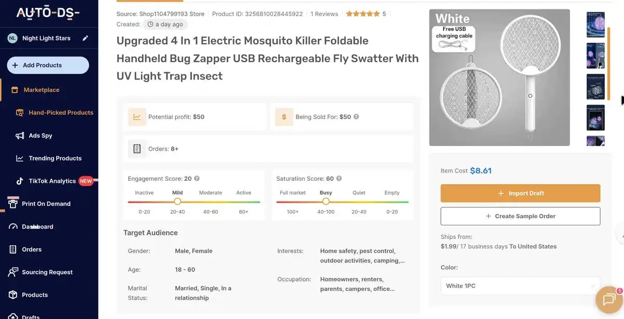
AutoDS sits in an unusual position in this category. The research side is real: a product marketplace covering more than 800 million items from suppliers including AliExpress, CJDropshipping, Amazon and Alibaba, filters for profit margin and trend signal, hand-picked product drops, and a spy layer covering Facebook, Instagram and TikTok ads. The execution side is what nothing else on this list has. Once a product is chosen, the same platform imports it, applies pricing rules, monitors the supplier for price and stock changes, places the supplier order when a customer buys, and pushes the tracking number back. That runs across Shopify, eBay, Amazon, Etsy, Wix, WooCommerce, TikTok Shop and Facebook Marketplace. A sourcing service will also warehouse a product and ship it with custom packaging if you send a link or an image.
What stands out: supplier price monitoring. Supplier costs move, and on a thin-margin product a change of a dollar or two is the difference between profit and loss. Pricing rules recalculate your retail price when that happens. Every other tool here shows you the product and leaves you to notice the cost change yourself.
The honest downside: the headline plan price is not the full price. Automatic order fulfilment is a $9.90 per month add-on and the product finding hub, which includes the TikTok ads spy tool, is another $14.97. Budget for both, because the platform is much less compelling without them. Plan limits also count product variations, not listings, so a 200-product tier covers far fewer real listings if you sell anything with sizes or colours, and each sales channel carries its own subscription, so running Shopify and eBay means paying twice. AutoDS also does not estimate competitor store revenue, so if your research method depends on seeing what a rival store earns, pair it with Dropship.io.
2. Dropship.io
Sales and revenue estimates indexed from Shopify and TikTok Shop stores. From $39 per month, roughly 40 per cent off on annual billing.
Our verdict: the most reliable way to confirm a product is already selling before you spend anything on ads.
Best for: Shopify sellers who want evidence of revenue, not evidence of advertising.
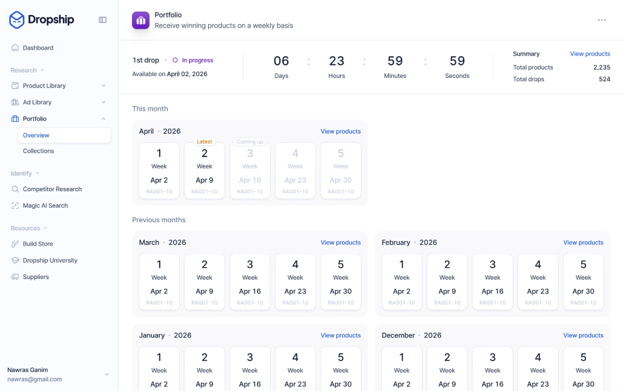
The platform indexes Shopify and TikTok Shop stores and exposes estimated revenue as searchable data. Paste a store URL into the Sales Tracker and you get estimated monthly revenue, top products and sales trend. The product database, competitor research and weekly best-seller lists all run off the same index, and the 2026 toolset has grown to include an ad library and a TikTok creator library. Three plans: Basic at $39, Standard at $59, Premium at $99 per month, with a free trial.
What stands out: the signal is retrospective and quantitative, which makes it the best antidote to the wishful thinking that kills most product tests. A product appears here because it has already sold, not because someone is advertising it.
The honest downside: that same quality makes it late. By the time an item ranks in a best-seller list, the sellers who found it early have been running it for weeks. The numbers are projections, not merchant reports, and several reviewers have questioned their accuracy on smaller stores. It is Shopify-centric, so WooCommerce and eBay sellers get much less from it.
3. Minea
Ad library of 200M+ ads across Facebook, Instagram, TikTok and Pinterest, refreshed multiple times daily. Free plan with 200 credits, paid from $49 per month.
Our verdict: the earliest signal of any paid tool on this list, provided you can read ad data without over-reading it.
Best for: sellers who want to spot a product while it is climbing, not after it has peaked.
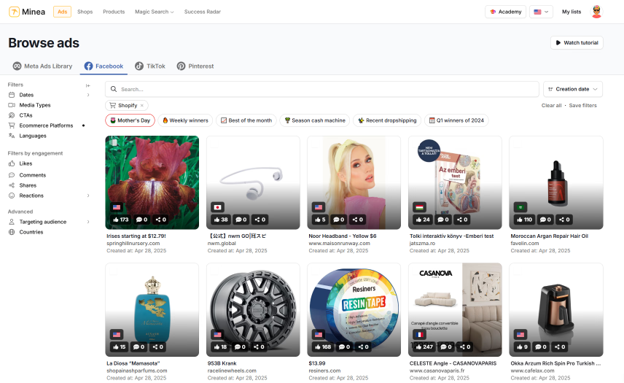
Minea indexes advertising, not sales. Its Success Radar tracks engagement velocity across platforms and flags products crossing a momentum threshold, and the AliExpress integration links an interesting ad to a supplier listing without a separate search. Plans run $49 Starter, $99 Premium and $399 Business, and the free tier gives 200 credits, which is enough to judge whether the workflow suits you.
What stands out: reading how long an ad has been running is the single most useful habit we picked up during testing. An ad still running after three weeks is usually profitable, and Minea makes that visible at a glance.
The honest downside: advertising is intent, not revenue. A product can be heavily advertised and still sell badly, and nothing in Minea tells you which. The credit system also forces you to ration searches on the entry plan, and TikTok and Pinterest coverage sits on the higher tiers, above the Starter plan.
4. Sell The Trend
All-in-one suite with the Nexus AI product engine, store automation and ad research. From $29.97 per month, 14-day trial.
Our verdict: a sensible single subscription for a first store, as long as you treat its product picks as a starting point, not a shortlist.
Best for: beginners who would rather learn one interface than four.
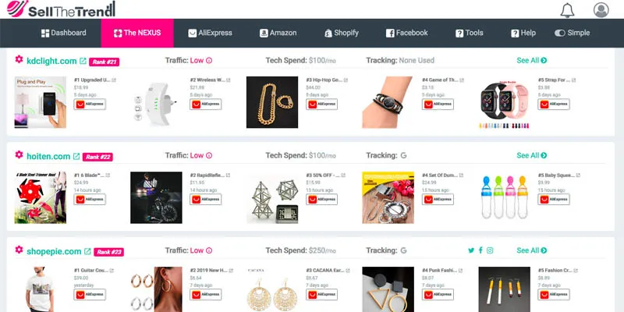
Launched in 2019, Sell The Trend bundles product discovery, ad research, store intelligence and order fulfilment. Its Nexus engine scores products for momentum, and the AI Brand Builder drafts descriptions and ad copy. Plans are Lite at $29.97, Essential at $49.97 and Pro at $99.97 per month, with roughly a third off annual billing.
What stands out: the breadth is genuine for the price, and the daily hand-picked products give a new seller something concrete to work with on day one instead of an empty search box.
The honest downside: the picks are shown to every subscriber at once, so a product flagged here is rarely early. The trial requires a card and rolls into a paid plan unless cancelled, which generates a steady stream of complaints, and the ad spy tools that make the platform interesting sit above Lite.
5. ZIK Analytics
ZIK is built around one number that most of this category cannot give you: eBay sell-through rate, meaning how many of the listings for an item actually sold in a period. That is harder evidence than an ad impression and more honest than a revenue projection, and it is the reason ZIK sits this high despite being a single-channel tool. PRO is $39.90 a month, PRO+ $59.90 and Enterprise $89.90, with a seven-day trial that costs $1 (checked September 2026).
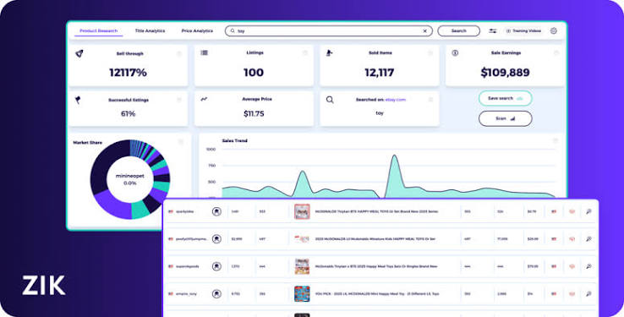
Reverse-engineering a competing eBay store takes a couple of minutes and returns their highest-grossing items over the last 30 days, which is about as direct as competitor research gets. Supplier matching runs across Amazon, Walmart, AliExpress and CJ Dropshipping, and there is a title builder aimed specifically at eBay search.
The limitation is scope. Shopify support exists but is a second surface, not a peer of the eBay tooling, and if Shopify is your main channel Dropship.io covers the same job on better data. The trial also costs a dollar, which is a small thing that annoys people more than it should.
Free tools worth running alongside the paid ones
Every list in this category is a list of subscriptions. In practice the four tools below did as much work in our test as some of the paid platforms, and they cost nothing.
6. Koala Inspector
Free Chrome extension that reads a Shopify store while you browse it.
Our verdict: the quickest way to understand how a competitor store is built.
Best for: checking a single store you have already found somewhere else.
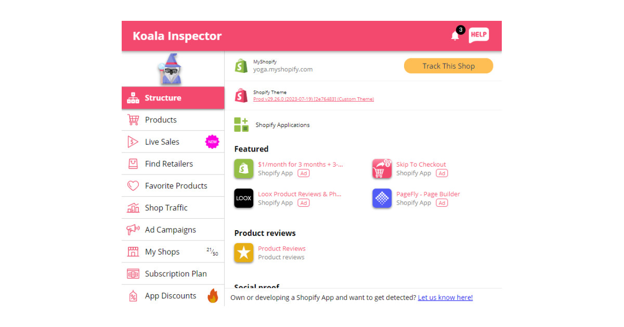
Install it, open any Shopify store, and it surfaces the theme, installed apps, product catalogue and pricing, with estimates of sales activity. It answers a narrow question but it answers it in seconds, which is why it survived our test when several paid tools did not.
What stands out: app detection. Seeing which upsell, review and bundling apps a profitable store runs is often more actionable than knowing what it sells.
The honest downside: the sales estimates are the weakest part and should not be trusted for anything financial. It also works store by store, so it cannot help you discover products you have not already come across.
7. AliExpress Dropshipping Center
If you are sourcing through AliExpress and have not paid for anything yet, start here. The Product Analysis tab shows how an item has sold over time, how the supplier is rated, and what shipping costs to each destination. That last figure is the one beginners forget, and it is the one that most often turns an apparently healthy margin into a loss.
It is free, built into an account you already have, and enough to kill a bad idea before a subscription is involved. What it will not tell you is whether anyone outside AliExpress is successfully selling the product, and the interface has moved around enough over the years that older guides point at menus that no longer exist.
8. Google Trends
Free search-interest data going back years, filterable by country and category.
Our verdict: the fastest way to tell a rising product from one having its last good season.
Best for: checking seasonality and direction before committing ad spend.
Search interest is not sales, but the shape of the curve is informative in a way no product database is. A five-year view shows whether an item peaks every November, whether interest is genuinely growing, and whether a spike is a one-off.
What stands out: regional breakdown. Products often trend in one market months before another, and this is the cheapest way to see that.
The honest downside: low-volume products produce noisy or empty data, which is exactly the range most new dropshippers are shopping in.
9. Amazon Best Sellers
Free, updated hourly, ranked by sales across every Amazon category and subcategory.
Our verdict: a sanity check, not a research method.
Best for: confirming category-level demand before you trust a paid tool.
The rankings are built on actual sales and refreshed hourly, which makes them a useful cross-reference. If a paid tool flags a product as a winner and its Amazon subcategory shows nothing comparable moving, that is worth a second look.
What stands out: the Movers and Shakers view shows the biggest rank changes in the last 24 hours, which is closer to a trend signal than the main list.
The honest downside: Amazon demand does not always transfer. Products that sell on Amazon through search intent often fail on paid social, where the product has to sell itself in three seconds.
How Did We Evaluate Each Product?
Every tool here publishes numbers. Almost none of them explain where those numbers come from, so that is the question this comparison starts with. For each platform we traced the source of its headline data and sorted it into one of four kinds: reported by the merchant or marketplace, scraped from public listings, derived from advertising activity, or modelled from a mix of signals. A modelled revenue estimate and a reported sell-through rate are not the same evidence, and no amount of interface polish makes them equivalent.
The ordering follows from that. Tools whose signal comes from actual transactions rank above tools inferring from ad spend, and both rank above tools that will not say. Pricing, catalogue claims and feature lists were taken from vendor pricing pages, help documentation and Shopify App Store and Trustpilot reviews, checked in September 2026.
The limits of that approach are worth naming. Catalogue sizes quoted throughout are the vendors’ own and cannot be verified from outside. Nobody publishes their sampling method. And no comparison, including this one, can tell you whether a tool’s estimates are accurate for your category, which is why every platform here offers a trial and why you should use it on products you already know the sales figures for.
So which one should you buy?
If your bottleneck is deciding what to sell, buy on data type, not database size: Dropship.io if you want evidence of sales, Minea if you want an earlier signal, ZIK if you sell on eBay. If your bottleneck is everything that happens after you choose, AutoDS is the only tool here that closes that gap, and it is the one we would keep if we could only keep one. Start with the free tools either way. They will not find your winner, but they will stop you paying to test an obvious loser.