The CFO leans back in the budget meeting. “You want ₹30 lakh for SEO next year. What will we get back?”
- Provide honest forecasts with ranges, clear assumptions, and regular updates to reflect real data.
- Start with a trend baseline, add keyword forecasts and seasonality, then present conservative, expected, and optimistic scenarios.
- Convert traffic into leads and revenue using conversion rates and average deal value, and compare value with paid search costs for leadership.
“More traffic” is not an answer. “It depends” is worse.
SEO forecasting helps you answer that question with numbers. It will never be perfect, because Google, competitors, and markets change. But a clear, honest forecast turns SEO from a hopeful expense into a planned investment.
This guide explains what SEO forecasting is, the main methods, a simple step-by-step model, and how to present forecasts without overpromising.
What Is SEO Forecasting?
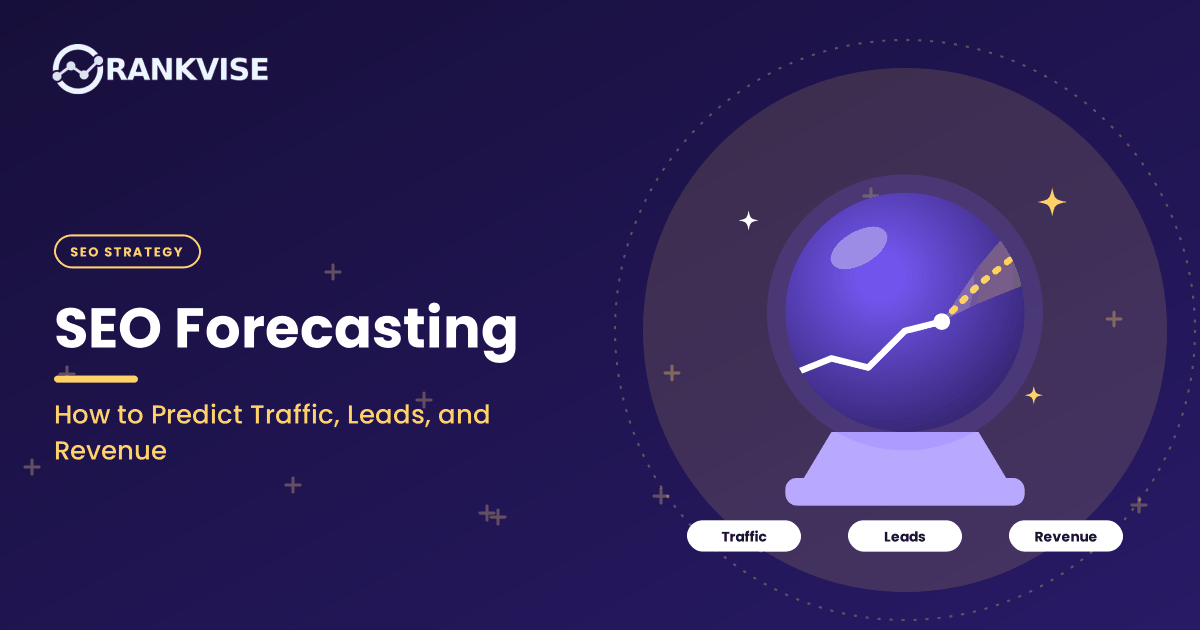
SEO forecasting is the process of estimating future organic search performance. That usually means traffic, but good forecasts go further, to leads, sales, and revenue.
A forecast answers questions like:
- How much organic traffic could we get in 12 months?
- How many leads or sales might that traffic produce?
- What would it be worth compared with paid ads?
- Which projects are likely to bring the biggest gains?
Why SEO Forecasting Matters
A good forecast helps you:
- Win budget, by linking SEO work to revenue.
- Prioritise projects, by comparing expected impact.
- Set realistic targets for teams and agencies.
- Spot problems early, when actual results drift from the forecast.
- Plan resources, such as writers, developers, and link building.
Without a forecast, SEO decisions often rely on gut feeling. With one, they rely on clear, shared assumptions.
The Honest Truth: Forecasts Are Estimates
Every SEO forecast is an educated guess. Search engines update algorithms. Competitors publish new content. AI Overviews can reduce clicks even when rankings hold.
That is why the best forecasts:
- Show a range, not a single number.
- State their assumptions clearly.
- Get updated regularly as real data arrives.
As one Search Engine Land guide puts it, forecasting models “provide estimates, not exact figures.” Say this upfront to stakeholders.
The Main SEO Forecasting Methods
| Method | How it works | Best for | Weakness |
|---|---|---|---|
| Trend-based | Projects past traffic forward | Established sites with steady data | Ignores new projects |
| Keyword-based | Estimates traffic from target rankings and search volume | New content or new markets | Depends on volume and CTR estimates |
| Seasonal model | Adds yearly patterns to trends | Seasonal businesses | Needs at least a year or two of data |
| Scenario-based | Builds low, expected, and high cases | Budget planning | Requires judgment |
| Tool-based | Uses forecasting features in SEO tools | Quick estimates | Hidden assumptions |
Most strong forecasts combine methods. For example, a trend forecast for existing pages plus a keyword forecast for new content.
Method 1: Trend-Based Forecasting
Trend-based forecasting uses your historical data to predict future performance. It answers: “If we keep going as we are, where will we land?”
Data You Need
- At least 12 months of monthly organic clicks or sessions. Two to three years is better.
- Data from Google Search Console or GA4.
Simple Spreadsheet Formulas
In Google Sheets or Excel, you can use:
- FORECAST or FORECAST.LINEAR for a straight-line trend.
- FORECAST.ETS in Excel, which can include seasonality automatically.
- A moving average, which smooths out short-term noise.
For example, =FORECAST(A14, B2:B13, A2:A13) predicts month 13 from the previous 12 months.
When to Use It
Use trend forecasting as your baseline. It shows what happens with no major new projects. Then layer planned projects on top.
Method 2: Keyword-Based Forecasting
Keyword-based forecasting estimates traffic from the rankings you hope to achieve. It works well for new content, new service pages, or new markets.
The Basic Formula
Estimated monthly traffic = Search volume × Expected click-through rate (CTR)
For example, a keyword with 2,000 monthly searches, ranked third with an estimated 10% CTR, could bring about 200 visits a month.
Example CTR Assumptions by Position
CTR varies by industry, device, brand, and search features. Use your own Search Console data where possible. If you have none, start with conservative assumptions like these:
| Position | Conservative CTR assumption |
|---|---|
| 1 | 20–30% |
| 2 | 10–15% |
| 3 | 7–10% |
| 4–5 | 4–7% |
| 6–10 | 1–4% |
| 11+ | Under 1% |
Reduce CTRs further for keywords with AI Overviews, ads, or map packs above organic results.
Step-by-Step Keyword Forecast
- List target keywords for each planned page.
- Add monthly search volume from your SEO tool.
- Set a realistic target position for each keyword.
- Apply a CTR for that position.
- Multiply volume by CTR for estimated traffic.
- Add a ramp-up period, because rankings take time.
Method 3: Adding Seasonality
Many businesses have strong seasonal patterns. A tax consultant peaks before filing deadlines. A gifting brand peaks before festivals and holidays.
To add seasonality:
- Calculate each month’s share of annual traffic from past years.
- Apply those shares to your annual forecast.
- Check the pattern against Google Trends for key topics.
Excel’s FORECAST.ETS can detect seasonality automatically when you have enough historical data.
Method 4: Scenario-Based Forecasting
Leadership teams usually want to know the risk. Scenarios give them that.
| Scenario | Assumption | Use |
|---|---|---|
| Conservative | Slower rankings, lower CTRs | Minimum expected result |
| Expected | Realistic rankings and CTRs | Main planning number |
| Optimistic | Faster progress, stronger CTRs | Upside if things go well |
Present all three. It sets honest expectations and builds trust.
From Traffic to Revenue: Completing the Forecast
Traffic alone does not convince a CFO. Convert it to business value.
Revenue = Traffic × Conversion rate × Average order value
For lead generation:
Revenue = Traffic × Lead conversion rate × Lead-to-customer rate × Average deal value
Worked Example
| Step | Value |
|---|---|
| Extra monthly organic traffic | 5,000 visits |
| Conversion rate to lead | 2% |
| Leads per month | 100 |
| Lead-to-customer rate | 10% |
| New customers per month | 10 |
| Average deal value | ₹50,000 |
| Extra monthly revenue | ₹5,00,000 |
Use your own GA4 and CRM data for conversion rates. Industry averages are a weak substitute.
Compare With Paid Search
Another useful view: what would this traffic cost in Google Ads? Multiply forecast clicks by average cost per click for the same keywords. This gives leadership an easy comparison.
Tools That Help With SEO Forecasting
| Tool type | Examples | Use |
|---|---|---|
| Real performance data | Google Search Console, GA4 | Baseline traffic and CTRs |
| Keyword data | Ahrefs, Semrush, Moz | Search volume and difficulty |
| Spreadsheets | Google Sheets, Excel | Building the model |
| Trend data | Google Trends | Seasonality checks |
| Built-in forecasting | Some enterprise SEO suites | Quick projections |
Ahrefs, for example, lists forecasting among its Enterprise plan features. Many teams still build their own spreadsheet models for control and transparency.
How to Forecast for a New Website
New websites have no history, so trend forecasting will not work. Use a keyword-based approach with extra caution.
- Start small. Forecast only the first 10 to 30 priority pages.
- Target easier keywords. New sites rarely rank for highly competitive terms in year one.
- Use slower ramp-ups. Assume 6 to 12 months before pages reach target positions.
- Lower your CTR assumptions. New brands often get fewer clicks than known names.
- Benchmark competitors. Look at similar-sized competitors’ estimated traffic in SEO tools for a reality check.
Review the forecast after three months. Early ranking and impression data will tell you whether your assumptions were too optimistic or too cautious.
How AI Search Affects SEO Forecasts
AI Overviews and AI chat tools are changing how people search. Some queries now get answered without a click.
To account for this:
- Flag keywords that show AI Overviews in your rank tracker.
- Apply lower CTRs to those keywords.
- Track brand mentions and citations in AI answers as a separate visibility metric.
- Focus forecasts on high-intent keywords, where people still click to buy or enquire.
How Long Before SEO Results Show?
Timelines depend on site strength, competition, and how much you invest. As a rough guide:
- Technical fixes can show results within weeks.
- Updates to existing content can move rankings within one to three months.
- New content often takes three to six months or more to reach its potential.
- Competitive keywords can take six to twelve months or longer.
Build these ramp-up periods into your forecast. Many forecasts fail because they assume new pages rank instantly.
Common SEO Forecasting Mistakes
- Giving one exact number instead of a range.
- Assuming top rankings for every target keyword.
- Ignoring AI Overviews and SERP features, which can reduce clicks.
- Using generic CTR curves when you have your own data.
- Forgetting seasonality.
- Not converting traffic to revenue.
- Never updating the forecast after launch.
How to Present an SEO Forecast to Leadership
Keep it simple and honest:
- Start with the business goal, such as more qualified leads.
- Show the baseline, what happens if nothing changes.
- Show the planned projects and their expected impact.
- Present three scenarios, with clear assumptions.
- Convert to revenue, and compare with paid search cost.
- Agree on review points, such as monthly or quarterly.
Real-World Example: Forecasting for a B2B Service Company
Consider a B2B software company planning 20 new service and solution pages.
The SEO lead built a baseline from two years of Search Console data. Then she added a keyword-based forecast for the new pages, using conservative CTRs and a six-month ramp-up.
She presented three scenarios to leadership, converting each to leads and pipeline using CRM conversion rates. The expected case showed the project paying back within a year.
Leadership approved the budget. Each month, the team compared actual results with the forecast and adjusted priorities. When a few pages outperformed, they doubled down on similar topics.
Conclusion: Forecast Honestly, Update Often
SEO forecasting is not about predicting the future perfectly. It is about making clear, shared assumptions that guide better decisions.
Start with a trend-based baseline. Add keyword-based forecasts for new projects. Include seasonality, use scenarios, and convert traffic into revenue.
Then review your forecast regularly. A forecast that adapts to real data becomes one of the most powerful tools for winning and keeping SEO budget.
FAQs
What is SEO forecasting?
SEO forecasting estimates future organic traffic, leads, and revenue using historical data, keyword data, and realistic ranking assumptions.
How accurate are SEO forecasts?
They are estimates. Use ranges and scenarios, state assumptions clearly, and update forecasts as real data arrives.
How do I forecast SEO traffic in Google Sheets?
Use 12+ months of Search Console data with the FORECAST function, or multiply keyword volume by expected CTR.
How long does it take to see SEO results?
Technical fixes can help within weeks. New content often takes three to six months or longer, depending on competition.
How do I calculate SEO ROI?
Multiply forecast traffic by conversion rate and average order or deal value, then compare it with SEO costs.