Your sales team closed 40 deals last quarter. Ten of them brought in 70% of the revenue. Those ten also renewed, expanded, and referred new clients.
- Build your ICP from top customers using CRM and billing data: revenue, retention, expansion, profitability, and satisfaction.
- Score leads on fit, engagement, and intent; prioritize high-fit, high-value, and ready-to-buy accounts for fast outreach.
- Define a negative ICP to filter poor-fit accounts early: churn risks, heavy support, long procurement, or unrealistic expectations.
- Document the ICP clearly, align sales, marketing, and success, and review quarterly to keep the model predictive and current.
The other 30 took just as much effort. Some churned within months.
That gap is the reason an ideal customer profile matters. When you know exactly who your best customers are, you can find more of them and stop chasing leads that drain your team.
This guide explains how to use an ideal customer profile to find high-value leads. You will learn how to build an ICP from real data, score leads against it, and keep it accurate over time.
What Is an Ideal Customer Profile (ICP)?
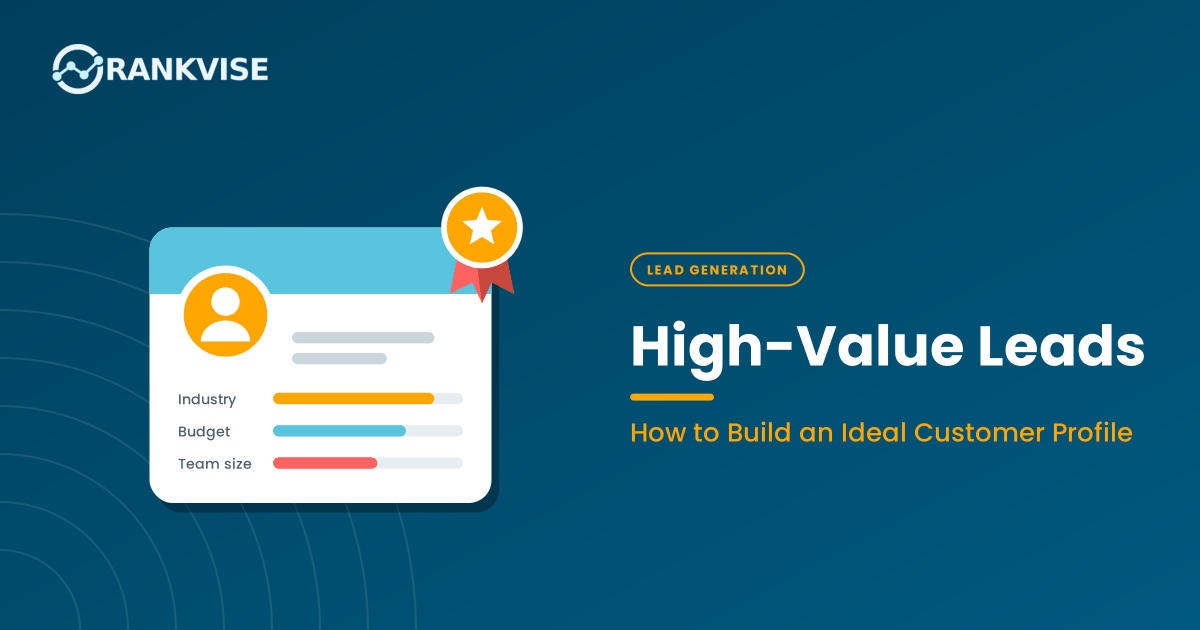
An ideal customer profile describes the type of company that gets the most value from your product and gives the most value back to your business.
It is a description of an organisation, not a person. A strong ICP usually covers:
- Industry and business model.
- Company size, by employees or revenue.
- Location and markets served.
- Growth stage, such as funded startup or established enterprise.
- Technology stack, especially tools you integrate with.
- Common problems your product solves for them.
- Buying triggers, like new leadership or rapid hiring.
A good ICP is specific. “Mid-sized tech companies” is too vague. “B2B SaaS companies in the US with 150–400 employees that use HubSpot and are hiring SDRs” gives your team something to act on.
What Makes a Lead “High-Value”?
Not every lead that looks good on paper is worth pursuing. A high-value lead combines three things:
| Factor | Question it answers | Example signals |
|---|---|---|
| Fit | Does this company match our ICP? | Right industry, size, tech stack |
| Value | Will they be worth a lot over time? | Large deal potential, likely to renew and expand |
| Timing | Are they likely to buy soon? | Recent funding, new leader, pricing page visits |
A lead with great fit but no buying need can sit in your pipeline for a year. A lead with urgent intent but poor fit may churn quickly. The best leads score well on all three.
ICP vs. Buyer Persona: What Is the Difference?
People often mix these up, but they work together.
| Ideal customer profile | Buyer persona | |
|---|---|---|
| Describes | A company | A person inside the company |
| Focus | Which accounts to target | Who to talk to and what to say |
| Example | Series B SaaS firms with 150–400 staff | Head of Sales Ops who owns the CRM budget |
| Used for | Targeting, lead scoring, account lists | Messaging, content, sales conversations |
A simple way to remember it: your ICP tells you which building to walk into. Your personas tell you which doors to knock on.
This matters because B2B purchases are rarely made by one person. Gartner research found that buying groups typically include 5 to 16 people across as many as four functions. Your ICP picks the right company. Your personas help you win over the whole group.
Why an ICP Helps You Find High-Value Leads
Without an ICP, sales and marketing chase anyone who seems interested. With one, every team works from the same definition of a good customer.
A clear ICP helps you:
- Focus budget on campaigns that reach the right companies.
- Qualify faster, because reps know what a good lead looks like.
- Shorten sales cycles by avoiding poor-fit deals that stall.
- Improve retention, since well-matched customers get more value.
- Align teams, so marketing sends leads sales actually wants.
It also improves how you speak to buyers. Gartner found that buying groups that reach consensus are 2.5 times more likely to report a high-quality deal. When you understand your ICP’s shared problems, you can speak to the whole buying group, not just one contact.
How to Build an Ideal Customer Profile: Step by Step
The best ICPs come from your own customer data, not guesswork. Follow these steps.
Step 1: Identify Your Best Existing Customers
Start with the customers who already deliver the most value. Pull a list from your CRM and billing system.
Rank customers by:
- Revenue, including lifetime value.
- Retention, such as how long they have stayed.
- Expansion, like upsells and added seats.
- Profitability, including support and service costs.
- Satisfaction, from NPS scores or account manager feedback.
- Sales cycle, meaning how quickly they bought.
Pick your top 10–20% of customers. These are your model customers.
Step 2: Find the Patterns They Share
Look for traits that appear again and again among your best customers.
Compare:
- Industry and sub-industry.
- Employee count and revenue range.
- Country or region.
- Tools they used before buying.
- Team structure, such as having a dedicated RevOps or marketing ops role.
- How they found you, such as referral, search, or outbound.
You may find surprising patterns. Perhaps your best customers all use a specific CRM, or all came through partner referrals.
Step 3: Talk to Customers and Your Team
Data shows what your best customers look like. Conversations explain why they buy.
Interview a handful of top customers. Ask:
- What problem made you start looking for a solution?
- What happened right before you decided to buy?
- Who else was involved in the decision?
- What almost stopped you from buying?
Then speak with sales and customer success. They know which accounts were easy to close and which caused constant friction.
Step 4: Define Your Negative ICP
A negative ICP describes the companies you should avoid. It is just as valuable as your ICP.
Look at customers who:
- Churned within the first year.
- Needed heavy support for little revenue.
- Pushed for large discounts.
- Stalled in long procurement processes.
- Had expectations your product could not meet.
Write down what they have in common. Then use those traits to filter leads out early.
Step 5: Document Your ICP Clearly
Turn your findings into a one-page profile that anyone in the company can use.
Here is a simple template:
| ICP element | Example |
|---|---|
| Industry | B2B SaaS and IT services |
| Company size | 150–400 employees |
| Revenue range | $15M–$50M annual revenue |
| Region | US, UK, and Canada |
| Tech stack | Uses HubSpot or Salesforce |
| Key pain point | Low outbound reply rates and messy CRM data |
| Buying triggers | New VP of Sales, recent funding, SDR hiring |
| Decision-makers | VP Sales, RevOps lead, CFO for final approval |
| Deal-breakers (negative ICP) | Under 50 employees, no dedicated sales team |
Keep it short. A profile nobody reads will not change behaviour.
Step 6: Turn Your ICP Into a Lead Scoring Model
Your ICP becomes truly useful when you score leads against it. A common approach combines three scores: fit, engagement, and intent.
One widely used model weights them like this:
Total score = (Fit × 40%) + (Engagement × 30%) + (Intent × 30%)
Here is an example of how points might be assigned:
| Category | Signal | Points |
|---|---|---|
| Fit | Industry matches ICP | +20 |
| Fit | Company size in target range | +15 |
| Fit | Uses a compatible CRM | +10 |
| Fit | Matches negative ICP trait | –30 |
| Engagement | Opened or replied to emails | +10 |
| Engagement | Attended a webinar | +10 |
| Intent | Visited pricing page | +20 |
| Intent | Recent funding or new sales leader | +15 |
Then sort leads into tiers:
| Tier | Score | Action |
|---|---|---|
| A (hot) | 80–100 | Sales outreach within 24 hours |
| B (warm) | 50–79 | Targeted sequences and account-based campaigns |
| C (nurture) | 25–49 | Nurture emails and content |
| D (monitor) | Below 25 | Track only |
Adjust these weights to fit your business. A company with long sales cycles might weight fit more heavily. A product-led company might weight engagement more.
Step 7: Validate and Refresh Regularly
Your ICP is a living document. Markets change, products evolve, and new segments open up.
Review your ICP and scoring model at least every quarter. Check:
- Do Tier A leads close at a much higher rate than Tier C? A good model should show a clear gap, often twice the win rate or more.
- Are deal sizes larger for high-scoring accounts?
- Are new customers retaining as well as your model customers?
- Has a new segment started performing well?
If the scores do not predict results, change the criteria.
How to Spot High-Value Leads in Practice
Once your ICP is in place, look for these signals when reviewing leads.
Strong fit signals:
- The company matches your industry, size, and region.
- They use tools you integrate with.
- They have the team structure your product supports.
Strong timing signals:
- They recently raised funding or announced expansion.
- A new executive joined in a relevant role.
- They are hiring for roles your product helps.
- They visited your pricing, demo, or comparison pages.
Red flags:
- They match your negative ICP.
- The contact has no link to the buying decision.
- They want heavy customisation you do not offer.
Common ICP Mistakes to Avoid
- Building it from opinions. Base your ICP on real customer data, not what leadership assumes.
- Making it too broad. “All B2B companies” is not a profile. Be specific.
- Ignoring the negative ICP. Knowing who to avoid saves as much time as knowing who to target.
- Confusing ICP with personas. You need both, but they do different jobs.
- Setting it and forgetting it. An outdated ICP sends your team after the wrong leads.
- Keeping it in one team. Sales, marketing, and customer success must all use the same profile.
Real-World Example: A Marketing Agency Refines Its ICP
Consider a digital marketing agency offering Google Ads and conversion tracking services. It worked with any business that asked, from local shops to large ecommerce brands.
After reviewing its client data, the agency noticed a clear pattern. Its most profitable, longest-staying clients shared these traits:
- Ecommerce brands running on Shopify.
- Annual ad spend in a mid-sized range.
- An in-house marketing manager to work with.
- A clear need for accurate GA4 and conversion tracking.
Small local businesses, by contrast, often paused campaigns within three months and needed heavy support.
The agency made three changes:
- It rewrote its ICP around Shopify ecommerce brands with in-house marketers.
- It added “no dedicated marketing contact” to its negative ICP.
- It scored inbound leads on fit before booking discovery calls.
Sales calls dropped, but the share of calls that turned into clients rose. The team spent less time on poor-fit prospects and more time on accounts worth keeping.
Conclusion: Better Targeting Starts With a Better Profile
High-value leads do not appear by chance. They come from knowing exactly who your best customers are and why they buy.
Start with your top customers. Find the patterns they share. Define who to avoid. Then turn your ideal customer profile into a scoring model your whole team uses.
Review it every quarter, and your pipeline will fill with leads that close faster, stay longer, and grow over time.
Frequently Asked Questions
What is an ideal customer profile in B2B sales?
It describes the type of company that gains the most from your product and brings the most value to your business.
How is an ICP different from a buyer persona?
An ICP describes the target company. A buyer persona describes the individual people inside it who influence or make the decision.
How do you identify high-value leads?
Look for leads with strong ICP fit, high long-term value potential, and clear buying signals, such as funding or pricing page visits.
What is a negative ICP?
A negative ICP lists traits of companies that are poor customers, such as fast churners or accounts needing heavy support for little revenue.
How often should you update your ideal customer profile?
Review it at least every quarter, and update it after major product changes or when a new segment starts performing well.