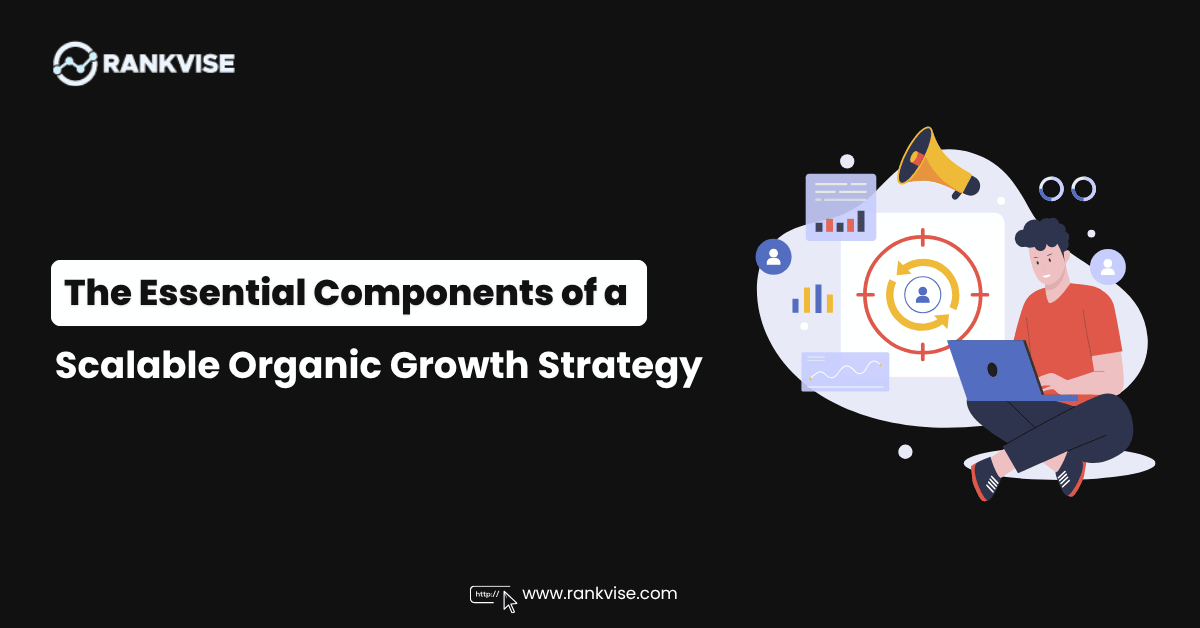
Organic growth is one of the most valuable ways to build a business online. Instead of depending entirely on paid advertising or short-term promotional campaigns, an organic strategy can create a steady stream of visibility, traffic, leads, and sales over time.
- Set clear goals aligned with broader business objectives to guide strategy, prioritization, and resource allocation.
- Maintain strong technical SEO foundations so search engines can discover, crawl, and index content as the site scales.
- Use keyword research focused on search intent and topic clusters to plan content across the customer journey.
- Develop repeatable content production and scalable processes that preserve quality while enabling increased output and clear responsibilities.
However, there is an important difference between achieving organic growth and building organic growth that can scale.
Here are the essential components businesses should consider when developing an organic growth strategy designed for the long term.
1. Clear Goals and a Defined Growth Strategy
Before creating content or targeting keywords, a business needs to understand what organic growth is expected to achieve.
Increasing website traffic might seem like the obvious objective, but traffic alone does not necessarily contribute to business growth. Thousands of additional visitors have limited value if they have little interest in the company’s products or services.
Organic goals should therefore connect to wider business objectives.
Depending on the organization, these goals might include increasing qualified leads, generating ecommerce revenue, entering new markets, building brand awareness, reducing reliance on paid acquisition, or attracting customers for a particular service.
Defining these priorities creates direction for the entire strategy.
For example, a company planning to expand into a new service area may prioritize building topical authority around that service. An established ecommerce company, on the other hand, might focus on improving the visibility of high-value product categories.
Clear goals also make it easier to determine where resources should be invested as the strategy grows.
2. Strong Technical SEO Foundations
Scaling organic marketing becomes considerably more difficult when a website has unresolved technical problems.
Technical SEO provides the foundation that allows search engines to efficiently discover, understand, and index website content. As a website expands, this becomes increasingly important.
A relatively small website might contain only a few dozen pages. Over time, however, new blog posts, service pages, product categories, location pages, and other resources can increase that number significantly.
Without proper management, this growth can create issues involving duplicate content, broken internal links, unnecessary redirects, poor site architecture, or pages that search engines struggle to crawl.
Technical SEO should therefore be treated as an ongoing part of organic growth rather than a one-time task.
Important areas include site speed, mobile usability, crawlability, indexing, URL structures, structured data, canonicalization, internal linking, and Core Web Vitals.
Regular technical audits can identify problems before they begin limiting organic performance. This becomes particularly valuable as the size and complexity of a website increase.
3. Keyword Research Based on Search Intent
Keyword research remains an essential part of organic growth, but scalable strategies need to look beyond individual high-volume search terms. Businesses should understand the wider topics their audiences search for and, more importantly, why people conduct those searches.
Search intent generally reflects what a user wants to accomplish. Someone might be looking for information, comparing possible solutions, researching a company, or preparing to make a purchase.
Understanding these differences helps businesses create content for multiple stages of the customer journey.
Rather than selecting unrelated keywords and creating individual pages for each one, a scalable approach can organize keywords into logical topic groups. These groups can then inform larger content clusters consisting of core commercial pages supported by useful informational resources.
This creates a more organized strategy while reducing the risk of producing several pages that compete for the same or very similar searches.
It also allows content planning to become systematic rather than reactive.
4. A Repeatable Content Production Process
Content is central to many organic growth strategies, but simply increasing publishing frequency does not guarantee better results.
Scalability depends on developing a repeatable process that maintains quality as content output increases.
That process might include keyword research, topic selection, competitor analysis, briefing, writing, editing, optimization, fact-checking, publishing, internal linking, and performance reviews.
Responsibilities should be clear at each stage.
Templates can also make production more efficient without making every piece of content feel identical. For example, content briefs might consistently include the primary topic, search intent, supporting keywords, audience, recommended structure, internal links, and conversion goal.
A structured workflow reduces unnecessary delays and makes it easier to involve additional writers, editors, SEO specialists, or external partners as demand increases.
The objective should not simply be to publish more. It should be to create a system capable of producing consistently useful content at the volume required to support growth.
5. Content That Supports the Entire Customer Journey
A scalable strategy should avoid focusing exclusively on top-of-funnel informational content. Educational articles can attract valuable traffic, but businesses ultimately need a route that takes visitors from initial discovery toward consideration and conversion.
Content should therefore address different stages of the customer journey.
Early-stage content might answer common questions or explain a problem. Mid-funnel resources can help people understand available solutions, compare approaches, or explore relevant features. Commercial pages can then address visitors who are closer to taking action.
Internal links help connect these stages.
A useful informational article, for example, might naturally direct readers toward a detailed service page. That service page could then provide the information and calls to action required to encourage an inquiry.
Building these pathways makes organic traffic more commercially meaningful.
6. Strategic Internal Linking
Internal linking becomes increasingly important as websites grow. Without a clear internal linking strategy, valuable pages can become buried several clicks away from the homepage or disconnected from related content.
Internal links help users discover additional information while also helping search engines understand the relationship and hierarchy between pages.
Topic clusters provide one way to approach this systematically.
A broad central page can link to several detailed supporting resources, while those resources link back to the main page and to other genuinely relevant content within the cluster. This creates a connected information structure instead of a collection of isolated pages.
Internal linking should also be reviewed regularly. New content creates opportunities to strengthen existing pages, while older content may contain links that need to be updated or replaced.
7. Sustainable Authority Building
Strong content and technical SEO can provide an excellent foundation, but businesses operating in competitive search environments may also need to strengthen their website’s authority.
Relevant backlinks from reputable websites can contribute to this. The emphasis should be on sustainable authority building rather than simply acquiring the largest possible number of links.
Digital PR, original research, expert commentary, useful resources, and strategic content outreach can all create opportunities to earn or build relevant links.
For businesses that need additional capacity, outsourcing can also become part of the scaling process. Platforms such as Click Intelligence can support agencies and businesses that need a more streamlined way to manage elements of their SEO activity as demand increases.
Whatever approach is used, quality and relevance should remain central. A smaller number of valuable links from appropriate websites can be considerably more useful than large volumes of low-quality placements.
8. Regular Content Updates and Optimization
Organic growth does not come exclusively from publishing new pages. Existing content can represent one of a website’s most valuable assets.
Pages that already have search visibility, backlinks, or traffic may have the potential to generate significantly better results with relatively modest improvements.
Content should therefore be reviewed periodically. This could involve updating outdated information, expanding sections that no longer satisfy search intent, improving headings, strengthening internal links, refreshing examples, consolidating overlapping pages, or improving calls to action.
Performance data can help prioritize these updates. For example, a page ranking just outside the strongest search positions might offer a better short-term opportunity than publishing an entirely new article in a highly competitive area.
Content decay should also be monitored. Rankings and traffic can decline as competitors publish stronger resources, search behavior changes, or information becomes outdated.
A scalable strategy includes maintaining what has already been built, not just continually adding to it.
9. Conversion Optimization
Traffic growth is only one part of organic growth. If a website attracts increasing numbers of visitors but struggles to convert them into leads or customers, scaling traffic may simply magnify an existing weakness.
Conversion optimization should therefore develop alongside SEO.
Businesses should examine what visitors are expected to do after arriving on important organic landing pages.
Calls to action need to be clear and appropriate to the user’s intent. Forms should be straightforward. Navigation should make it easy to move toward relevant services, products, or resources. Trust signals should also be positioned where they can help users make decisions.
Different pages may require different conversion goals.
Someone reading an introductory guide may not be ready to request a quote immediately. A newsletter signup, downloadable resource, or link to more detailed information could provide a more appropriate next step.
A visitor arriving on a highly commercial service page, however, may be ready for a direct inquiry.
Matching conversion opportunities to intent helps turn organic visibility into measurable business outcomes.
10. Processes That Can Scale with the Business
One of the most overlooked elements of organic growth is operational capacity. A strategy can be excellent on paper but still fail if the team cannot execute it consistently.
As organic activity expands, businesses need processes capable of handling additional keyword research, briefs, content production, optimization, technical work, reporting, and outreach.
Automation can reduce repetitive administrative work, but it should be used selectively. Tasks requiring expertise, judgment, creativity, or quality control still benefit from human oversight.
Documentation is equally important.
Clearly documented workflows make it easier to onboard new employees, work with freelancers, collaborate with agencies, and maintain standards when responsibilities change.
The goal is to prevent growth from creating unnecessary complexity.
Building Organic Growth That Lasts
Scalable organic growth is not about finding one tactic that suddenly transforms website performance. It comes from building several connected systems that can continue operating effectively as a business expands.
Technical SEO provides the foundation. Keyword and audience research identify opportunities. High-quality content creates visibility and value. Internal linking strengthens the website’s structure, while authority building improves competitiveness. Conversion optimization helps turn increased visibility into commercial results, and accurate measurement provides the information required to make better decisions.
The processes behind these activities matter just as much as the activities themselves.
When workflows are repeatable, priorities are clear, and performance is measured against meaningful business objectives, organic marketing becomes easier to expand without losing focus or quality.