Skip to content
When your niche is crowded, keyword research can feel like showing up late to a packed concert. The obvious terms are owned by big brands, the SERP looks locked, and every “good idea” seems taken. That is when you stop chasing the loudest keywords and start hunting for the ones competitors keep overlooking.
- Prioritize SERP inspection to spot weak, unsatisfying pages before relying on keyword tools.
- Target specific, high-intent modifier keywords that indicate readiness to choose.
- Perform content gap analysis to find overlooked angles competitors mention but never fully answer.
- Validate targets by assessing top results format and backlink strength to set realistic effort levels.
- Build complete, updatable pages and monitor SERP changes to maintain advantage over time.
Untapped keywords are rarely secret. They are usually ignored because they look too specific, too weird, or too small. Yet those are often the terms that bring the cleanest leads, since the searcher already knows what they need and is close to choosing.
If you are learning SEO and need сoursework help, this article works for that, too. You can use the exact process for a real site or learn how to explain it clearly in a paper. You will learn how to spot gaps, validate opportunities, and turn them into pages that can win even when the market feels saturated.
Spot Weak SERPs Before You Touch a Keyword Tool
In competitive markets, the keyword tool is useful, but the SERP is the truth. Your job is to spot weakness: results that rank because nobody has built a truly satisfying page yet. When you find that, you can win without needing a massive brand.
Open the search results and pay attention to what Google is rewarding. Is the page answering the question directly, or dancing around it? Is it current? Is it written for the right audience? Weak pages often look “fine” at a glance, then fall apart once you actually read them.
Here are common signs of weak SERP competition that you can use as a quick checklist:
- The first page is full of thin listicles that repeat the same vague points
- Forum threads or Reddit posts rank high because no solid guide exists
- Results do not agree on format, which suggests Google is still testing intent
- Titles promise one thing, but the content delivers something else
- Pages are outdated, yet still ranking due to authority
When you see these signals, you have leverage. You can create a page that fits the real intent and feels complete. In a packed niche, that is often enough to move.
Organic Traffic Growth Without Chasing Head Terms
In tough markets, traffic usually comes from accumulation. You win a cluster of smaller searches, then those pages support each other and build topical strength. The result feels quiet at first, then you look up and realize your site is ranking for dozens of terms you never explicitly targeted.
This approach works because smaller queries tend to be cleaner. The searcher has context. They want an answer, a comparison, or a next step. If you satisfy that need better than the current results, you earn the click.
This is also where search intent optimization becomes your biggest advantage. Think like the searcher. Someone searching “best accounting software for contractors” wants quick decision help, clear tradeoffs, and a sense of who each option fits. Someone searching “how to set up job costing in QuickBooks” wants steps, screenshots, and a realistic example that matches a real workflow.
If you match intent and keep your internal linking simple, those smaller wins start stacking into meaningful traffic.
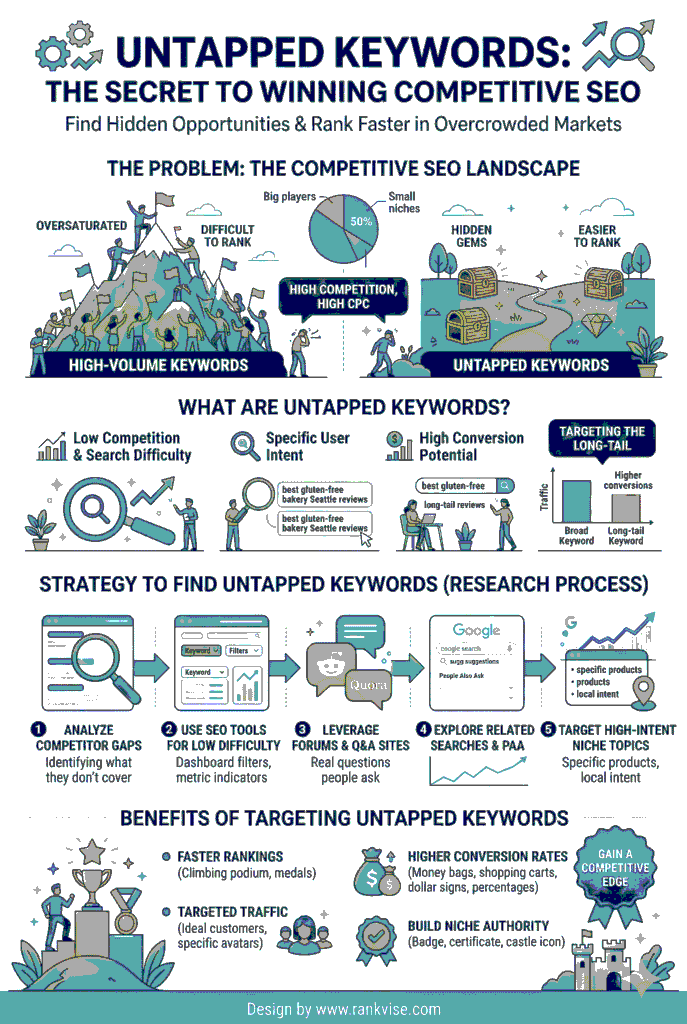
Content Gap Analysis That Finds What Others Skip
Most people treat competitor research like a copy exercise. They look at what ranks, then publish a similar version with new wording. That rarely wins in a saturated niche. The smarter move is to find what competitors avoid, under-explain, or handle lazily.
Scan competitor sites for missing angles. Look for topics they mention but never answer fully. Look for “safe” advice that never gets practical. Look for pages that rank but feel shallow. These are gaps, even if the keyword is technically “covered.”
A strong way to do this is to compare three things: their navigation, their blog categories, and the questions their audience keeps asking publicly. Check their Google Business Profile Q&A, their review comments, their YouTube replies, or their Reddit mentions if relevant. People are blunt in those places. They point out what content failed to explain.
When you identify these weak areas, you can build pages that feel more useful, more current, and more specific. Competitive markets reward the page that feels like the best answer, not the page with the most buzzwords.
Validate Targets With Realistic Difficulty Signals
Before you build anything, validate whether you can win now or whether it belongs in a later phase. A good plan includes both, but you need to label them honestly.
Ranking difficulty scores are useful, yet they can hide the real story. The better check is to open the top results and measure what you are up against. Are the top pages from massive brands with strong link profiles? Are they niche blogs with focused content? Are they tools? Are they guides? Are they category pages?
Match the format that Google is rewarding. If the SERP is filled with tools, a blog post often struggles. If the SERP is filled with guides, a product page tends to fight uphill. Also, notice how complete the top content feels. If the best result still leaves obvious questions unanswered, that is a chance to outperform it.
Treat validation like a budget decision. You are choosing where to spend time, writing, design, and promotion.
Find Low-Competition Keywords by Going Specific on Purpose
Low competition keywords often live inside real-life constraints. People add details when they are close to choosing. Industry, budget, timeline, tool stack, location, compliance needs. Those details shrink the audience, but they sharpen intent.
Instead of targeting “email marketing software,” you target “email marketing software for real estate agents.” Instead of “CRM,” you target “CRM for small law firms with intake forms.” The volume is lower, but the visitor is warmer, and the SERP often looks less polished.
A practical way to generate low-competition keywords is to collect common “modifier” language your customers use, then build topics around it. For example:
- “for beginners” and “step by step” phrases for setup content
- “template” and “checklist” phrasing for action-ready assets
- “pricing” and “cost” terms for decision-stage readers
- “alternatives” terms for comparison intent
- “without” constraints like “without coding” for specific pain points
The strongest source is still your customer conversations. Sales calls, support emails, live chat logs. People tell you exactly what they want when they are deciding.
Analyze Keyword Gaps Without Becoming a Copycat
A keyword gap analysis is useful when it shapes a plan, not when it turns into cloning. The point is to see what competitors win on, then decide where you can create a better answer or a better angle.
Start by comparing against competitors that match your size and approach. If you only benchmark against the biggest brands, everything looks impossible. Mid-tier competitors show you what is actually winnable.
Then categorize gaps in a simple way. Some are missing topics. Some are weak pages that rank due to authority, not quality. Some are outdated pages that have not been touched in years. Each category suggests a different move. Missing topics usually give you the fastest path. Weak pages give you a chance to beat them with a better intent match. Outdated pages give you a chance to publish a fresher, more relevant version.
When you build a roadmap from real gaps, publishing becomes less emotional. You know why a page exists and what it is meant to win.
Check Backlink Gaps to Explain Why They Rank
Sometimes, the content is not the main reason a competitor wins. Sometimes the page ranks because it has links you do not. A backlink gap analysis helps you tell the difference, which saves you time and frustration.
Look at the pages that beat you for your target queries. Do they have many unique referring domains? Are those links relevant to the niche? Do they come from industry sites, local publications, directories, or partnerships? This tells you how hard it will be to outrank them through content alone.
If the competitor has strong links and average content, you can choose a narrower keyword where authority matters less. Or you can create a more linkable asset tied to your topic, like a tool, a dataset, a template, or a research-led guide. This is not about chasing links randomly. It is about choosing content formats that give you a realistic path to earning them.
In competitive markets, links often decide the final positions. Knowing that early helps you plan smarter.
Build Pages That Beat the SERP, Then Update
A strong page in a crowded niche needs two things: a better answer today, and a plan to stay better next month. Competitive SERPs change. New results enter, formats shift, and Google starts surfacing different features.
Create pages that feel complete. Give the reader a clean structure, direct answers, and examples that feel real. Make the next step obvious. Then watch what happens over time. If new competitors climb, check what they added. If the SERP starts showing “People also ask,” integrate those questions naturally where they fit.
Updates are one of the most reliable levers in tight markets. A page that stays fresh tends to keep earning clicks, even as the niche gets noisier.
Closing Notes
In competitive markets, the best opportunities come from attention. You look at the SERP and notice what is missing. You listen to customers and notice what keeps confusing them. You find queries that feel small, then realize they represent high intent and real revenue.
Good keyword work is less about clever tools and more about judgment. You validate what you can realistically win, choose targets with clear intent, and build pages that solve the problem better than what already ranks. When you do that consistently, you start earning visibility where competitors assumed the door was closed.