Skip to content
In performance marketing, the difference between profitable and unprofitable campaigns rarely comes down to the offer itself. The decisive factor is the type of traffic and how it is delivered. Each ad format brings its own balance of cost, user intent, engagement level, and scalability.
- Use popunder as a low-cost, high-volume traffic generator for broad offers and initial funnel testing.
- Use push ads to build retention and re-engagement, enabling repeated outreach and scalable monetization for subscriptions and financial verticals.
- Deploy native ads as the primary conversion driver when quality and user intent matter, accepting higher creative costs and slower testing.
- Layer formats: popunder for acquisition, push for engagement, native for conversions, and smartlinks to automate offer optimization and monetize remnant traffic.
Modern ad networks like GTARoads are built around high-performance formats that prioritize measurable results over brand visibility. Instead of relying on traditional display ads, these platforms focus on four core traffic types: popunder, push ads, native ads, and smartlinks.

Understanding how each format performs — and when to use it — is essential for maximizing ROI.
1. Popunder Traffic — High CTR, Lowest Cost Entry
How It Works
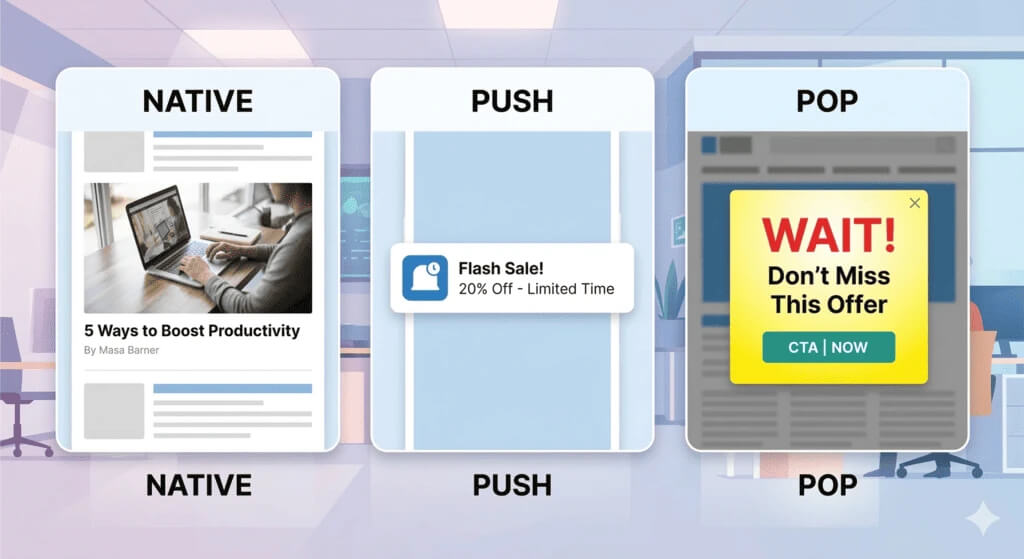
Popunder ads open a landing page in a new browser tab behind the active window. The user typically sees it after closing their current session. Popunder Traffic is widely used by advertisers to drive high-volume traffic at a low cost while maintaining strong visibility.
Performance Profile
- CTR: Very high (forced exposure model)
- Traffic Cost: Extremely low
- User Intent: Low
- Volume: Massive
Strengths
Popunder is one of the most aggressive traffic formats available. Its main advantage is scale:
- Immediate access to large volumes of traffic
- Minimal cost per visit
- No dependency on ad creatives or click motivation
Because users do not actively choose to click, the format bypasses traditional CTR limitations.
Weaknesses
- Lower engagement quality
- Requires strong funnel optimization
- Can feel intrusive to users
Best Use Cases
- Broad offers (sweepstakes, crypto, betting)
- Tier 2–3 geos
- Initial testing of funnels
Strategic Role
Popunder is best used as a traffic generator, not a direct conversion tool.
2. Push Ads — Scalable Reach with Retention
How It Works
Push ads are notifications sent to users who previously opted in via a website or landing page.
Performance Profile
- CTR: Medium to high
- Traffic Cost: Low
- User Intent: Medium
- Retention: High
Strengths
Push ads combine scale with repeat engagement:
- Users receive ads multiple times
- Campaigns run independently of websites
- Strong re-engagement capabilities
Unlike popunder, push traffic allows ongoing communication with the same audience.
Weaknesses
- Creative fatigue is common
- Requires continuous testing of angles and creatives
- Audience quality varies by source
Best Use Cases
- Subscription-based products
- Financial offers
- Nutra and health verticals
- Crypto updates
Strategic Role
Push ads act as a retention and monetization layer, extending user lifetime value.
3. Native Ads — Higher Trust, Better Conversion Rate
How It Works
Native ads are embedded within content feeds and designed to match the surrounding platform visually and contextually.
Performance Profile
- CTR: Medium
- Traffic Cost: Medium to high
- User Intent: High
- CR (Conversion Rate): High
Strengths
Native ads stand out for their quality:
- Seamless integration into content
- Higher trust from users
- Strong performance in Tier 1 markets
Users interact with native ads more naturally, which results in better downstream conversions.
Weaknesses
- Higher cost per click
- Requires high-quality creatives and copywriting
- Slower testing cycles
Best Use Cases
- E-commerce
- SaaS tools
- Long-form affiliate funnels
- Health and wellness products
Strategic Role
Native ads serve as the primary conversion driver, focusing on quality over quantity.
4. Smartlink — Automated Offer Optimization
How It Works
Smartlink is a dynamic link that redirects users to the most relevant offer based on multiple parameters such as GEO, device, and behavior.
Performance Profile
- CTR: Depends on traffic source
- Traffic Cost: Variable
- User Intent: Mixed
- CR: Algorithm-optimized
Strengths
Smartlink simplifies campaign management:
- No need to select individual offers
- Automatic optimization across multiple variables
- Monetizes diverse traffic types
It is particularly useful for handling large, unsegmented traffic flows.
Weaknesses
- Limited control over specific offers
- Lower margins compared to manual optimization
- Dependence on algorithm efficiency
Best Use Cases
- Arbitrage campaigns
- Remnant traffic monetization
- Beginners in affiliate marketing
- Scaling operations
Strategic Role
Smartlink acts as a universal monetization tool, ensuring every visitor has conversion potential.
5. Direct Comparison of Formats
| Format | CTR | CR | Cost | Traffic Quality | Scalability |
|---|---|---|---|---|---|
| Popunder | Very High | Low–Medium | Very Low | Low | Very High |
| Push Ads | Medium | Medium | Low | Medium | High |
| Native Ads | Medium | High | Medium–High | High | Medium |
| Smartlink | Variable | Optimized | Variable | Mixed | Very High |
6. Key Differences That Impact ROI
Cost vs Intent
- Popunder: lowest cost, lowest intent
- Native: highest intent, higher cost
Engagement Model
- Push: repeated exposure
- Native: one-time but high-quality interaction
Optimization Level
- Smartlink: automated
- Native/Push: manual optimization required
7. Combining Formats for Maximum Efficiency
Using a single format limits performance. The highest ROI comes from combining formats strategically.
Example Structure
Step 1 — Acquisition
- Popunder drives large traffic volumes
Step 2 — Engagement
- Users subscribe to push notifications
Step 3 — Conversion
- Native ads target high-intent segments
Step 4 — Monetization
- Smartlink captures remaining traffic value
This layered approach ensures:
- Better cost efficiency
- Higher lifetime value
- Reduced dependency on a single traffic source
8. Why Platforms Like GTARoads Matter
GTARoads focuses specifically on these high-performance formats, allowing advertisers to:
- Launch campaigns quickly
- Access multiple traffic types in one place
- Scale without switching platforms
- Optimize campaigns in real time
Unlike traditional ad platforms, which prioritize brand safety and strict policies, GTARoads enables:
- More aggressive traffic strategies
- Faster testing cycles
- Greater flexibility in verticals
This makes it particularly effective for:
- Affiliate marketers
- Media buyers
- Performance-driven campaigns
9. When to Use Each Format
- Popunder → when budget is limited and scale is needed
- Push Ads → when retention and repeat engagement matter
- Native Ads → when conversion quality is the priority
- Smartlink → when automation and efficiency are required
10. Final Perspective
There is no universally “best” ad format. Each one solves a different problem within the marketing funnel:
- Popunder solves scale
- Push solves retention
- Native solves conversion quality
- Smartlink solves optimization and monetization
The most effective campaigns are built by aligning these formats into a single system rather than choosing between them.
Platforms like GTARoads make this integration possible, giving advertisers the tools to control traffic flow, optimize performance, and maximize ROI across multiple channels simultaneously.